








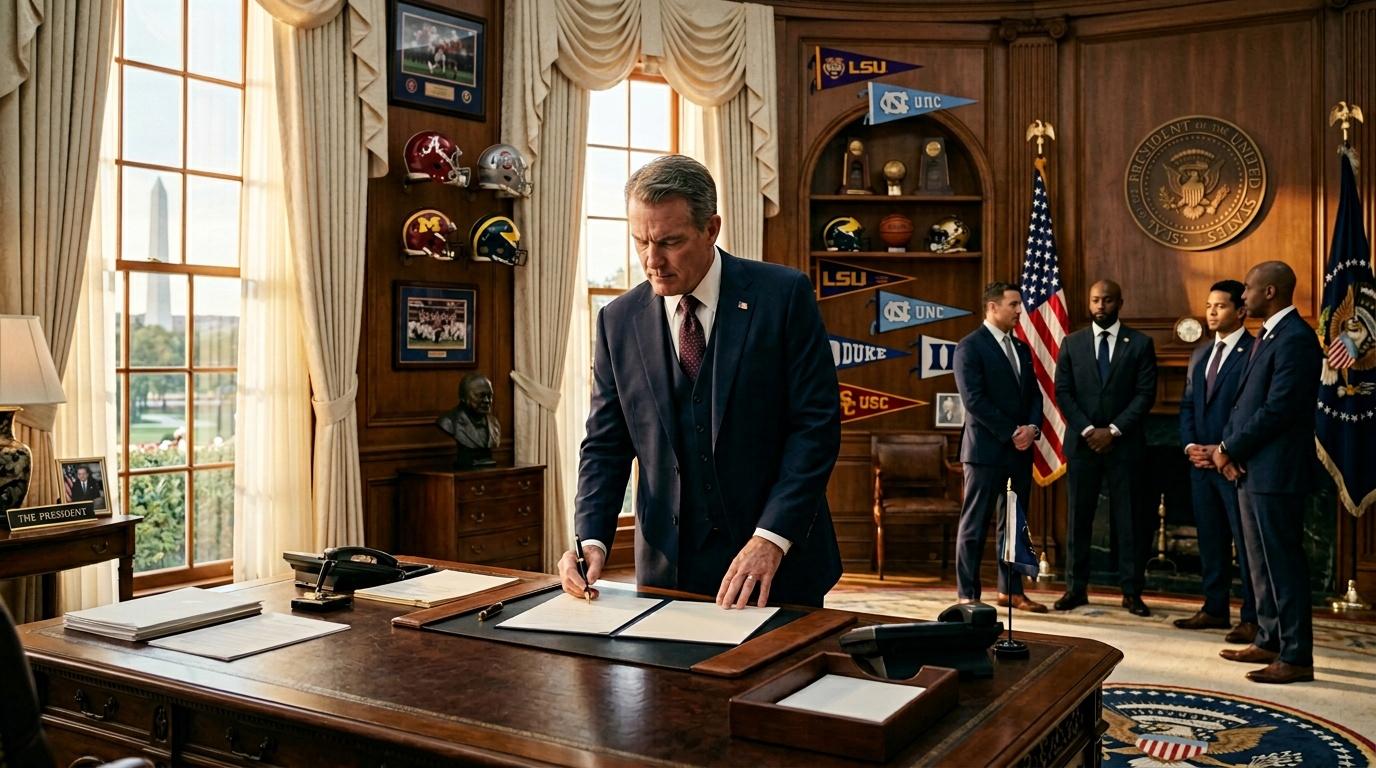
College athletics is at a crossroads. Mounting financial pressures, chaotic NIL rules, and an increasingly fractured competitive landscape have pushed university leaders to seek federal intervention. On March 7, 2026, that call for help reached the White House directly — and President Donald Trump responded with a bold promise : an executive order within one week.
A historic White House roundtable on college sports
The East Room of the White House hosted what many consider an unprecedented gathering in the history of collegiate athletics. Roughly 50 participants attended the first “Saving College Sports” roundtable, co-chaired by Secretary of State Marco Rubio, New York Yankees president Randy Levine, and Florida Governor Ron DeSantis. The meeting was originally scheduled for one hour but stretched to nearly two, signaling just how much ground needed to be covered.
Commissioners from every major conference were present. The table included Greg Sankey (SEC), Tony Petitti (Big Ten), Jim Phillips (ACC), Brett Yormark (Big 12), and Tim Pernetti (American Conference). NCAA president Charlie Baker and Notre Dame athletic director Pete Bevacqua also attended. Reporters were permitted to observe the entire session from the back of the room.
One face stood out prominently : former Alabama head coach Nick Saban, seated just two chairs from the president, became the first voice from the college sports world to address the room. He expressed serious concern about the current system’s failure to prioritize student development and academic growth. “How much does anybody talk about getting an education anymore ?” he asked. “Nobody talks about it at all.”
Former Ohio State coach Urban Meyer went further, calling for the elimination of donor collectives, which he described bluntly as pay-for-play schemes operating outside the rules. “Donors put money in a pot. It’s distributed to the players through coaches and managers,” he said. “That’s not allowed.”
| Participant | Role | Key concern raised |
|---|---|---|
| Nick Saban | Former Alabama coach | Student development and academic priorities |
| Urban Meyer | Former Ohio State coach | Elimination of donor collectives |
| Jim Phillips | ACC commissioner | Player employee classification risks |
| Greg Sankey | SEC commissioner | Urgency to act before further fracturing |
| Sarah Hirshland | USOC CEO | Threat to Olympic athlete pipeline |
Notably, no student-athletes were present at the roundtable. When asked about this absence, Trump defended the setup by suggesting that coaches and administrators care deeply enough about student-athletes to represent their interests adequately.
Trump’s executive order and the NIL crisis in college athletics
The centerpiece of the meeting was Trump’s direct commitment to issue a sweeping executive order targeting college sports reform. His words left little room for ambiguity : “I will have an executive order within one week, and it will be very all-encompassing.” He acknowledged the likely legal challenges ahead, stating matter-of-factly, “We will get sued. That’s the only thing I know for sure.”
The core issues driving this intervention are well-documented. The NIL (Name, Image, and Likeness) landscape has become increasingly unregulated since its opening in 2021. Donor collectives funnel millions to recruits in ways that blur the line between amateur athletics and professional contracts. Conference commissioners and university presidents have struggled to find coherent solutions without a unified federal framework.
Among the legislative proposals discussed, the SCORE Act — the leading Republican-backed bill to create a national NIL regulatory structure — emerged as a focal point. However, Senator Ted Cruz was candid about the political obstacles : the bill needs 60 Senate votes, including at least seven Democrats, and currently not a single Democrat has signaled support.
Texas Tech booster Cody Campbell, who has spent months working on this issue, offered a sobering perspective on compromise :
- No single party in the room will get everything they want.
- Political agendas will shift as the bill moves through the Senate.
- A viable deal requires all sides to accept some degree of dissatisfaction.
- The goal is a workable outcome, not a perfect one.
ACC commissioner Jim Phillips summed up the mood of the room when he told Trump directly : “We need your help.” He also noted that no athlete he had spoken with actually wanted to be classified as an employee, adding, “They’re smart enough to understand what that means.”
What’s at stake for Olympic sports and the future of collegiate competition
Sarah Hirshland, CEO of the United States Olympic and Paralympic Committee, brought a broader national perspective to the debate. She reminded the room that college sports serve as the primary development pipeline for Team USA. At the Paris Games, athletes from 231 colleges and 71 conferences competed, with medalists coming from 90 different schools.
But Hirshland warned against complacency. The U.S. topped the gold medal table in eight of the last ten Summer Olympics, yet the margin over rival nations is shrinking. Countries around the world are building centralized training systems and increasing athlete funding aggressively. Meanwhile, American universities face mounting financial pressure to prioritize football investment, often at the expense of Olympic and non-revenue sports.
“The economic pressures are unsustainable,” she said plainly. If colleges reduce investment in these programs, the consequences will ripple directly into international competition. For Hirshland, the urgency of federal action is not just about fairness in college athletics — it’s about preserving American sporting dominance on the global stage.
SEC commissioner Greg Sankey echoed that urgency with a stark warning : “We’ll fracture more if we fail to act.” The executive order, if it survives legal challenges, could reshape college sports in ways not seen since the NCAA’s founding. Whether it delivers the sweeping change promised remains to be seen.