







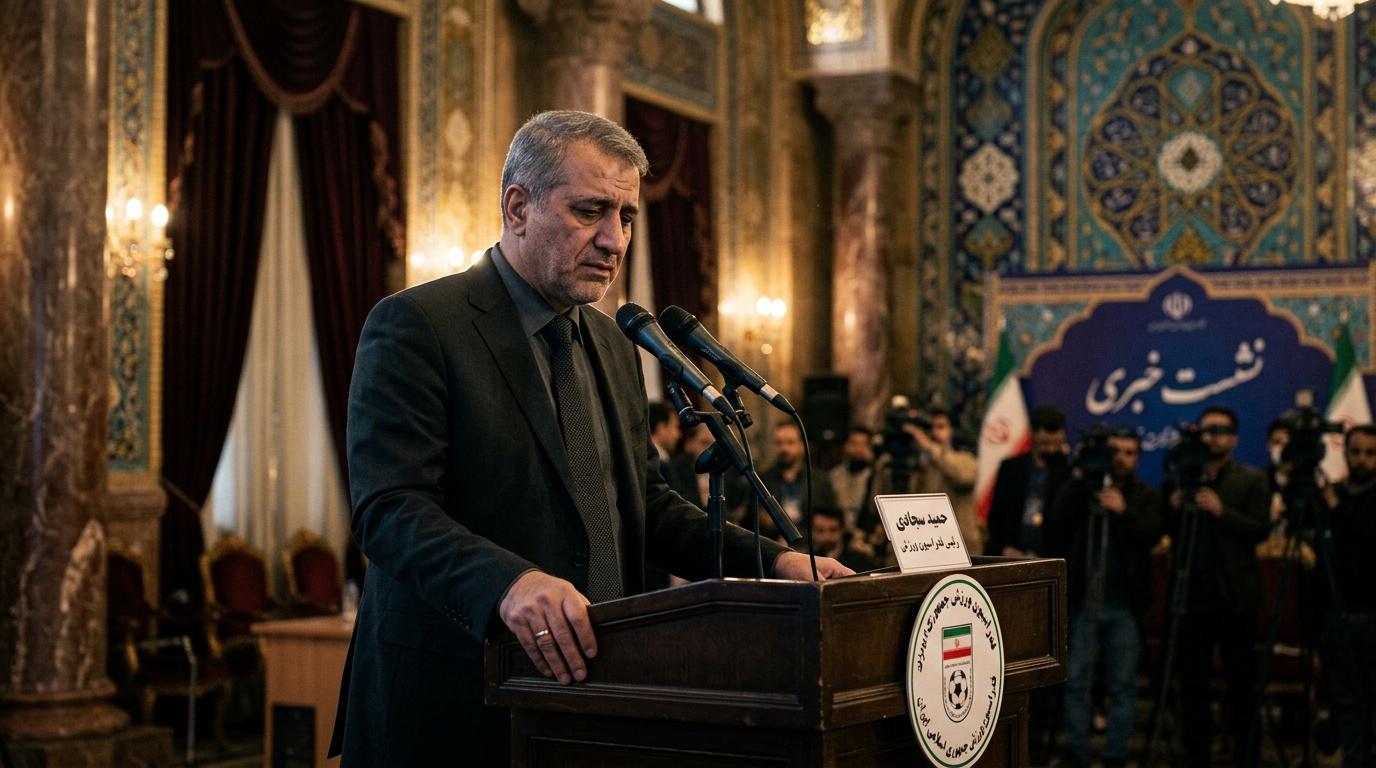
The geopolitical crisis between Iran and the United States has cast a long shadow over the upcoming FIFA World Cup 2026. Iran’s sports and youth minister, Ahmad Donyamali, declared on state television that participation in the tournament is simply not feasible given the current state of war. His words reflect a deepening conflict that now extends far beyond the battlefield and into the world of sport.
Iran’s minister rules out World Cup participation
Speaking directly to Iranian state television, Ahmad Donyamali left little room for ambiguity. He stated that, given the attacks carried out by the United States and the killing of Supreme Leader Ayatollah Ali Khamenei, sending Iranian players onto American soil is simply out of the question. “Definitely it’s not possible for us to take part in the World Cup,” he said bluntly.
His statement followed weeks of growing tension after the United States and Israel launched airstrikes on Iran on February 28. The minister cited two wars imposed on Iran in less than nine months and the deaths of thousands of Iranian citizens. From his perspective, expecting athletes to compete in the host nation responsible for these acts is an unreasonable demand.
This position was further reinforced by Mehdi Taj, Iran’s top football official and a vice president of the Asian Football Confederation. He had already stated the previous week that no one could reasonably expect Iran to approach the World Cup with optimism after such attacks. The sentiment within Iranian football leadership is clearly unified.
Iran was scheduled to play three group-stage matches in the United States :
- June 15 — Iran vs New Zealand in Inglewood, California
- June 21 — Iran vs Belgium in Inglewood, California
- June 26 — Iran vs Egypt in Seattle
These fixtures, now under serious threat, had been part of Group G alongside Belgium, Egypt, and New Zealand. Whether Iran will ultimately withdraw remains formally undecided, but the minister’s declaration signals that the path toward participation has narrowed dramatically.
FIFA, Trump, and the diplomatic scramble around Iran’s status
FIFA president Gianni Infantino moved quickly to address the situation. Following a meeting with US President Donald Trump, he posted on social media that Trump had personally confirmed Iran would be “welcome” to compete in the tournament. Infantino framed the World Cup as an event capable of uniting people, even amid global conflict.
“We all need an event like the FIFA World Cup to bring people together now more than ever,” Infantino wrote. A White House official, speaking anonymously, confirmed to the Associated Press that Trump had delivered this message to the FIFA chief. Trump himself, however, had said earlier that he “really didn’t care” whether Iran played — a remark that added confusion to an already volatile situation.
| Key figure | Position | Statement summary |
|---|---|---|
| Ahmad Donyamali | Iranian Sports Minister | Declared participation “not possible” |
| Mehdi Taj | Iranian football chief / AFC VP | Cannot expect hope for the World Cup after attacks |
| Gianni Infantino | FIFA President | Confirmed Trump’s welcome message for Iran |
| Donald Trump | US President | Mixed signals; ultimately expressed welcome |
If Iran formally withdraws, FIFA‘s regulations on replacement teams remain vague and unclear. Iraq or the UAE could potentially step in to fill the vacant spot in Group G, though no official process has been triggered. The tournament itself runs from June 11 to July 19, co-hosted by the United States, Canada, and Mexico.
Iranian women’s team in Australia and asylum requests
While the men’s team’s World Cup future hangs in the balance, the situation surrounding the Iranian women’s football squad has drawn equal attention. After their participation in the Women’s Asian Cup in Australia, several players chose not to return to Iran.
Australia’s Home Affairs Minister Tony Burke confirmed that six members of the Iranian delegation had been granted humanitarian visas. Five players had initially sought asylum. A sixth person — one player and one support staff member — subsequently expressed the same desire to remain in Australia. However, one of those two individuals later changed their mind and decided to return home.
The backdrop to these asylum requests is deeply significant. Before their first match against South Korea, several players refused to sing the Iranian national anthem. This act of silent protest sparked sharp criticism from supporters of the Iranian regime. In their second and third group matches, the team did sing and salute — but the damage to their relationship with Iranian authorities had already been done.
Donald Trump publicly urged Australia to grant asylum to the entire Iranian women’s team, pledging that the United States would do so if Australia declined. This rare intersection of sport, asylum policy, and geopolitics underlines how deeply the Iran-US conflict has permeated every layer of international football. The coming weeks will determine whether Iran’s men’s team follows a similar path of withdrawal — or finds an unexpected route back to the pitch.