







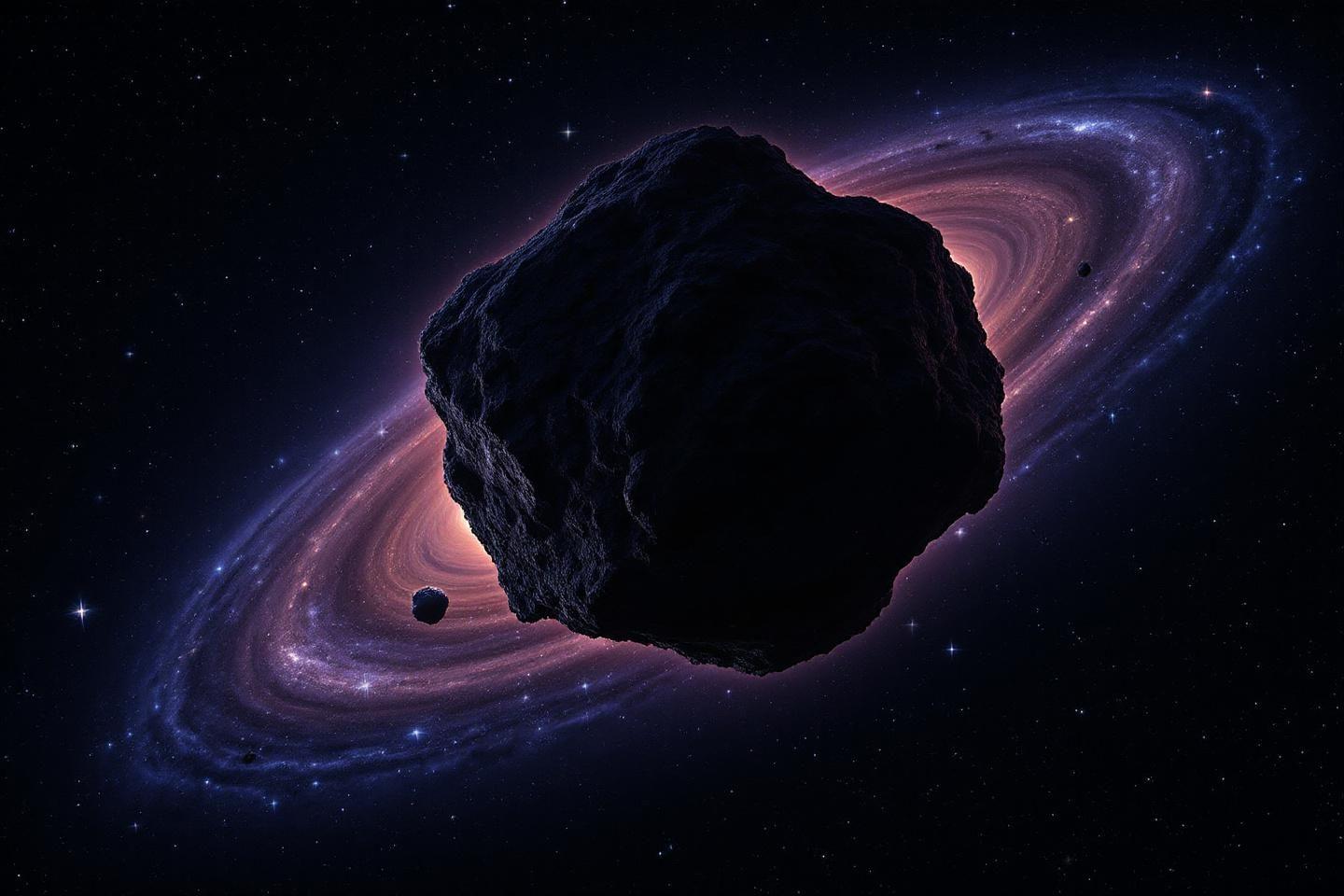
Astronomers examining the third confirmed interstellar visitor to our solar system have uncovered compelling evidence suggesting that cosmic radiation has significantly altered the object’s surface composition during its lengthy voyage through space. This discovery, while scientifically valuable, presents unexpected challenges for researchers hoping to study pristine material from distant stellar environments. The findings indicate that 3I/ATLAS, detected by the Asteroid Terrestrial-impact Last Alert System on July 1, 2025, may not provide the unmodified samples from another star system that scientists had anticipated.
The Belgian and American research team’s spectroscopic analysis reveals how billions of years of exposure to galactic cosmic rays have transformed the comet’s outer layers. This transformation process creates an irradiated crust that conceals potentially pristine material beneath, fundamentally changing our interpretation of what interstellar objects can teach us about their origins.
Unusual chemical composition challenges conventional understanding
The spectroscopic observations conducted by JWST and the Spectro-Photometer for the History of the Universe, Epoch of Reionization, and Ices Explorer revealed an extraordinary chemical signature within 3I/ATLAS’s coma. The carbon dioxide to water ratio measured at 7.6 ± 0.3 represents one of the highest values ever documented in cometary observations. This measurement places the interstellar visitor 4.5 standard deviations above typical solar system comet trends at comparable distances from our Sun.
Such extreme ratios demand explanation, particularly given that observations occurred when the object remained far from solar radiation that might typically alter surface composition. Scientists investigating this phenomenon evaluated multiple hypotheses, including variations in protoplanetary disk conditions where the comet originally formed. These alternative explanations examined whether carbon monoxide destruction in disk midplanes or specific physical conditions could naturally produce elevated carbon dioxide abundances.
However, after careful analysis, researchers determined that galactic cosmic ray processing provides the most compelling explanation for the observed chemical signatures. Laboratory experiments demonstrate that sustained exposure to these high-energy particles efficiently converts carbon monoxide into carbon dioxide over timescales spanning approximately one billion years. This conversion process simultaneously generates an organic-rich surface layer that matches both the compositional data and the observed spectral reddening of 3I/ATLAS.
Radiation exposure reveals interstellar journey details
The evidence for cosmic ray modification presents both opportunities and limitations for astronomical research. Erosion rate calculations suggest that current outgassing activity samples only the processed outer zone, penetrating approximately 15 to 20 meters into the nucleus. This depth corresponds precisely to the region most affected by prolonged radiation exposure, whether accumulated in distant reservoirs of the parent stellar system before ejection or during transit through interstellar space.
| Processing factor | Effect on composition | Observational signature |
|---|---|---|
| Galactic cosmic rays | CO to CO2 conversion | Elevated CO2/H2O ratio |
| Organic synthesis | Crust formation | Spectral reddening |
| Surface irradiation | Chemical alteration | Non-pristine material |
Tom Statler, serving as NASA’s lead scientist for Solar System small bodies, emphasized to The Guardian that despite its unusual properties, 3I/ATLAS remains fundamentally cometary in nature. The object exhibits typical comet behaviors, including coma development from ice and dust, and even displayed a rare anti-tail phenomenon during observations. Its status as a natural body rather than artificial construct is overwhelmingly supported by evidence.
Implications for studying distant stellar systems
The discovery that interstellar objects carry signatures of processed material rather than pristine compositions fundamentally alters expectations for what these cosmic messengers can reveal. Instead of providing direct windows into conditions within distant protoplanetary disks, objects like 3I/ATLAS may function primarily as natural laboratories demonstrating cosmic-ray processing effects. This realization complicates efforts to understand environments around other stars through analysis of visiting objects.
The substantial carbon monoxide levels detected indicate ongoing chemical evolution rather than unchanged primordial composition. Key factors affecting our interpretation include :
- Extended exposure timeframes spanning billions of years
- Radiation effects both before ejection and during interstellar transit
- Surface layer transformation concealing interior material
- Limited depth of current outgassing activity
Despite these challenges, researchers maintain cautious optimism that pristine material might still be released as 3I/ATLAS approaches perihelion, its closest point to the Sun. While considered unlikely, increased solar heating could potentially trigger outgassing from deeper, unprocessed regions of the nucleus. This possibility keeps alive hopes of accessing unaltered samples from the object’s formation environment.
Future observations and ongoing research
The unpeer-reviewed paper posted to the arXiv preprint server requires further validation through independent analysis and additional observations. Professional and amateur telescopes worldwide continue monitoring the interstellar visitor, gathering data that will either support or challenge the cosmic ray processing hypothesis. These ongoing observations remain crucial for understanding whether the apparent modification extends throughout the object or affects only surface layers.
The third confirmed interstellar object following 1I/ʻOumuamua and 2I/Borisov potentially represents a 10-billion-year-old time capsule from earlier cosmic epochs. Even if surface alteration limits direct access to formation conditions, studying the processing effects themselves provides valuable insights into interstellar environments and radiation exposure during lengthy journeys between stars. This perspective transforms apparent disappointment into opportunity, recognizing that modified surfaces tell their own compelling story about the universe beyond our solar system.