








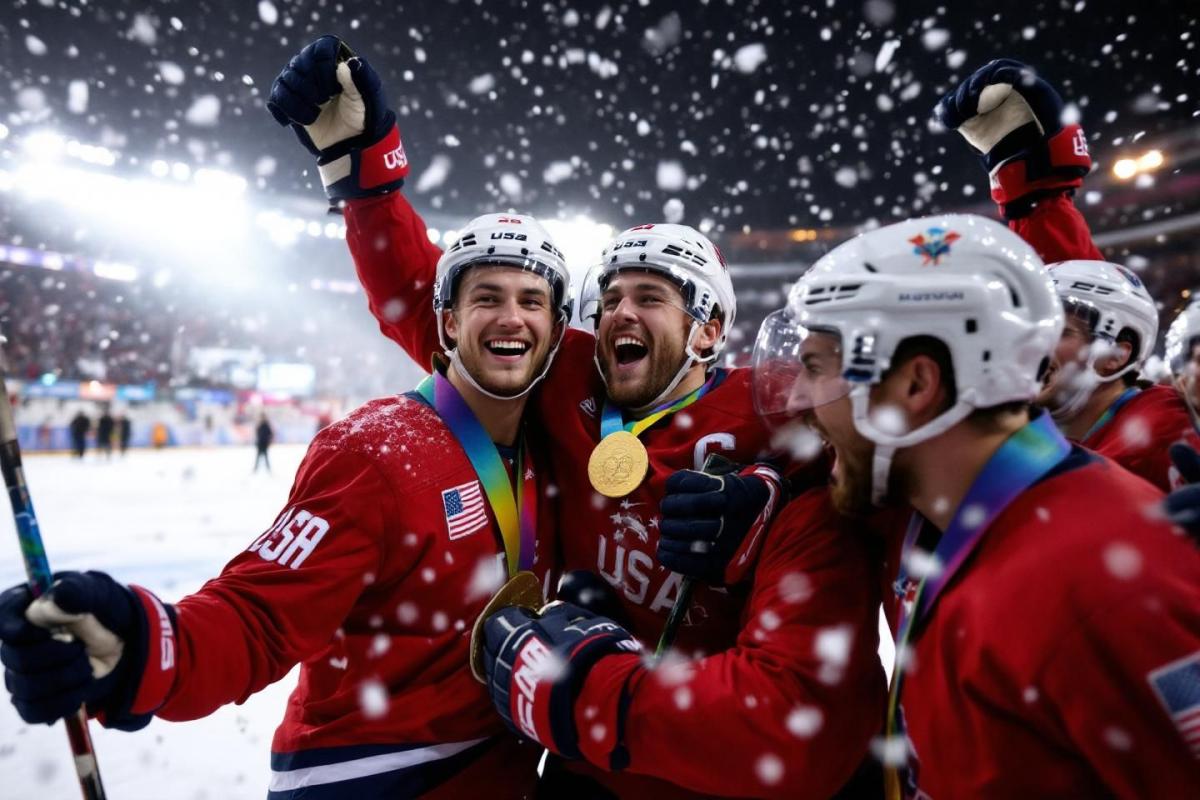
When Jack Hughes unleashed his overtime winner past Jordan Binnington on February 22, 2026, exactly 46 years after the legendary Lake Placid triumph, American hockey fans witnessed history repeating itself in the most spectacular fashion. The United States defeated Canada 2-1 in overtime at Milan’s Santagiulia Ice Hockey Arena, claiming their first Olympic gold medal in men’s hockey since the iconic 1980 “Miracle on Ice.” This wasn’t just another victory—it represented the culmination of decades of near-misses and heartbreaking defeats against their northern rivals on the sport’s grandest stage.
The path to gold required more than talent alone. Connor Hellebuyck delivered a superhuman performance between the pipes, turning away 41 of 42 Canadian shots in what can only be described as a goaltending masterclass. His heroics kept American dreams alive against relentless waves of Canadian pressure, particularly during a critical 93-second five-on-three penalty kill in the second period.
Hellebuyck’s heroic stand against Canadian firepower
The American netminder faced constant bombardment from Canada’s elite forward corps throughout the contest. Connor McDavid, the Olympics’ leading scorer, found himself denied on a breakaway by Hellebuyck’s exceptional positioning. Macklin Celebrini experienced similar frustration in the third period when his breakaway attempt met Hellebuyck’s pad with precision timing.
Perhaps the most spectacular save came early in the final frame when Devon Toews appeared certain to score with the right side of the net wide open. Hellebuyck, somehow reaching behind his back with his stick, prevented the puck from crossing the goal line at the last possible instant. The crowd gasped collectively at the athleticism displayed.
| Period | USA Shots | Canada Shots | Score |
|---|---|---|---|
| First | 7 | 9 | USA 1-0 |
| Second | 9 | 19 | Tied 1-1 |
| Third | 10 | 13 | Tied 1-1 |
| Overtime | 1 | 0 | USA 2-1 |
Canada dominated possession and territorial advantages throughout regulation, outshooting the Americans significantly. However, Hellebuyck’s wall-like presence frustrated every Canadian scoring opportunity. The shot differential told one story, but the scoreboard told another—a testament to exceptional goaltending under immense pressure.
Boldy’s brilliance breaks the deadlock
Matt Boldy opened the scoring just six minutes into the opening period with a goal showcasing both individual skill and opportunistic awareness. Facing two of the NHL’s premier defensemen in Cale Makar and Devon Toews, Boldy executed a remarkable sequence—flipping the puck over both their sticks before gliding untouched between them.
With Binnington suddenly vulnerable, Boldy deked the Canadian goaltender before finishing with a backhand that sent American supporters into ecstasy. The goal energized U.S. fans who had gathered in bars across New York, Minneapolis, and Milwaukee, many waking before sunrise to witness the historic matchup.
The atmosphere in Milan proved equally electric. Metro trains arriving at Santagiulia carried fans wearing jerseys spanning decades of hockey history—Eruzione, Gretzky, McDavid, and Tkachuk all represented. Competing chants of “U-S-A” and “Let’s go Canada” echoed through the corridors as anticipation built for the clash everyone wanted to see.
Canada’s resilience forces overtime drama
Despite American resistance, Cale Makar finally solved Hellebuyck with 1 :44 remaining in the second period. The Colorado defenseman unleashed a perfectly placed wrist shot from the right faceoff circle that whistled over Hellebuyck’s right pad but beneath his blocker—the only shot that beat him in regulation.
Canada had squandered numerous golden opportunities before Makar’s equalizer. The statistics favored them heavily, yet they entered the third period tied at one goal apiece. The momentum shifts created tension that permeated throughout the arena, with both sets of supporters nervously anticipating the outcome.
Key moments that defined the tightly contested battle included :
- The extended five-on-three penalty kill where American discipline and Hellebuyck’s positioning denied Canada’s best chance
- McDavid’s breakaway save that preserved the American advantage
- Brock Faber hitting the post in the dying seconds of regulation
- Nathan MacKinnon missing an open net opportunity in the third period
- A controversial non-call when replays suggested USA had too many players during a line change
The third period featured relentless Canadian pressure as they outshot the Americans significantly. Sam Bennett’s four-minute double-minor penalty for high-sticking Jack Hughes gave Team USA a crucial power-play opportunity late in regulation, though neither team could capitalize before the buzzer sounded.
Overtime magic delivers redemption
Jack Hughes created the winning sequence with a defensive poke check in the American zone. Zach Werenski exploded up the ice, retrieving the puck near the left corner. Spotting Hughes wide open, Werenski delivered a centering pass that Hughes converted with authority—the puck whistled past Binnington just 1 :40 into three-on-three overtime.
The victory carried profound significance beyond simply capturing gold. Canada had dominated this rivalry since NHL players began Olympic participation in 1998, defeating the United States in gold-medal games at Salt Lake City 2002 and Vancouver 2010, plus shutting them out in the Sochi 2014 semifinals. Though America won a round-robin game at the 4 Nations Face-Off, they had consistently fallen short when championships hung in the balance.
Following the victory, Team USA honored Johnny Gaudreau’s memory, paying tribute to the late star who embodied the spirit of American hockey excellence. The players celebrated not just ending a 46-year drought, but exorcising decades of heartbreak against their greatest rival on sport’s biggest stage.