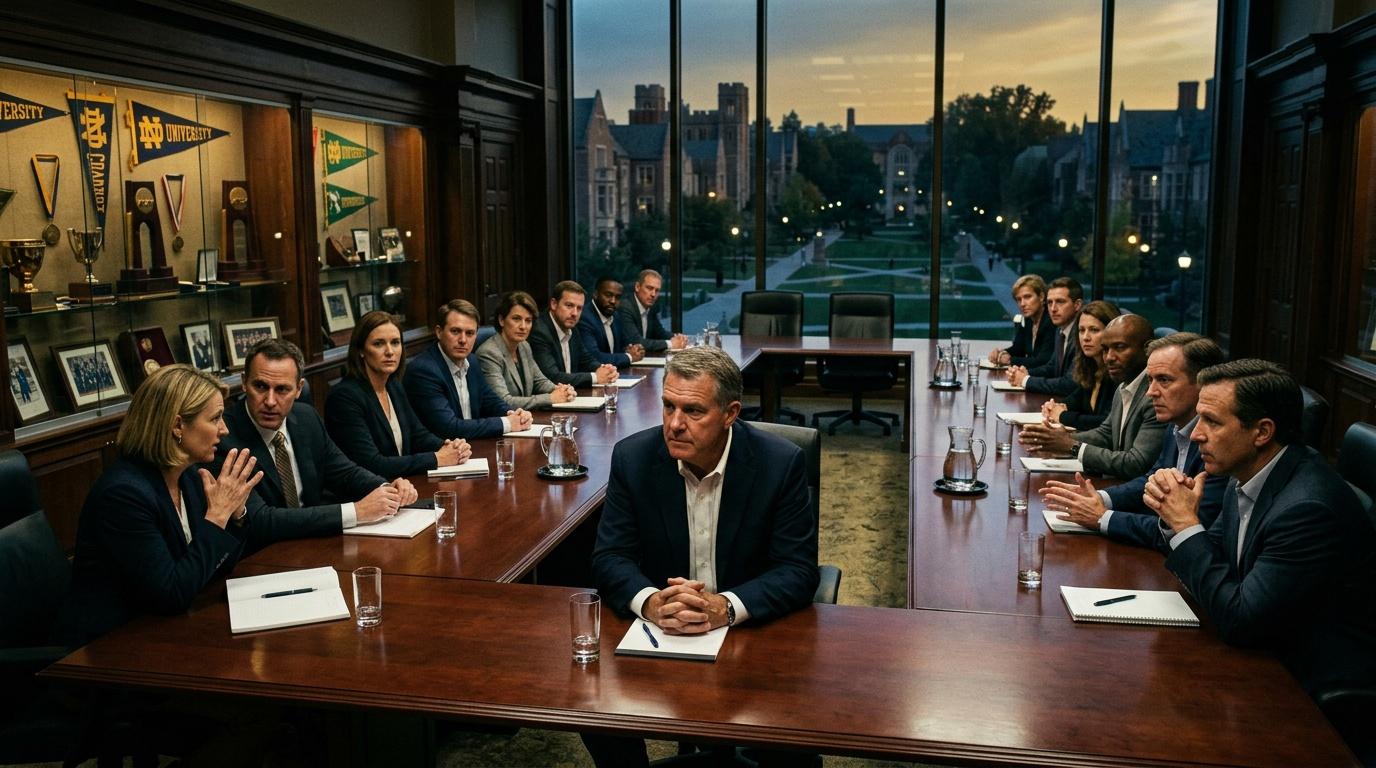
The college athletics landscape finds itself at a critical juncture in March 2026, with stakeholders gathering for two pivotal sessions that could fundamentally reshape how universities manage their sports programs. While public attention focuses on a White House roundtable scheduled for Friday, featuring President Donald Trump, a more discreet assembly in Dallas on Tuesday brings together influential decision-makers from across the nation’s top athletic conferences. These parallel gatherings underscore the deep divisions within collegiate sports administration and highlight the urgent need for structural transformation in an industry grappling with unprecedented financial and regulatory challenges.
Powerful stakeholders convene in Dallas for transformative discussions
Approximately 1,300 miles from the nation’s capital, an invitation-only summit hosted by Smash Sports brings together more than a dozen institutions’ representatives in Dallas. The attendee roster reads like a who’s who of collegiate athletics power brokers, including university trustees, wealthy donors, and at least two sitting university presidents. Penn State, USC, LSU, Clemson, Louisville, SMU, Texas Tech, Boise State, Michigan, TCU, and Maryland all have representatives at this confidential gathering.
Smash Sports, backed by private capital and led by former television executives including Evan Richter, Tom Staggs, and Kevin Mayer, has spent two years developing what they call “Project Rudy” — a comprehensive proposal for restructuring college sports around consolidated FBS television rights. The initiative takes its name from the famous Notre Dame walk-on, symbolizing the underdog spirit that many believe current structures threaten to eliminate. LSU President Wade Rousse and TCU Chancellor Daniel Pullin plan to attend, with Louisiana Governor Jeff Landry publicly endorsing Rousse’s participation and describing the proposal as offering common-sense solutions to financial instability.
However, not all participants arrive with their institutions’ blessings. Some board members and donors attend independently, occasionally against their conference commissioners’ preferences. This independence particularly applies to representatives from SEC and Big Ten schools, whose leadership has vocally opposed the consolidation framework. The schism illustrates how deeply divided stakeholders have become regarding the sport’s trajectory, with one key participant describing the situation as “all coming to a head.”
Financial pressures threaten sustainability across athletic departments
The current crisis stems from years of court-mandated policy changes that transformed athlete compensation structures. Unlimited transfer mobility, evolving eligibility standards, and the explosion of player payments have created what many administrators consider an unsustainable environment. The NCAA’s settlement of three antitrust cases, collectively known as House, legalized direct institutional compensation for athletes but failed to deliver the stability many anticipated when they voted to approve it.
Football programs traditionally served as cash generators that subsidized other sports, funded lavish facilities, and supported multimillion-dollar coaching salaries. Today, these programs face mounting pressure to allocate increasing portions of their budgets directly to football and basketball players. Without federal legislation or collective bargaining agreements, athletic departments find themselves in what observers describe as proverbial winds of escalating player compensation with no ceiling in sight. Ohio State President Ted Carter, occupying one of the most influential positions in college athletics, bluntly stated : “It’s not sustainable. Something’s going to have to give.”
Just eight months into the new revenue-sharing system, some leading administrators privately regret their settlement votes. Instead of stability and congressional protection, they’ve witnessed football and basketball rosters exceeding combined payrolls of $30 million as institutions exploit loopholes involving donors, sponsors, and apparel brands to circumvent caps. Several administrators now publicly support uncapping the revenue-share system entirely and urge commissioners to pursue collective bargaining arrangements.
| Challenge | Current Impact | Proposed Solution |
|---|---|---|
| Player compensation escalation | Rosters exceeding $30M combined | Collective bargaining agreements |
| Revenue distribution inequity | Big Ten/SEC control 59% of CFP revenue | Consolidated media rights pooling |
| Regulatory uncertainty | Inconsistent eligibility standards | Federal legislation framework |
| Competitive imbalance | Six schools generate majority viewership | Enhanced revenue sharing model |
Congressional action emerges as essential pathway forward
Both external reform movements — the “Saving College Sports” campaign led by Texas oil tycoon and Texas Tech booster Cody Campbell, and Smash Sports’ Project Rudy — depend fundamentally on congressional intervention. Specifically, they require lawmakers to amend the Sports Broadcasting Act of 1961, which currently grants professional leagues antitrust protection for pooling media rights. Extending this protection to college football would theoretically allow the ten FBS conferences and College Football Playoff to negotiate one consolidated television package rather than separate deals.
Proponents argue this consolidation could dramatically increase revenues, projecting growth from $6.7 billion in 2035 without consolidation to $14 billion with it. Steve Bornstein, NFL Network’s architect and former ESPN CEO for a decade, describes the consolidation approach as “the right path” and believes the SEC and Big Ten should pursue it for the greater good. The Smash Sports proposal includes the following key components :
- Optimized football scheduling creating more attractive non-conference matchups
- Establishment of new governing structures with broader stakeholder representation
- Billions in private capital financing to bridge gaps before consolidated packages begin
- Guaranteed annual distribution increases for all 138 FBS programs
- Conference-determined distribution formulas maintaining current CFP-style autonomy
Senate Democrats led by Maria Cantwell of Washington drafted the SAFE Act, which would govern college sports and amend the SBA. Cantwell publicly responded to opposition from the Big Ten and SEC, expressing surprise they would reject a measure that “would bring in more revenue to invest in women’s sports and our current and future Olympians.” Even some Republicans, including Missouri Senator Eric Schmitt and Texas Senator Ted Cruz, have expressed openness to SBA amendments during recent hearings.
Deep divisions surface between conferences over reform proposals
The SEC and Big Ten distributed a joint white paper to lawmakers last week specifically refuting consolidation proposals, describing them as “misguided” and based on “flawed assumptions.” Notably, neither the ACC nor Big 12 signed this document despite receiving invitations. Campbell responded accusingly, suggesting the two leagues resist fixing college sports because they profit handsomely from current arrangements. Smash Sports issued its own rebuttal document Friday, systematically discounting the leagues’ claims.
Big 12 Commissioner Brett Yormark offered pointed personal criticism of Smash Capital, stating while he encourages collaborative problem-solving, he takes exception to the firm “preying on current vulnerabilities” with the primary goal of generating significant returns. Yormark recommended engaging with established financial institutions rather than Smash if third-party resources become necessary. Meanwhile, Larry Benz, University of Louisville Board of Trustees chair, posted what he termed a “dismantling” of the SEC-Big Ten paper, characterizing it as sophisticated defense of the status quo by parties who benefit most from existing structures.
Louisville’s administration released its own eight-page white paper Monday advocating for immediate structural reform, prominently featuring SBA amendment among recommended changes. This public positioning by ACC representatives against SEC-Big Ten dominance reflects broader resentment regarding competitive imbalance. According to data shared with administrators, eighteen schools produced 60% of broadcast viewership over seven years, with six schools — Alabama, Ohio State, Georgia, Michigan, Texas, and independent Notre Dame — generating the majority. The two behemoth conferences currently negotiate 59% of playoff revenues after threatening to establish their own separate playoff system two years ago.
