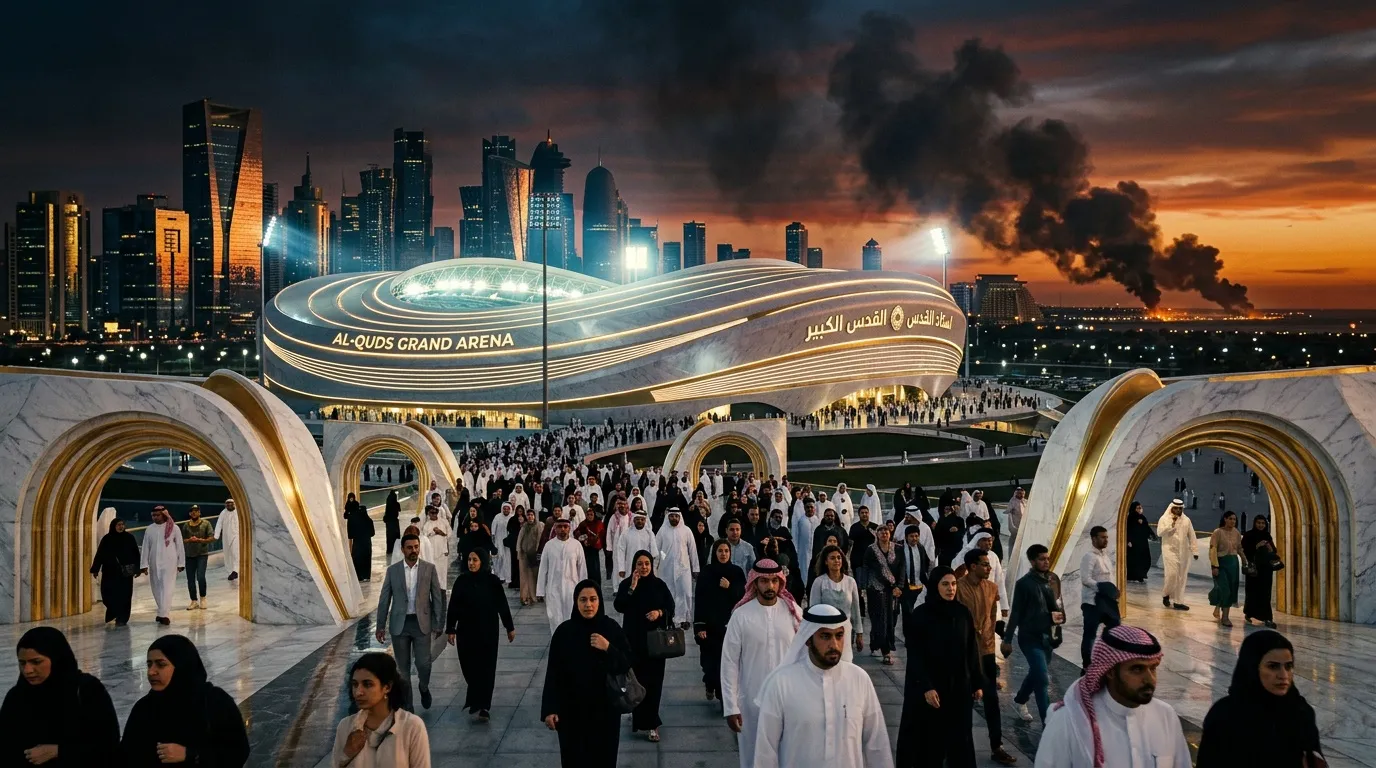
The ongoing conflict involving Iran has sent shockwaves far beyond the battlefield, striking at the heart of one of the most ambitious economic transformation projects in modern history. The Gulf states — Qatar, Saudi Arabia, the UAE, and Bahrain — have spent the better part of a decade repositioning themselves as global sports destinations. Today, that carefully constructed vision is fracturing under the pressure of war.
A sporting empire built on fragile foundations
Qatar was the undisputed pioneer of this regional ambition. It poured approximately $220 billion into the 2022 FIFA World Cup, effectively building Doha into a sporting megacity almost from scratch. The Lusail Stadium, which hosted the World Cup final, recently welcomed Qatar’s triumph in the Asian Cup final — a symbol of how seriously the country takes its sporting identity.
Neighbours quickly followed Qatar’s blueprint. Saudi Arabia, the UAE, and Bahrain all launched Vision 2030 programmes to shift their economies away from oil dependency toward sport, tourism, and entertainment. Saudi Crown Prince Mohammed bin Salman publicly stated the goal of growing sport to 3% of GDP by 2030 — a target that dwarfs the EU average of just over 2%.
The early signs were promising. Saudi Arabia secured an unopposed bid to host the 2034 World Cup. Global stars like Cristiano Ronaldo and Karim Benzema signed for Saudi Pro League clubs. Formula One, golf, tennis, boxing — all became part of the kingdom’s expanding sports portfolio, funded largely by the Public Investment Fund (PIF).
Yet Simon Chadwick, professor of Eurasian sport industry at Emlyon business school in Lyon, identifies a structural weakness at the core of this model : “They have not diversified enough, and failed to develop a sustainable sports ecosystem.” Hosting events and buying players is not the same as building an industry. Countries like Vietnam and Thailand manufacture sports equipment and apparel. China and South Korea invest heavily in e-sports. The Gulf, by contrast, remains almost entirely dependent on imported labour and foreign expertise.
War disrupts a packed calendar of global sporting events
The immediate impact of the Iran conflict on Gulf sports has been dramatic and swift. The cancellations have accumulated rapidly, recalling the early days of the Covid-19 pandemic when sporting calendars collapsed overnight.
Among the most high-profile events affected :
- The Bahrain and Saudi Arabian Formula One Grand Prix races, both called off for the coming month
- The MotoGP Qatar Grand Prix, rescheduled to November
- A flagship football match between world champions Argentina and European champions Spain, cancelled in Doha
- The Artistic Gymnastics World Cup and the GCC Games, both with uncertain status
Doha-based communications firm Northbourne Advisory reported that more than 100 events across all sectors had been cancelled in the Gulf since hostilities began. The ripple effects stretch well beyond sport, hitting hospitality, aviation, and tourism simultaneously.
Even figures at the very summit of world sport have felt the disruption. Nasser al-Khelaifi — PSG president, chair of Qatar Sports Investments, and head of the European Football Clubs association — was grounded in Doha when Qatari airspace closed, missing a Champions League match for the first time in years. He eventually reached London for the second leg against Chelsea only after airspace partially reopened.
Long-term damage to investor confidence and oil-funded spending
Beyond immediate cancellations, the Gulf’s sporting ambitions face deeper, structural risks that could prove far more damaging over time.
| Sports sector | Risk level under PIF review |
|---|---|
| Football and Formula One | Lower risk — likely to be protected |
| Boxing | Lower risk — strategic visibility retained |
| Tennis and golf | Higher risk — budgets seen as vulnerable |
| Darts | Highest risk — expenditure most exposed |
A consultant working with the Saudi ministry of sport confirmed this hierarchy of priorities. PIF’s budget cuts had already begun before the war, with The Guardian reporting in December 2025 that World Cup stadium construction funding had been reduced, causing delays. The new Qiddiya Speed Park track near Riyadh, intended to host the Saudi Arabian Grand Prix from next year, remains unfinished.
Disruptions to oil and gas exports will inevitably tighten state finances further. Chadwick puts it plainly : “The war has come at the wrong time.” Had this crisis occurred a decade from now, after the Gulf had built more resilient, self-sustaining sports industries, the damage might have been containable.
Inside Saudi Arabia, the response has been marked by a degree of official denial. A sports promoter with years of experience brokering deals in the kingdom described recent conversations with the Saudi ministry of sport as “surreal,” with officials appearing reluctant to acknowledge the scale of the crisis. The Saudi Pro League initially insisted matches would continue, though AFC Champions League Elite fixtures involving Saudi clubs have since been postponed without a rescheduling date.
Player departures remain limited for now. No SPL athlete has publicly requested a transfer. However, drone attacks on the King Fahd Causeway linking Saudi Arabia and Bahrain have unsettled expatriate communities, and agents report that some families may not return from Europe after the current international break. An end-of-season exodus in May remains a genuine possibility.
Qatar faces its own longer-term exposure. It is scheduled to host the FIBA Basketball World Cup in 2027, an event that will require sustained international confidence in the region’s stability. That confidence is now anything but guaranteed. The Gulf’s sports hub dream is not dead — but it has never looked more vulnerable.
