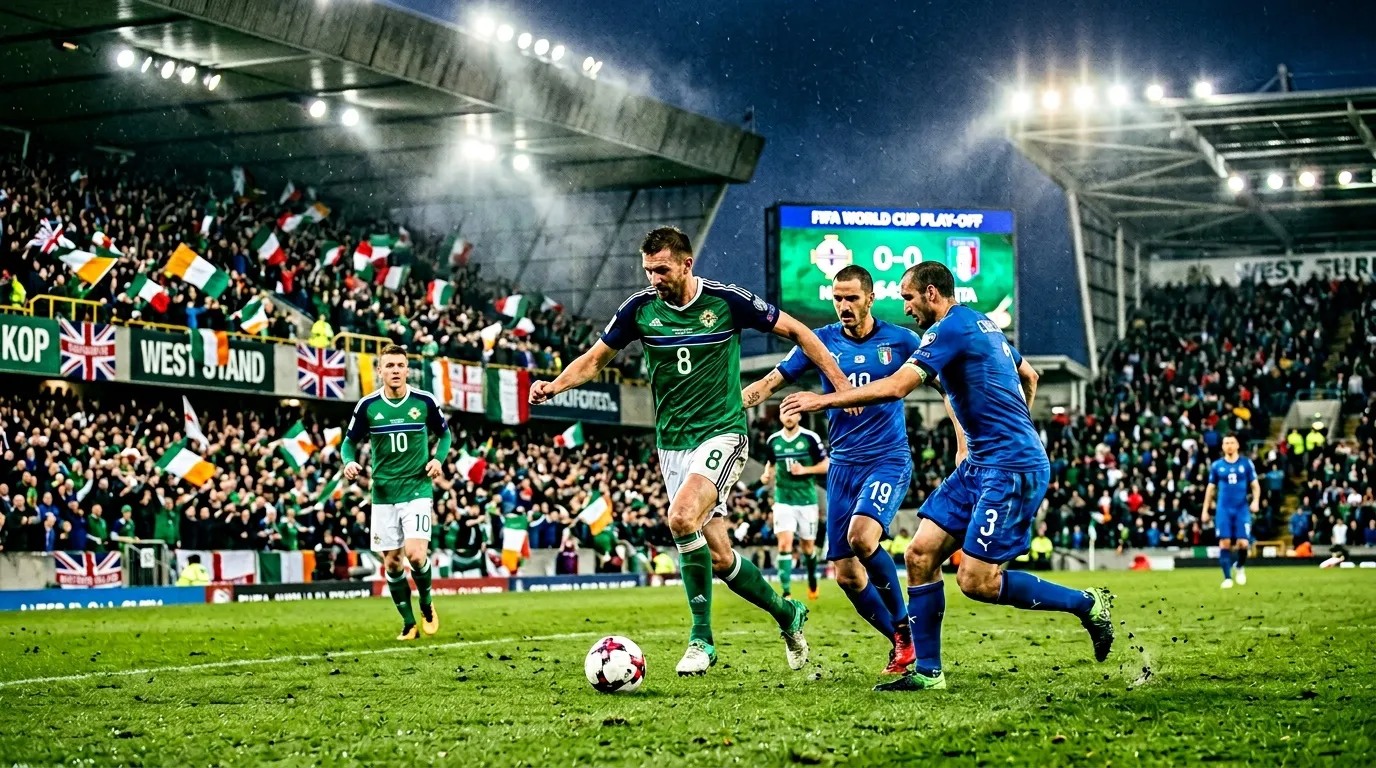
The date is set : 26 March 2026, Bergamo, Italy. Northern Ireland travel to face the four-time world champions in what many consider an almost impossible mission. Yet Michael O’Neill’s squad refuses to see it that way. Belief, organisation and youthful energy — these are the weapons Northern Ireland intend to bring to a game that could rewrite their football history.
A young squad with everything to gain against Italy
Northern Ireland are well aware of the scale of the challenge ahead. Gennaro Gattuso’s Italian side is packed with Serie A and Premier League talent. Despite not being the dominant force of previous generations, Italy remains a nation that carries the weight of expectation from millions of passionate supporters. O’Neill acknowledges it is “very difficult to win” on Italian soil, but he keeps reminding his players of one key truth : they are still in the fight.
What sets this Northern Ireland group apart is its age profile. Players like Shea Charles, Trai Hume and Dan Ballard represent a next generation that is only beginning to find its feet at international level. Compare this to the side that reached Euro 2016 under O’Neill — built on experienced figures like Steven Davis, Jonny Evans and Aaron Hughes — and the contrast is striking. This current squad is younger, less battle-hardened, but arguably more free-spirited.
O’Neill believes that inexperience can actually be an advantage in a high-pressure knockout match. His message to the dressing room has been consistent throughout :
- Never waste an opportunity on an international pitch.
- Embrace the moment, however daunting it feels.
- Remember that every cap could be your last.
- Approach each game as a team with more to gain than to lose.
That mindset has helped shape a group that O’Neill describes as still developing. During the qualifying campaign, Northern Ireland faced significant injury setbacks. Goalkeeper Pierce Charles missed the entire campaign, while both his brother Shea and midfielder Ali McCann were absent at various points. Despite these disruptions, the squad adapted and grew. O’Neill is proud of how his players compensated collectively.
There is also the matter of team momentum. Gattuso has only managed six international matches, winning five of them, suggesting Italy are also finding their rhythm under a relatively new head coach. Northern Ireland, on the other hand, have built consistency over a longer campaign, even if the final standings placed them in this demanding play-off route.
Defence, discipline and the blueprint for a potential upset
History offers a compelling precedent for Northern Ireland’s hopes. In a 2021 World Cup qualifier at Windsor Park, they held Italy to a goalless draw. That single point denied the Italians top spot in their group, sending them into the play-offs — where they were sensationally knocked out by North Macedonia. Northern Ireland did not cause that elimination directly, but their defensive discipline planted the seed.
O’Neill is building his 2026 play-off strategy on that same defensive foundation. Being difficult to beat is not a compromise for Northern Ireland — it is a philosophy. The manager has been clear : this match is unlikely to be a goal fest, and defensive solidity combined with sharp counter-attacking will be the team’s primary tools.
| Player | Club | Status for play-off |
|---|---|---|
| Conor Bradley | Liverpool | Unavailable |
| Dan Ballard | Sunderland | Doubt (hamstring) |
| Shea Charles | Southampton | Available |
| Trai Hume | Sunderland | Available |
The absence of Conor Bradley, the dynamic Liverpool full-back, is a genuine blow. Ballard’s hamstring concern adds further uncertainty to a defence that must function as close to perfectly as possible against a technically superior opponent. O’Neill knows this. He has spoken openly about the need to be almost flawless at the back while remaining dangerous on the break.
The manager also points out that Italy carry all the pressure in this fixture. For Gattuso’s men, anything short of victory would represent a fresh national embarrassment, similar to the North Macedonia disaster four years ago. Northern Ireland, by contrast, play with freedom. The expectation bar is set far lower, and O’Neill intends to use that psychological edge.
What a first World Cup in 40 years would mean for Northern Ireland
Should Northern Ireland defeat Italy in Bergamo, the reward would be equally demanding. A second away game — against either Wales or Bosnia-Herzegovina — would stand between them and a place at the 2026 World Cup in Canada, Qatar and Switzerland. Northern Ireland last appeared at a World Cup in 1986. Forty years is a long time for a football nation to wait, and O’Neill understands the weight of that history.
Yet he frames it positively. His squad has more to gain than to lose, and that is a liberating place to compete from. The manager believes that winning the first play-off game would release a wave of confidence powerful enough to carry his players through a second match, regardless of the opponent.
O’Neill also draws a direct line between the 2016 Euro qualification story and this current challenge. That earlier achievement was built on similar foundations — hard work, collective spirit, tactical discipline — even if the individual talent levels differed. He sees this young group following the same path, just at an earlier stage of its journey.
Northern Ireland will not be favourites in Bergamo. But football has a habit of rewarding teams that believe fiercely in what they are doing. On 26 March 2026, O’Neill’s side steps onto that pitch with nothing to fear and everything to fight for.
