








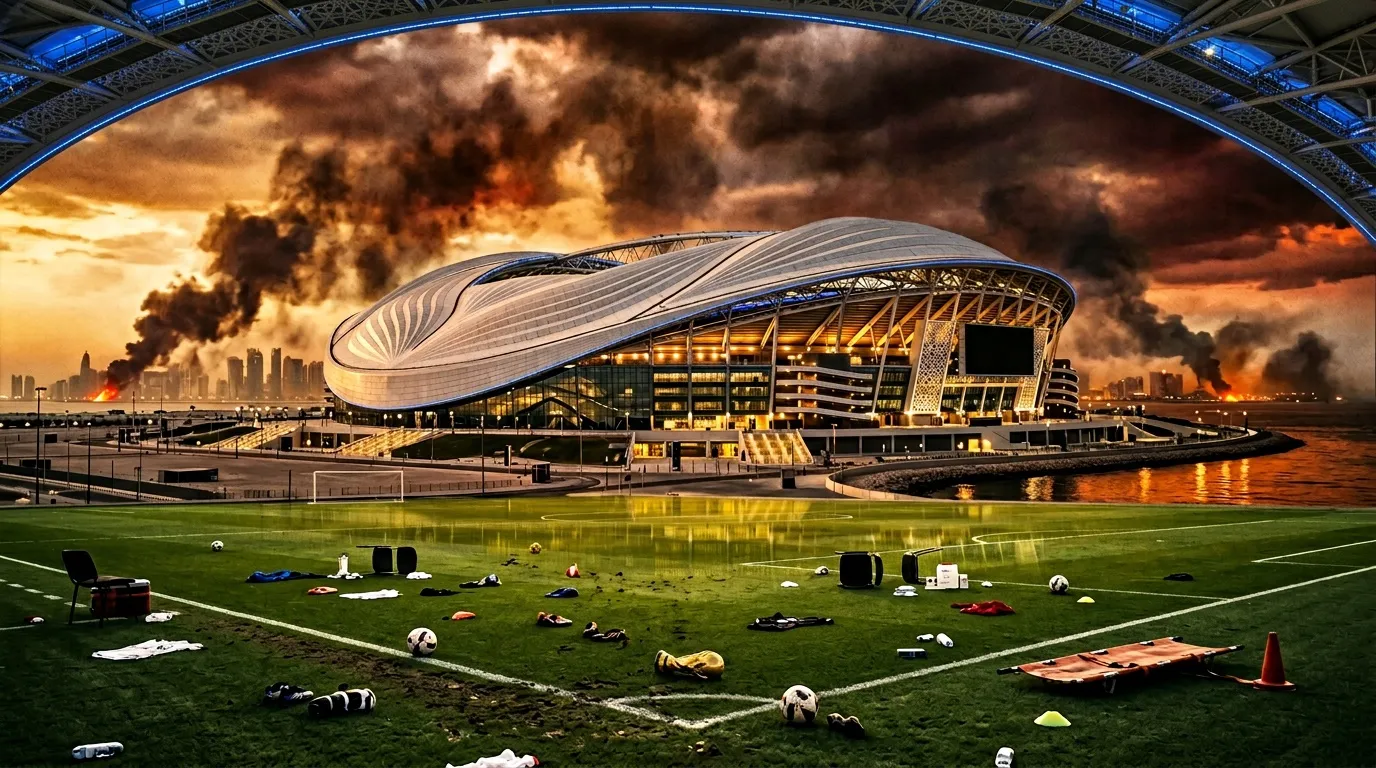
The Iran-Gulf war, which erupted in early March 2026, has sent shockwaves through one of the most ambitious sporting transformation projects the modern world has ever seen. From Formula One circuits to football stadiums, the Gulf states’ carefully constructed sports empire is now facing an existential stress test nobody anticipated at such a critical moment.
A sporting empire built on event-based ambitions suddenly shaken
Over the past decade, Qatar, Saudi Arabia, the UAE and Bahrain have poured extraordinary resources into sport. Qatar’s $220 billion investment in the 2022 World Cup transformed Doha into a sporting megacity almost overnight. Neighbours quickly followed the Qatari blueprint, launching their own Vision 2030 programmes designed to shift their economies away from oil dependency.
Saudi Arabia’s ambitions remain the most striking. Crown prince Mohammed bin Salman set a target of growing sport to 3% of GDP by 2030. For context, the EU’s entire sport industry contributes just over 2% to GDP, while the UK sits around 2.5%. Signing global icons like Cristiano Ronaldo and Karim Benzema for Saudi Pro League clubs signalled this was no vanity project.
Yet Simon Chadwick, professor of Eurasian sport industry at Emlyon Business School in Lyon, offers a sobering diagnosis : “The conflict has laid bare the weakness of the Gulf states’ plans for diversification through sport, especially a model that is event based.” The region, he argues, has been hosting events and importing talent without building a truly sustainable sports ecosystem underneath.
The Gulf has not developed domestic manufacturing of sporting equipment or apparel, unlike Vietnam or Thailand. It has not invested heavily in e-sports infrastructure, unlike China or South Korea. “If this had happened ten years later,” Chadwick notes, “perhaps they would have been able to cope better. The war has come at the wrong time.”
A cascade of cancellations hits the Gulf sports calendar
The immediate damage to the sporting calendar has been swift and severe. Formula One cancelled both the Bahrain and Saudi Arabian Grands Prix scheduled for next month. A high-profile football match between world champions Argentina and European champions Spain, set for Doha, was also scrapped. MotoGP’s Qatar Grand Prix has been pushed back to November.
The Doha-based communications firm Northbourne Advisory reported that over 100 events across all sectors had been cancelled in the Gulf since hostilities began. Beyond major motorsport and football, smaller competitions remain in limbo :
- The Artistic Gymnastics World Cup, scheduled for next month, is still unconfirmed.
- The GCC Games, a regional multi-sport event planned for May, faces uncertainty.
- AFC Champions League Elite fixtures involving Saudi clubs have been postponed indefinitely.
- Qatar’s hosting of the FIBA Basketball World Cup next year is now under scrutiny.
Even high-profile executives have felt the disruption personally. Nasser al-Khelaifi, president of PSG and chair of the European Football Clubs lobby group, was stranded in Doha when Qatari airspace closed during PSG’s Champions League last-16 first leg against Chelsea. He eventually reached London for the second leg, a 3-0 PSG win at Stamford Bridge, after partial airspace reopening. His temporary grounding became a symbol of the region’s broader vulnerability.
The following table illustrates the scale of sporting disruption across the Gulf since March 2026 :
| Event | Country | Status |
|---|---|---|
| Bahrain Grand Prix (F1) | Bahrain | Cancelled |
| Saudi Arabian Grand Prix (F1) | Saudi Arabia | Cancelled |
| Qatar Grand Prix (MotoGP) | Qatar | Rescheduled – November |
| Argentina vs Spain football match | Qatar | Cancelled |
| AFC Champions League Elite fixtures | Saudi Arabia | Postponed |
Long-term financial pressure threatens the Gulf’s sporting future
The financial consequences stretch well beyond cancelled fixtures. Difficulties exporting oil and gas are forcing significant budget reviews across the region. The Public Investment Fund (PIF) of Saudi Arabia had already started trimming budgets for World Cup stadium construction before the conflict escalated, causing project delays. The new Qiddiya Speed Park track near Riyadh, intended to host the Saudi Arabian Grand Prix from 2027, remains unfinished.
A consultant working with the Saudi ministry of sport suggests PIF’s spending on tennis, golf and darts is considered most vulnerable. Football, Formula One and boxing are expected to receive protection, but the overall picture for investors and sporting organisations is deeply uncertain. A sports promoter with years of experience in the kingdom described recent conversations with Saudi officials as surreal, with some apparently in denial about the crisis’s true scale.
Player movements are another emerging concern. While no Saudi Pro League stars have publicly requested exits, an agent representing one player revealed that some families may not return from Europe after the international break. Drone attacks on the King Fahd Causeway linking Saudi Arabia and Bahrain have unsettled many expatriates. A wider player exodus at the season’s end in May cannot be ruled out.
The broader risk extends to events planned well beyond 2026. the World Cup 2026 and its potential disruption due to Middle East conflict is already a growing concern among football governing bodies. Saudi Arabia won an unopposed bid to host the 2034 edition, but investor confidence and athlete willingness to commit to the region now hang in the balance. Qatar’s interdependence model, built on attracting foreign investment into its sporting infrastructure, is precisely what Chadwick identifies as its greatest weakness in this moment of regional instability. Building a resilient sports hub requires more than spectacular events — it demands deep structural roots that the Gulf, despite its vast wealth, has not yet fully grown.