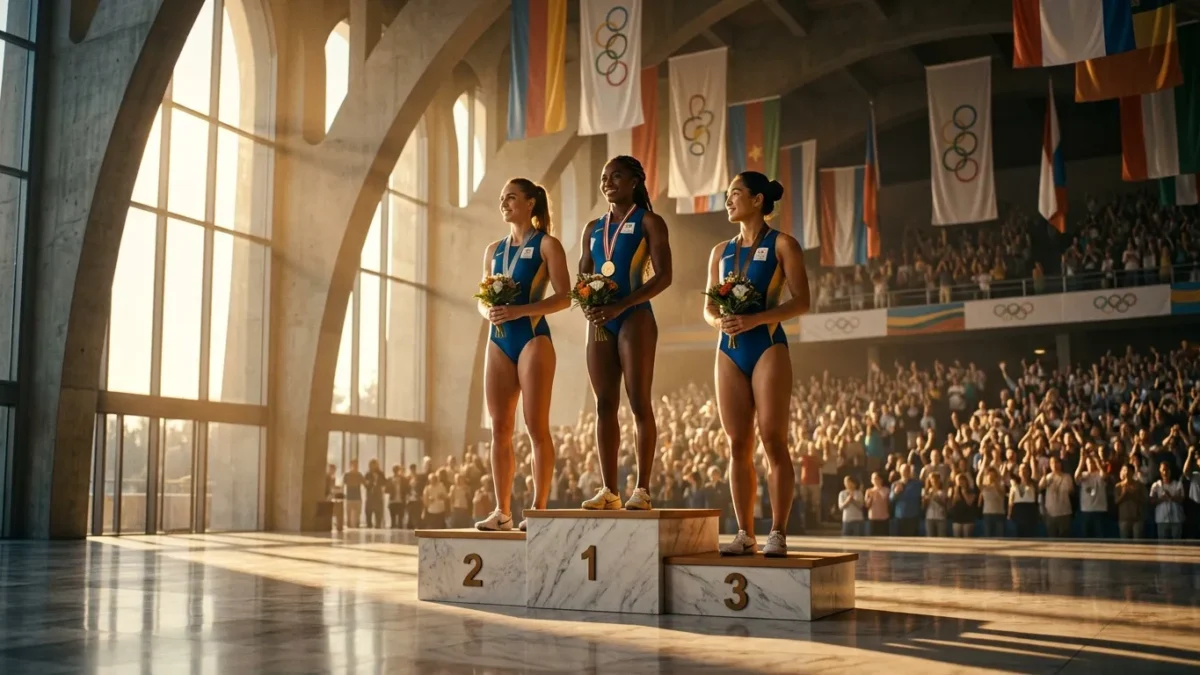
The International Olympic Committee has announced a landmark ruling : starting from the 2028 Los Angeles Games, only biological females will be eligible to compete in women’s Olympic sports. This decision marks a dramatic shift in how global athletics governs female category eligibility, ending years of fragmented, sport-by-sport policies. IOC president Kirsty Coventry confirmed the policy is “led by medical experts,” stressing that fairness and safety in women’s competition are non-negotiable priorities.
A historic shift in Olympic eligibility rules
For decades, the IOC left sex eligibility decisions to individual sports federations rather than imposing a single universal framework. Some disciplines, including athletics, swimming, cycling, and rowing, had already introduced restrictions. Others simply required transgender women to suppress their testosterone levels. That patchwork approach ends with this ruling.
The new policy relies on SRY gene screening — the sex-determining region Y gene, part of the Y chromosome, which triggers male biological development. Testing can be carried out via saliva, cheek swab, or blood sample. The IOC describes this method as unintrusive compared to other possible techniques. Athletes who test negative for the SRY gene will permanently satisfy eligibility requirements for the women’s category. Barring evidence of error, the test need only be taken once per lifetime.
Athletes who test positive will not be excluded from Olympic competition entirely. The IOC clarified they remain eligible for :
- Any male category, including designated male slots within mixed events
- Open categories where available
- Sports or events that do not classify athletes by biological sex
Kirsty Coventry emphasised that every athlete must be treated with dignity and respect, and that counselling alongside expert medical advice will be made available throughout the screening process. The findings will not be applied retrospectively, and the policy does not affect grassroots or recreational sport.
One notable exemption exists : athletes with complete androgen insensitivity syndrome (CAIS), a rare condition meaning they have not undergone male puberty despite carrying XY chromosomes, remain eligible for the women’s category.
High-profile cases that shaped the debate
The path to this ruling was paved by years of controversy. Caster Semenya, the two-time Olympic 800m champion from South Africa, has DSD and carries male XY chromosomes. At the 2016 Rio Olympics, all three women’s 800m medallists were DSD athletes. World Athletics subsequently required DSD competitors in certain track events to reduce their testosterone levels. Semenya refused, citing human rights grounds, triggering a protracted legal dispute. In 2023, World Athletics tightened its regulations further.
At the Tokyo 2020 Games, New Zealand’s Laurel Hubbard became the first openly transgender woman to compete at the Olympics, selected for the women’s weightlifting team. She failed to record a successful lift in her event. By Paris 2024, no transgender women were known to be competing in women’s events, largely due to federation-level bans.
| Athlete | Country | Situation | Olympics |
|---|---|---|---|
| Laurel Hubbard | New Zealand | Transgender woman, weightlifting | Tokyo 2020 |
| Imane Khelif | Algeria | DSD reported, boxing gold medal | Paris 2024 |
| Caster Semenya | South Africa | DSD, 800m double champion | Rio 2016 |
| Lin Yu-ting | Taiwan | Cleared after passing sex test | Paris 2024 |
Paris also brought controversy in boxing, where Algeria’s Imane Khelif won the women’s welterweight gold medal after being disqualified from the previous World Championships. Reports suggested she may have XY chromosomes, though the BBC could not independently verify this. Khelif has consistently identified as a woman and stated she would submit to sex testing ahead of LA 2028. Taiwan’s Lin Yu-ting, similarly cleared by the IOC to compete in Paris, has since passed a sex test and returned to women’s sport.
Scientific grounding, reactions, and what comes next
The IOC’s working group spent 18 months reviewing scientific evidence before arriving at this policy. Researchers identified a clear consensus that male biology confers measurable performance advantages in sports requiring strength, power, and endurance. The consultation also included over 1,100 athlete survey responses and direct interviews with impacted competitors worldwide. Athlete feedback strongly supported science-based eligibility rules and the protection of the female category.
A World Athletics spokesperson welcomed the unified approach, noting that a consistent framework across all sport is a positive development. Campaigners from Sex Matters and SEEN in Sport praised the ruling as long overdue, arguing that biological females had been unfairly disadvantaged for years. They also noted the policy would reduce the intense media scrutiny some athletes had faced.
Critics, however, raised serious concerns. A group of academics submitted a report to the British Journal of Sports Medicine this month, calling sex testing a backwards step and a harmful anachronism. They argued it violates athletes’ human rights, risks psychological distress, and oversimplifies a complex biological reality by reducing sex to a single gene marker. The IOC itself previously used SRY testing in the 1980s before abandoning it in the 1990s following false positives and fears of penalising natural biological variation.
Caster Semenya responded sharply, stating the policy “does not smell of science — it smells of stigma.” Meanwhile, US President Donald Trump had already signed an executive order barring transgender women from female sports categories, and stated he would deny visas to transgender athletes seeking to compete at LA 2028. The IOC ruling now aligns Olympic policy with this geopolitical reality, setting the stage for what may become one of the most legally scrutinised sporting decisions in modern history.
