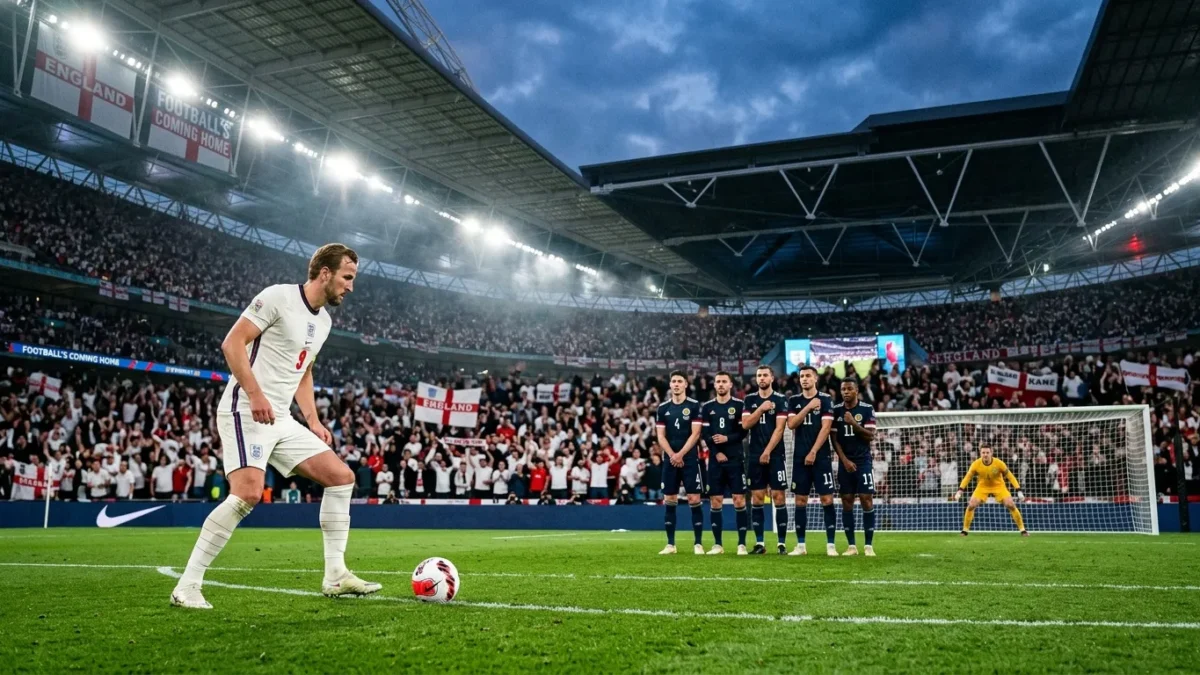
Set-pieces have long divided opinion in football. Some coaches swear by them, others dismiss them as crude shortcuts. But heading into the 2026 World Cup, England may hold a decisive edge — and Thomas Tuchel appears ready to exploit it fully.
The fine margins that decide World Cups
At major international tournaments, the difference between glory and elimination often comes down to a single moment. A deflected shot, a missed penalty — or a perfectly executed set-piece. For England, this reality is not lost on those who have studied the game closely.
Former defender Peter Robinson has pointed out that Tuchel watches an enormous amount of Premier League football. He understands the current trends, he identifies patterns, and he is ruthless enough to act on what he sees. Robinson put it plainly : Tuchel won’t care who he upsets if a particular tactic wins games. Criticism simply doesn’t factor into his thinking.
What Robinson sees clearly is that set-pieces represent a legitimate weapon — one England cannot afford to ignore. If a corner can be delivered under the crossbar, or a free-kick sent into a dangerous area with pinpoint accuracy, why not use it ? That is precisely the kind of cold logic Tuchel applies.
England’s players have demonstrated throughout the 2025–26 Premier League season that they possess the technical quality to deliver from dead-ball situations. The platform exists. The personnel are there. The question is simply whether the coaching staff commits to using this advantage at the highest level.
| Team | Set-piece goals (2025–26) | League position |
|---|---|---|
| Arsenal | Among the highest in the league | 1st |
| England (national) | Strong recent record | World Cup contenders |
Robinson used a striking anecdote to illustrate the point. A manager once told his squad : “If you want to score in the 93rd minute, where do you put the ball ?” The answer — into the box — was obvious. The manager’s reply was sharper : “Then we’ll do it in the first minute if we get the chance.” That mentality is exactly what England need to adopt at the World Cup.
Overcoming football’s snobbery about dead-ball tactics
For years, a certain intellectual snobbery surrounded the use of set-pieces. Teams that relied on them were labelled unsophisticated. Managers like Sam Allardyce and Tony Pulis were dismissed as dinosaurs, their methods seen as antithetical to “proper” football. This attitude, though widespread, was always more about aesthetics than results.
Today, that bias is crumbling. Arsenal’s success in 2025–26 has done more to rehabilitate dead-ball tactics than any tactical essay ever could. Sitting top of the Premier League and competing seriously in the Champions League, Arsenal have become the most effective set-piece team in the country — and nobody is laughing anymore.
The shift in perception matters because it removes a psychological barrier. England’s coaching staff no longer need to justify using set-pieces defensively. The evidence is overwhelming. When the best team in England scores repeatedly from corners and free-kicks, the argument against doing so collapses entirely.
- Set-pieces remove the need for sustained possession build-up
- They create high-probability scoring opportunities in compact defensive blocks
- They reward physical presence and delivery quality — areas where England excel
- They are rehearsable, repeatable, and adaptable to specific opponents
Robinson’s point is simple : fine margins win tournaments. Sixty-four passes before a goal might look prettier. But a corner delivered under the crossbar achieves the same outcome. At a World Cup, where every match carries enormous pressure, that pragmatism has enormous value.
Tuchel’s ruthless approach and the refereeing question
What makes Tuchel particularly suited to maximising England’s dead-ball threat is his character. He is, by all accounts, an operator who leaves no advantage untouched. If set-pieces can win England matches — and the evidence suggests they can — Tuchel will integrate them systematically. His track record at club level shows a manager who adapts without sentimentality.
However, one legitimate concern arises when England step outside the Premier League context. English referees have developed a relatively permissive approach to physical contact inside the penalty area at set-pieces. Movement before delivery is monitored, and officials will intervene verbally — but as long as no clear infringement occurs once the ball is kicked, play continues.
Foreign referees at a World Cup may not share this tolerance. Some will apply stricter interpretations of obstruction and holding. Others may be equally lenient. There is genuine uncertainty here, and England’s coaching staff must prepare for both scenarios. Adapting delivery routines and movement patterns to work within tighter officiating standards could prove essential.
Robinson acknowledges the risk but remains confident. England’s set-piece quality is too significant an advantage to set aside over refereeing uncertainty alone. Tuchel, he believes, will identify what can and cannot be replicated at international level — and he will adjust accordingly. That is what elite managers do.
Ultimately, the 2026 World Cup will be decided by moments rather than systems. England have the delivery quality, the physical presence, and now a head coach willing to use every tool available. Set-pieces may not win the World Cup alone — but in the right moment, at the right stage of the tournament, a single perfectly executed dead ball could change everything. That is a chance England must not waste.
