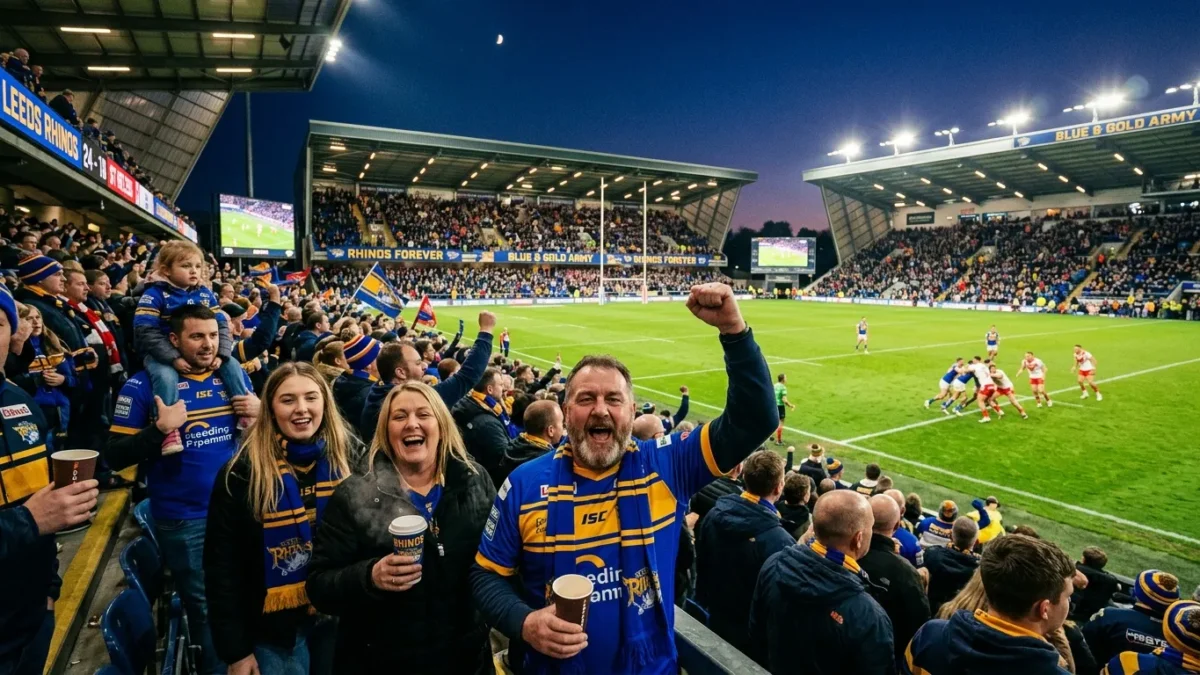
Thirty years ago, on 29 March 1996, rugby league’s summer revolution began with Paris Saint-Germain defeating Sheffield Eagles 30–24 at Stade Charléty. Nearly 18,000 spectators witnessed that opening fixture, which now feels almost mythological. The sport that emerged from that first season barely resembles what fans experience today at the turnstiles.
From Thrum Hall to luxury stadiums : the radical transformation of matchday
The venues alone tell the story of three decades of change. When Super League launched, fans filed into ageing Edwardian grounds across the north of England — grounds with names like Thrum Hall and Watersheddings that sound lifted from a Dickens novel. St Helens, Wigan, Warrington and Hull all relocated to modern arenas, encouraged by local councils eager to regenerate urban areas. Fans under 40 have never known anything else.
Yet some grounds endure. Wheldon Road in Castleford and Odsal in Bradford remain largely as they were. Headingley has been transformed beyond recognition. Wakefield’s Belle Vue, however, offers the most striking contrast. A decade ago, the place looked like an abandoned archaeological dig. Today, the Ellis family — owners of Europe’s largest kitchen company — have converted it into a high-spec sports entertainment venue, complete with a podium beneath a giant curved screen and 16 television screens in a swanky sports bar.
When Leigh coach Adrian Lam walked into Belle Vue’s refurbished press room, he summed it up perfectly : “This is a bit posh, innit ?” That reaction captures exactly how far matchgoing conditions have shifted for supporters of clubs once considered rugby league’s second tier.
| Club | Ground in 1996 | Situation in 2026 |
|---|---|---|
| Wigan Warriors | Central Park | DW Stadium (modern arena) |
| Wakefield Trinity | Belle Vue | DIY Kitchens Stadium (renovated) |
| Castleford Tigers | Wheldon Road | Wheldon Road (largely unchanged) |
| Leeds Rhinos | Headingley | Headingley (fully transformed) |
Crowds, clubs and competition : who has risen, who has fallen
Average attendances in Super League’s first season sat at around 6,571 — perfectly standard for top-flight rugby league at the time. Wigan rarely pulled 14,000 to Central Park. Fewer than 5,000 attended Leeds’ final home game of that dismal inaugural campaign. Today, the league average nudges 10,000, and five-figure gates are commonplace at Wigan and Leeds.
The contrast for some clubs is extraordinary. Leigh and Wakefield combined drew negligible crowds in 1996. Together they now attract approximately 17,000 fans per match. Matt Ellis has plans to expand Belle Vue’s north stand to accommodate 11,000 — a capacity Wakefield last achieved regularly in the 1960s.
Yet growth has not been universal. Only half of the dozen founding clubs remain in Super League today. The competition has visited and departed from :
- London (twice)
- Paris
- Sheffield
- Tyneside
- Toronto
- Wales
- Cumberland
In 1996, Leigh and York ranked 30th and 31st in English rugby league. Of the four clubs ranked below them that year, only Barrow still exist. The sport’s geography has contracted significantly, with 14 Super League clubs now squeezed into five northern English markets plus two French clubs.
The salary cap has played a crucial role in redistributing competitiveness. Without one in 1996, Wigan were overwhelming favourites yet lost the title to St Helens by a single point. Since the cap was introduced — rising only modestly from £1.8m in 2002 to £2.1m plus exemptions — eight different clubs have reached the Grand Final in the last eight years alone.
What a 1996 fan would barely recognise at a modern Super League fixture
Beyond bricks and mortar, the everyday experience of attending a match has shifted enormously. The game itself looks different : skin-tight jerseys replaced baggy cotton shirts, six-again calls interrupt the flow, and green cards send players to the sin bin temporarily. HIAs — head injury assessments — pause the action regularly. These were all unimaginable in 1996.
Off the pitch, the commercial landscape is unrecognisable. Betting company advertisements dominate perimeter boards where keg beer brands once sat. Paper programmes and printed tickets have largely disappeared. Giant sponge fingers — once a staple of the terraces — are gone. Supporters spend much of the match staring at their phones.
The overseas player landscape has also transformed completely. Champions St Helens used just three overseas players in their 1996 title-winning squad. Runners-up Wigan fielded only two. Today, clubs can register ten foreign players, and many are scouring Australia’s second tier for affordable talent — exactly as expansion clubs London Broncos and Paris did three decades ago, when London alone had 30 Antipodeans on their books.
Perhaps the most symbolic change came on the weekend of Super League’s 30th birthday : Tara Jones became the first female referee to officiate a top-flight match, taking charge of Wigan against Huddersfield. In 1996, such a development would have been inconceivable to most supporters at the ground.
A generational shift is also visible in the players themselves. The fathers of Ben McNamara, Jarrod O’Connor and Kai Pearce-Paul all featured in Super League’s opening round. Current coaches Paul Rowley and Chris Chester lined up for Halifax that day alongside RFL director Abi Ekoku. The sport has quite literally moved on a generation — and for those still going through the turnstiles every week, the journey from 1996 to 2026 has been one of the most dramatic transformations in British sport.
