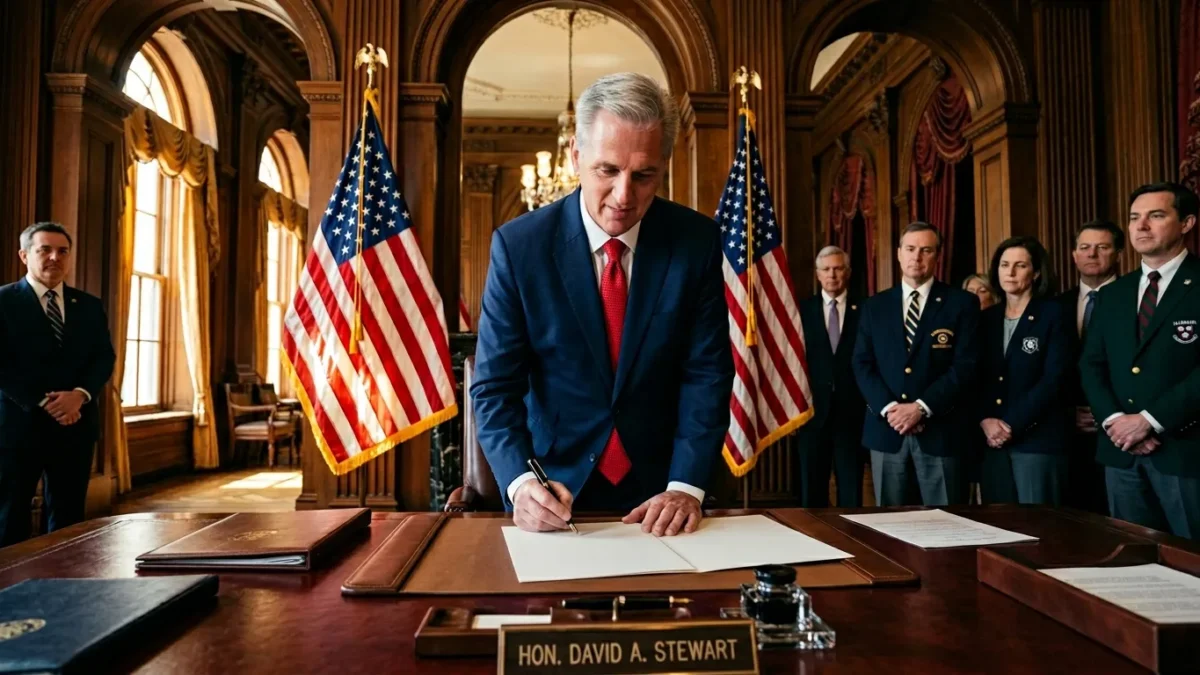
On April 4, 2025, Donald Trump signed a sweeping executive order targeting college sports — right on the eve of the NCAA Men’s Basketball Tournament Final Four in Indianapolis. The timing was deliberate. The document, ten pages long, drops at the most-watched moment in collegiate athletics, maximizing public attention on an industry that has resisted federal oversight for decades.
What the executive order actually says about college sports regulation
The order covers several pressure points that have destabilized collegiate athletics over the past few years. Transfer rules, NIL compensation, eligibility limits, and funding protections for women’s and Olympic sports all appear as targets. Schools that fail to align with the order’s guidelines risk losing federal funding — a serious financial stick for universities that depend heavily on government grants and contracts.
On the transfer front, the directive instructs the NCAA to reinstate a modified version of its former “one-time” transfer rule by August 1. Under this structure, athletes could transfer once without penalty. A second transfer would trigger a mandatory year in waiting. This matters enormously right now : the basketball transfer portal opens Tuesday, with thousands of players already positioning their next move.
- Reinstatement of the one-time transfer rule
- Five-year eligibility window (currently four competitive seasons over five years)
- Ban on professional athletes returning to play college sports
- Prohibition on booster-backed NIL collectives, described in the document as “fraudulent NIL schemes”
- Revenue-share models that preserve or expand scholarships in women’s and Olympic programs
- No use of federal funds for NIL or revenue-sharing arrangements
Trump has also instructed the NCAA to define a clear five-year eligibility window. Currently, athletes may compete across four seasons within a five-year span — a standard that courts have stretched further through individual injunctions. The NCAA spent $16 million in legal fees alone fighting eligibility lawsuits over the past year, with more than 70 athletes suing the governing body for extensions. That figure alone illustrates why reform has become unavoidable.
The order also nullifies certain state laws that conflict with its provisions — particularly state statutes governing NIL arrangements. This federal override of state-level legislation will almost certainly trigger immediate legal pushback. Trump himself, during a March 6 White House roundtable that included former Alabama coach Nick Saban, Secretary of State Marco Rubio, and Chief of Staff Susie Wiles, openly predicted legal challenges. His exact words : he “hoped” for a favorable judge. That’s not exactly a ringing endorsement of the order’s legal durability.
Congressional gridlock and the presidential committees behind the push
This executive order doesn’t exist in a vacuum. It follows a previous directive issued in July that produced no measurable results — no new rules, no enforcement, no change on the ground. This new version goes significantly further by setting concrete requirements rather than simply telling cabinet members to draft guidelines that never materialized.
The deeper goal appears to be forcing Congress to act. Legislators have spent seven years fielding lobbying efforts from the NCAA, yet no comprehensive bill has passed. The Republican-authored SCORE Act — the most complete piece of legislation to emerge from committee — has twice failed to reach the House floor for a vote. Republicans hold a slim majority and can’t afford defections from within their own caucus, some of whom oppose portions of the bill.
| Legislative chamber | Key figures | Current status |
|---|---|---|
| U.S. House | Republican leadership (SCORE Act) | Twice failed to reach floor vote; vote-whipping ongoing |
| U.S. Senate | Ted Cruz (R-TX) and Maria Cantwell (D-WA) | Separate negotiations; wide disagreements on antitrust scope |
Even if SCORE clears the House, it needs 60 Senate votes to advance — meaning at least seven Democrats must cross the aisle. That’s a tall bar given that Democrats and Republicans diverge sharply : Republicans back a narrow, NCAA-friendly framework with athlete restrictions, while Democrats push for broader protections and athlete freedoms. True bipartisan consensus remains elusive, despite early assumptions that college sports reform would be an easy common-ground issue.
Meanwhile, five presidential committees have begun meeting to inform legislative efforts. Each studies a specific area : legislative strategy for antitrust protections, NIL and transfer rules, NCAA governance reform, media rights, and athlete-agent relationships. A sixth oversight committee — including university presidents from Georgia, Nebraska, Tennessee, Kansas, Utah, and North Carolina, plus former Clemson president Jim Clements and Florida Governor Ron DeSantis — reviews their output. High-profile names assigned to these committees include Nick Saban, Condoleezza Rice, and NBA Commissioner Adam Silver, alongside conference commissioners from the SEC, ACC, Big 12, Big Ten, and American Athletic Conference.
What college sports leaders should watch for next
Conference commissioners responded swiftly after the order’s Friday night release — SEC Commissioner Greg Sankey, Big Ten Commissioner Tony Petitti, Big 12 Commissioner Brett Yormark, and ACC Commissioner Jim Phillips all weighed in publicly. Their reactions reflect genuine uncertainty about enforcement scope and legal resilience.
The order’s August 1 deadline for NCAA rule updates creates a compressed timeline. If courts block enforcement — as they have with several other Trump executive orders in recent months — the pressure shifts back entirely to Congress. That’s arguably the intended outcome : use the executive order as a forcing function, not a permanent fix.
For athletes currently preparing to enter the transfer portal, the immediate practical impact remains uncertain. The one-time transfer rule cannot be reinstated overnight, particularly when antitrust rulings already deemed it unlawful. Legal challenges will likely pause implementation. Athletic directors, coaches, and compliance staff should track court filings closely over the coming weeks — the window between now and August 1 will define whether this order reshapes college athletics or simply fades like its predecessor.
