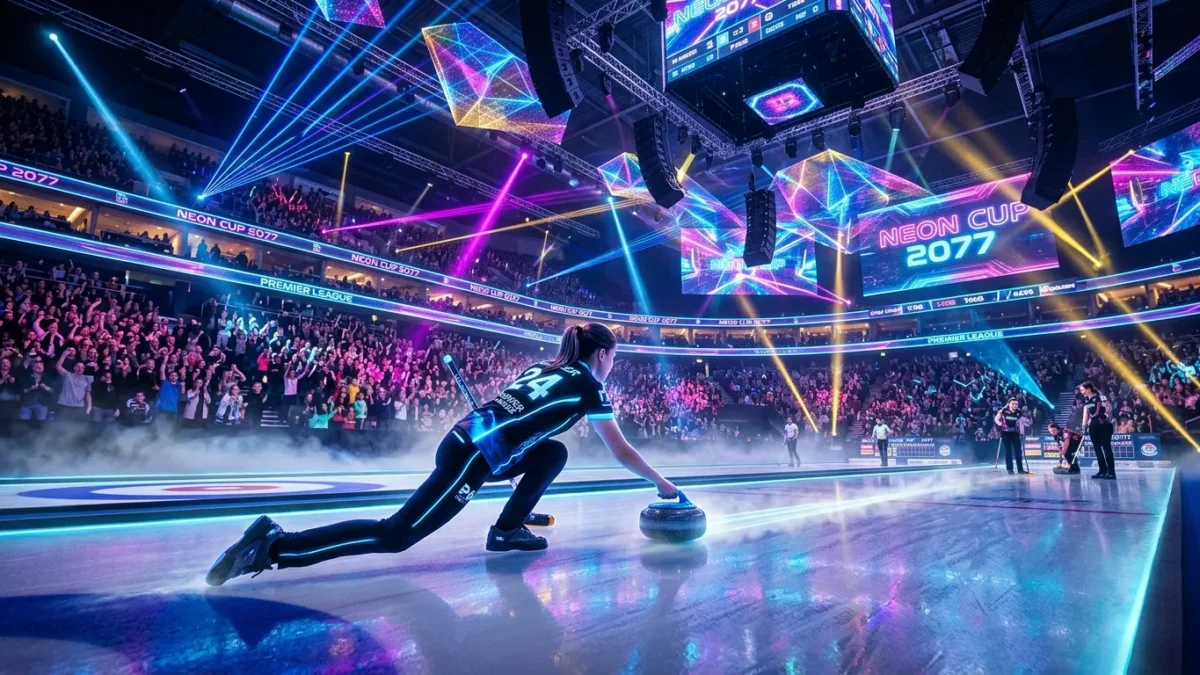
Curling rarely makes headlines outside of Olympic season. But Rock League — the new entertainment-driven franchise competition — is changing that. With seven Scottish athletes signed up and names like Eve Muirhead and Bruce Mouat headlining the rosters, this format could genuinely reshape how the sport reaches new audiences.
Scottish curling stars front Rock League’s boldest experiment
The numbers speak for themselves. Five of the seven Scottish participants competed at the 2026 Winter Olympics in Cortina, while two others arrived fresh from the recent World Championship. That’s an extraordinary concentration of elite talent for a competition still finding its footing.
The franchise structure is deliberately international. Here’s how the Scottish contingent is spread across the league’s global teams :
| Player | Franchise | Region |
|---|---|---|
| Bruce Mouat | Northern Shield | Europe |
| Jen Dodds | Northern Shield | Europe |
| Robin Brydone | Northern Shield | Europe |
| Hammy McMillan | Alpine Curling Club | Europe |
| Grant Hardie | Frontier Curling Club | North America |
| Ross Whyte | Maple United | Canada |
| Bobby Lammie | Typhoon Curling Club | Asia |
Mouat skips Northern Shield, reuniting with his Olympic mixed doubles partner Jen Dodds alongside Robin Brydone. On the other European franchise, Alpine Curling Club, Eve Muirhead takes a different kind of role entirely — not as a player, but as general manager, alongside Hammy McMillan.
Muirhead’s credentials are hard to argue with. The 2022 Olympic gold medallist also served as Team GB’s chef de mission at the Cortina Games. Her presence in a management capacity signals that Rock League wants credibility, not just spectacle. “I think we’ve five Olympic medals between us from this recent Games, which is pretty incredible,” she told BBC Sport Scotland — and she’s not wrong. That’s a staggering collective pedigree for a fledgling league.
Grant Hardie crosses the Atlantic to join Frontier Curling Club, an American outfit, while Ross Whyte lines up for Maple United on the Canadian side. The deliberate scattering of Scottish talent across different franchises isn’t accidental — it builds narrative, rivalry, and cross-national storylines that traditional curling competitions rarely generate.
Bobby Lammie’s Asian adventure : language barriers and a very personal dynamic
Of all the storylines emerging from Rock League’s launch, Bobby Lammie’s situation stands out. The Scottish curler has joined Typhoon Curling Club, the league’s Asian franchise — and he’ll be competing alongside his girlfriend, South Korean curler Seol Ye-eun.
Lammie was refreshingly candid when speaking to BBC Sport Scotland. “That could be an interesting dynamic,” he admitted. “I’m looking forward to it, but hopefully we don’t fall out.” It’s the kind of honest, unfiltered quote that cuts through the usual sports PR gloss. Mixing professional competition with a personal relationship is genuinely uncharted territory, even in a sport known for its tight-knit community.
But the personal dynamic is only one layer of complexity. Typhoon Curling Club brings together players from China, Japan, South Korea, New Zealand, and Sweden. That’s five different nationalities and multiple languages under one team banner. Lammie acknowledged the practical challenge head-on : “The main challenge for us in the Asian franchise is going to be the language barrier. But that’s part of the fun.”
That attitude matters. Rock League isn’t designed to be a frictionless, predictable competition. It’s built on exactly these kinds of tensions — cultural, linguistic, personal. Whether audiences will buy into it depends on how well the league packages and presents these narratives.
- Chinese, Japanese, and Korean players must coordinate tactics across language gaps
- New Zealand and Swedish athletes add further cultural diversity to Typhoon’s roster
- Lammie and Seol Ye-eun will navigate both competitive pressure and their relationship simultaneously
- Team chemistry — always critical in curling — becomes a far more complex equation
Frankly, Typhoon Curling Club could be the most watchable franchise in the competition — not despite its complications, but because of them.
What Rock League actually needs to prove
Entertainment-first sports formats have a mixed track record. Some, like T20 cricket, transformed their sport’s global reach permanently. Others burned bright briefly before fading. Rock League sits at that crossroads right now, and the talent investment alone won’t settle the question.
What the league does well is use franchise geography to create stakes that go beyond individual performance. When Grant Hardie represents an American team against Ross Whyte’s Canadian side, there’s a built-in competitive tension — even without a home crowd filling the arena. That structural drama is smart design.
The real test will come in execution. Curling’s core audience is deeply traditional — the sport’s culture prizes tactical patience over showmanship. Winning over that base while simultaneously attracting casual viewers is a genuine tightrope walk. The presence of Muirhead in a general manager role, rather than just as a player ambassador, suggests Rock League is thinking longer-term than a one-season spectacle.
If you follow curling seriously, keep an eye on how Typhoon Curling Club performs — not just on the scoreboard, but as a social experiment. A team built on five nationalities, personal relationships, and linguistic improvisation is either a disaster waiting to happen or the most compelling narrative in the sport right now. My money is on the latter.
