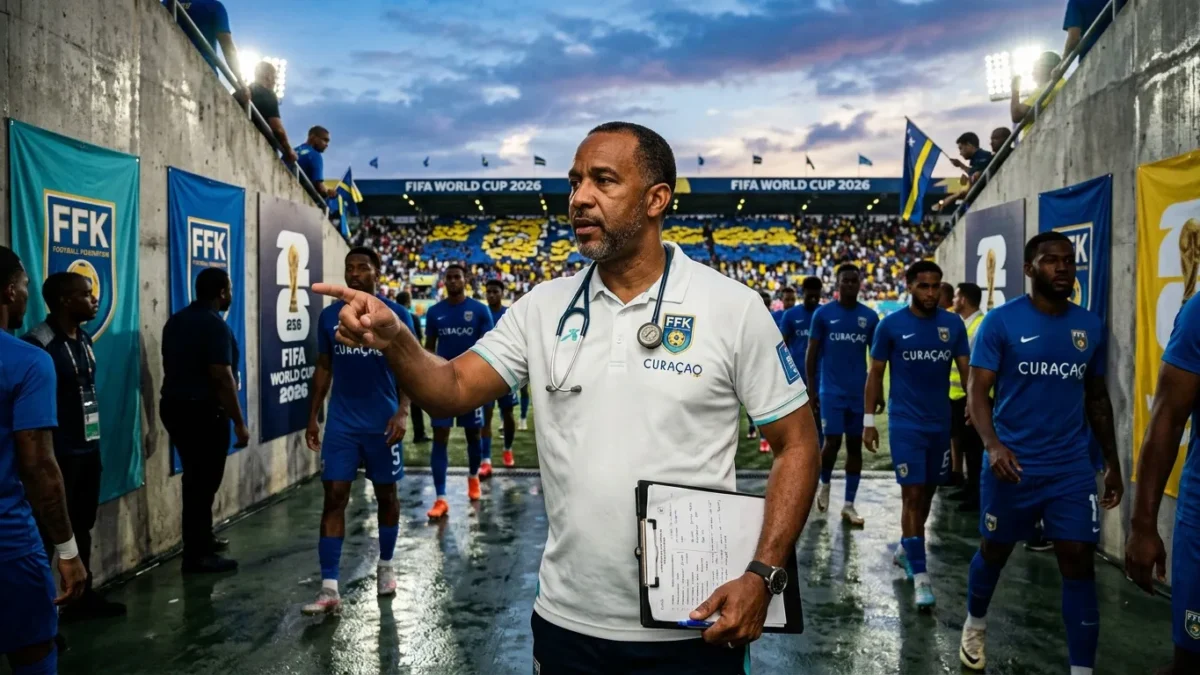
Houston, June 22, 2026. For the first time in men’s World Cup history, an entirely female medical team stood pitch-side during a FIFA match. The game ? Curacao versus Germany. The moment ? Historic. And at the center of it all stood Dr. Suzanne Huurman, head of medical for the Curacao men’s national football team.
A landmark moment for women in sports medicine
The Curacao-Germany group stage clash was far more than a football match. On the touchline, five female medical professionals formed a complete care unit, a first in the tournament’s century-long history. FIFA match doctor Dr. Emma Lunan, emergency medicine specialist Dr. Carrie Bakunas, Germany’s team doctor Dr. Silja Schwarz, injury spotter Dr. Kerry Peek, and Dr. Huurman herself composed this groundbreaking team.
Dr. Lunan framed it clearly when speaking to FIFA : “Hopefully this is a springboard to show that expertise in sports medicine and performance medicine is not dependent on your sex or gender, and the opportunities to progress can be based on your competence.” That sentence deserves to be read twice. Competence, not gender. Simple, but apparently still radical in elite football.
This did not happen by accident. In 2026, FIFA introduced new mandatory regulations for women’s tournaments requiring at least one female member of medical staff and at least one female coach per squad. These rules accelerated a shift that had been stalling for years. Dr. Huurman supports them without hesitation : the regulations open doors that informal goodwill alone never managed to unlock.
Here is a quick overview of the five women who made history in Houston :
| Name | Role | Team/Organisation |
|---|---|---|
| Dr. Emma Lunan | FIFA match doctor | FIFA |
| Dr. Suzanne Huurman | Head of medical | Curacao |
| Dr. Silja Schwarz | Team doctor | Germany |
| Dr. Carrie Bakunas | Emergency medicine doctor | FIFA |
| Dr. Kerry Peek | Injury spotter | FIFA |
Dr. Huurman’s path to the World Cup sideline
Dr. Suzanne Huurman did not arrive at this World Cup by luck. She studied medicine at Radboud University in the Netherlands between 2008 and 2014, built her clinical foundation, then moved into elite sport. She later completed a leadership programme at Harvard Business School, a detail that says a lot about how seriously she approaches the business side of high-performance environments.
Her entry into professional football came in 2020 with Real Madrid, where she worked initially with the women’s team before transitioning to the men’s side. That transition was not smooth optics-wise. When the women’s team was first assembled at Real Madrid, she was the only female staff member. Every other person in that medical and coaching unit was male. She navigated that environment, proved her value, and moved forward.
Frankly, her trajectory required more persistence than most male colleagues face in comparable roles. She has heard the objection directly and repeatedly : “You cannot do this because you’re a woman.” Her response is not a speech, it is a method. Prove your quality. Be a good professional. The door opens. It is not a perfect system, but she is pragmatic rather than paralyzed by it.
On the structural side, Dr. Huurman raises a point worth taking seriously. Countries like Sweden already use rotating doctor systems, where different physicians cover different weeks rather than assigning one permanent doctor to a squad. This kind of flexible working model could make elite sport more accessible to female doctors, many of whom balance clinical responsibilities with family commitments. Elite football, she acknowledges, is not accustomed to this model. But that does not mean it should be off the table.
Curacao’s historic goal and what comes next
The medical milestone was not the only first for Curacao in Houston. The Caribbean nation, nicknamed the Blue Wave, scored their very first World Cup goal against Germany. That is a genuine piece of football history, regardless of what followed. What followed was a 7-1 defeat to the four-time world champions. The scoreline stings, but the goal stands forever.
Two group matches remain for Curacao : against Ecuador and Ivory Coast. The squad’s attitude, according to Dr. Huurman, is anything but defeated. Consider that Spain, one of the tournament favourites, drew 0-0 with Cape Verde. Elite football at major tournaments is unpredictable, and Curacao knows it.
Dr. Huurman described the mood in the camp with precision : “We are optimistic for our next two games. They’re happy, they’re focused.” That is not spin. Coming off a heavy loss, maintaining squad morale is a medical and psychological challenge as much as a coaching one, and it falls partly within her remit.
Beyond the remaining games, the wider takeaway from Curacao’s World Cup 2026 campaign is this : representation in sports medicine changes what young doctors believe is possible. One female physician on a touchline at a men’s World Cup is unusual. Five at once sends a different message entirely. If FIFA’s new regulations push more tournaments toward this reality, the long-term impact on recruitment and retention of women in elite sports medicine could be substantial, and measurable within a decade.
