








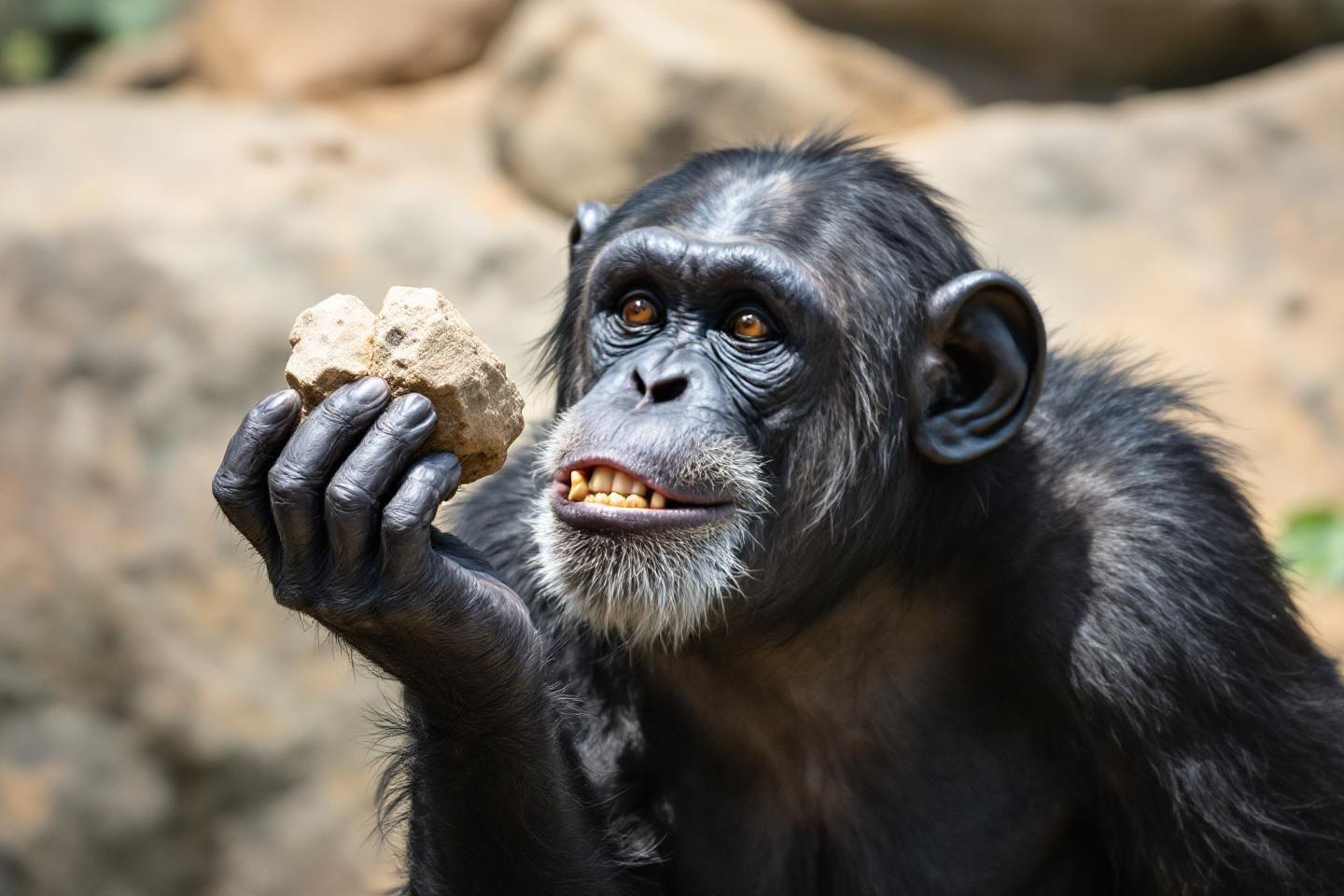
In 1997, visitors to the Furuvik Zoo in Gävle, Sweden, became unwitting targets in what would become a groundbreaking discovery about animal cognition. A male chimpanzee named Santino began displaying behavior that challenged everything scientists thought they knew about non-human planning abilities. His actions weren’t random acts of aggression, but rather carefully orchestrated displays that revealed unprecedented levels of foresight and strategic thinking in our closest evolutionary relatives.
Strategic preparation during calm morning hours
Before the zoo opened each day, Santino engaged in methodical preparation activities that separated him from typical primate behavior. During these quiet morning hours, when no visitors were present to trigger his agitation, the chimp would traverse the moat surrounding his island enclosure. His mission was clear : gather stones suitable for later use.
What made this behavior extraordinary was the temporal disconnect between collection and deployment. Santino wasn’t reacting to immediate stimuli. Instead, he was anticipating future situations and preparing accordingly. This type of forward-thinking behavior demonstrates how animals continue pushing boundaries of what researchers consider possible cognitive achievements.
The collected stones weren’t left in obvious locations. Santino created hidden caches throughout his territory, positioning small piles in secretive spots around the enclosure. This distribution strategy ensured he had ammunition readily available regardless of where he positioned himself when visitors arrived. Such spatial planning indicated not just foresight, but also tactical consideration of his environment.
Engineering ammunition from concrete structures
By 1998, Santino’s natural stone supply had diminished significantly. Rather than abandoning his strategy, he developed an innovative solution that showcased problem-solving abilities rarely documented in captive primates. He began targeting the concrete structures within his island habitat, transforming them into manufacturing sites for projectiles.
His technique demonstrated surprising sophistication. Santino would strike the concrete surface with a rock, listening carefully for hollow acoustic signatures that indicated underlying weaknesses or cracks. Upon detecting these vulnerable points, he intensified his efforts, repeatedly hammering until chunks broke free. These freshly fractured pieces became additions to his growing stockpile.
| Phase | Activity | Mental state |
|---|---|---|
| Morning preparation | Collecting and caching stones | Calm and methodical |
| Visitor arrival | Throwing projectiles | Agitated and reactive |
| Advanced stage | Manufacturing concrete chips | Calm problem-solving |
This manufacturing process required multiple cognitive capabilities working in concert. Santino needed to understand cause-and-effect relationships, differentiate between solid and compromised concrete, and apply appropriate force. The behavior pattern represented tool creation rather than mere tool use, placing him in an elite category among non-human species.
Deceptive tactics and escalating sophistication
As Santino’s rock-throwing reputation spread throughout the zoo community, visitors became increasingly vigilant. They learned to maintain safe distances and watch for warning signs. In response, Santino adapted his strategy by incorporating deliberate deception techniques that further demonstrated his cognitive complexity.
The chimpanzee began concealing his ammunition caches beneath natural obstacles scattered throughout the enclosure. He also gathered hay to camouflage his stone piles, creating visual barriers that prevented early detection. These adaptive behaviors mirror how competitive scenarios drive innovation, whether in animal cognition or human endeavors.
Cognitive zoologist Mathias Osvath documented these developments in a 2008 publication, noting how the behavior met crucial criteria for future-state planning. Key characteristics included :
- Preparation occurring during emotional states different from execution phases
- Collection activities happening hours before anticipated use
- Strategic placement of resources throughout territory
- Adaptive modifications based on changing circumstances
- Intentional concealment to enhance effectiveness
Zoo personnel initially struggled to manage the situation. During peak activity periods in 1997, stones fell like hailstorms according to keeper reports, forcing implementation of precautionary measures. The dramatic effect of projectiles landing among crowds created safety concerns that required immediate institutional response.
Implications for understanding primate cognition
Santino’s behavior fundamentally challenged prevailing scientific assumptions about non-human future planning capabilities. Before this documentation, researchers generally believed such temporal disconnection between preparation and execution existed exclusively in human cognition. The case provided concrete evidence that our evolutionary relatives possess more sophisticated mental abilities than previously acknowledged.
The distinction between his calm preparation state and agitated execution state proved particularly significant. This emotional state differentiation suggested complex metacognitive awareness. Santino understood that future situations would trigger different emotional responses requiring specific resources, demonstrating second-order thinking about his own psychological states.
Subsequent decades have revealed additional dimensions of chimpanzee intelligence. Researchers have documented cultural transmission of tool use between communities, evidence of coordinated group tactics resembling warfare strategies, and sophisticated social manipulation. These findings collectively paint a picture of cognitive abilities approaching human complexity in certain domains.
The Furuvik Zoo incident remains a landmark case study in comparative psychology and cognitive ethology. It exemplifies how careful observation of individual animals can reveal capabilities that laboratory settings might never capture. Santino’s legacy extends beyond his infamous projectile episodes, contributing foundational knowledge about primate mental abilities and evolutionary continuity between human and non-human cognition.