








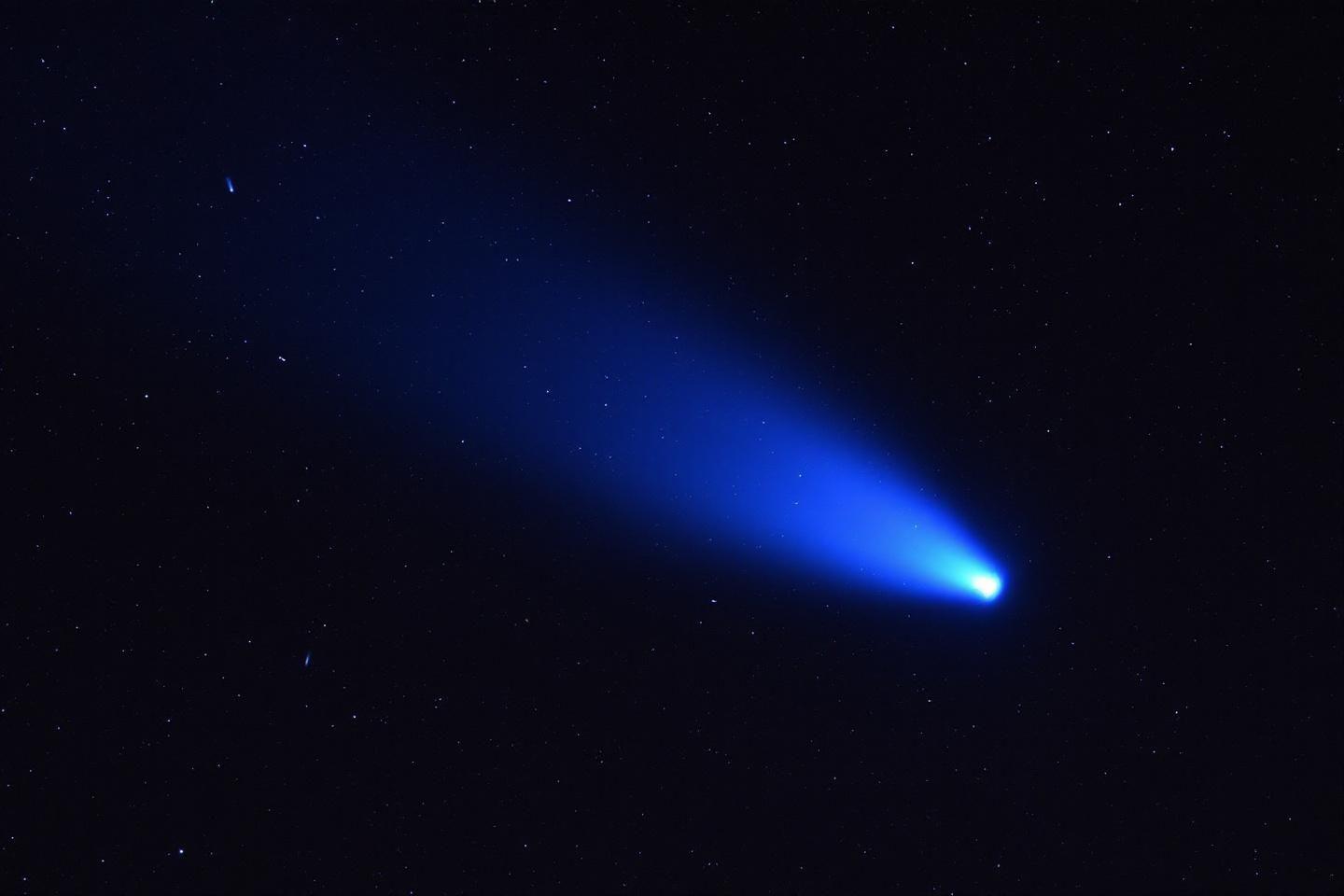
A remarkable celestial wanderer has captured astronomers’ attention as it races through our cosmic neighborhood at extraordinary velocity. This visitor from beyond our solar boundaries, designated 3I/ATLAS, represents humanity’s third confirmed encounter with an object originating from interstellar space. Scientists now predict that before departing our system, this fast-moving comet might experience a significant gravitational interaction with our solar system’s largest planet, potentially altering its trajectory in ways that could reshape our understanding of such encounters.
The discovery occurred when monitoring systems detected an unusual object traveling at exceptional speed. Unlike typical solar system bodies, this celestial visitor demonstrated characteristics that immediately set it apart from familiar astronomical objects, prompting extensive investigation into its origins and future path.
Understanding our latest cosmic visitor
The Asteroid Terrestrial-impact Last Alert System made this groundbreaking identification on July 1, 2025. Astronomers measured the object’s velocity at approximately 58 kilometers per second, equivalent to 36 miles per second, accompanied by an unusual eccentricity that distinguished it from ordinary cometary bodies. This discovery marked a significant milestone, as 3I/ATLAS joined the exclusive group of confirmed interstellar objects, following in the footsteps of the pioneering 1I/’Oumuamua and 2I/Borisov.
Despite sensationalist speculation suggesting artificial origins, scientific analysis firmly establishes this as a natural phenomenon. Nevertheless, the scientific value remains immense. Every interstellar visitor provides unprecedented opportunities to study material from distant stellar systems, offering glimpses into planetary formation processes occurring light-years away. The chemical composition and physical characteristics of such objects can reveal conditions in remote regions of the Milky Way, areas otherwise inaccessible to direct observation.
Chris Lintott, a Professor of Astrophysics at the University of Oxford, emphasized the significance of the object’s velocity profile. The vertical movement relative to our galaxy’s plane suggests origins in the Milky Way’s thick disk, a region populated by older stellar systems. Lintott’s team proposes that this wanderer may have existed longer than our entire solar system, potentially traveling through interstellar space for billions of years before entering our neighborhood.
Tracing origins across galactic distances
Determining the precise birthplace of interstellar objects presents extraordinary challenges. Research teams have employed sophisticated modeling techniques to reconstruct 3I/ATLAS’s journey through space. One comprehensive study concluded that this comet likely experienced no close stellar encounters during the past 10 million years, suggesting an isolated trajectory through the galactic void. Some researchers even propose an astonishing possibility : this object might have wandered alone for 10 billion years before humans detected its presence.
The available evidence points toward origins associated with transitional regions between our galaxy’s thin and thick disks. While astronomers observe that 3I/ATLAS follows an orbit consistent with the solar neighborhood’s thin disk, its characteristics suggest considerable age. Possible formation scenarios include :
- Ejection from a primordial planetesimal disk surrounding an ancient stellar system
- Escape from an exo-Oort cloud belonging to a distant star
- Expulsion during planetary system formation billions of years ago
- Gravitational perturbations from passing stellar objects in crowded galactic regions
Recent pre-print research attempted to map both the arrival vector and departure trajectory. Scientists created 500 statistical clones of the comet, running simulations spanning centuries into past and future. Their findings indicate that 3I/ATLAS approached from the Sagittarius constellation with a mean radial velocity of -57.995 ± 0.011 kilometers per second. Upon departing, projections suggest the comet will travel toward the Gemini constellation at approximately 58.01 ± 0.01 kilometers per second.
The upcoming Jupiter encounter in 2026
Before bidding farewell to our solar system, 3I/ATLAS faces potentially dramatic gravitational interactions. Researchers identified two planetary bodies capable of influencing the comet’s trajectory : Mars and Jupiter. However, Jupiter’s massive gravitational field will exert considerably stronger effects due to the proximity of the encounter.
The critical date arrives on March 16, 2026, when the interstellar visitor will pass remarkably close to Jupiter’s Hill radius, the region where Jupiter’s gravitational influence dominates. The comet will approach within 0.355 astronomical units of the gas giant, placing it in a zone where significant perturbations become likely. This gravitational interaction could substantially modify the object’s velocity and trajectory, potentially affecting its ultimate departure angle from our solar system.
| Encounter Parameter | Value | Significance |
|---|---|---|
| Optimal observation window | March 9-22, 2026 | Best period for detailed study |
| Distance to Jupiter | 0.355 AU | Near Hill radius boundary |
| Maximum Juno distance | 0.4 AU | Spacecraft observation range |
| Closest approach date | March 16, 2026 | Peak gravitational interaction |
Uncertainty surrounds the non-gravitational forces acting upon 3I/ATLAS. These accelerations, resulting from processes like outgassing and solar radiation pressure, remain poorly constrained. Modeling suggests that accelerations below 10⁻⁷ astronomical units per day squared would produce negligible trajectory changes. However, accelerations ranging from 10⁻⁶ to 10⁻⁵ astronomical units per day squared could dramatically reshape the comet’s future path, introducing unpredictability into departure projections.
Maximizing scientific opportunities during transit
The research team identified an optimal observation window when NASA’s Juno spacecraft could provide unprecedented views. Between March 9 and March 22, 2026, geometric configurations will allow detailed examination as the interstellar comet passes through Jupiter’s vicinity. During this period, the distance from Juno to 3I/ATLAS will actually be shorter than the comet’s separation from Jupiter itself, creating ideal conditions for comprehensive measurements.
These observations hold tremendous scientific value. Spectroscopic analysis could reveal chemical compositions reflecting conditions in distant stellar nurseries. Surface mapping might identify thermal properties and structural characteristics developed during billions of years of cosmic radiation exposure. Outgassing patterns would illuminate volatile content, providing clues about formation temperatures and chemical environments in alien planetary systems.
Additional observations remain crucial for refining trajectory predictions and understanding acceleration mechanisms. Each data point collected helps constrain models of the comet’s behavior, improving our ability to predict similar encounters with future interstellar visitors. The knowledge gained will inform strategies for studying subsequent objects, building a comprehensive understanding of material exchange between stellar systems across our galaxy.