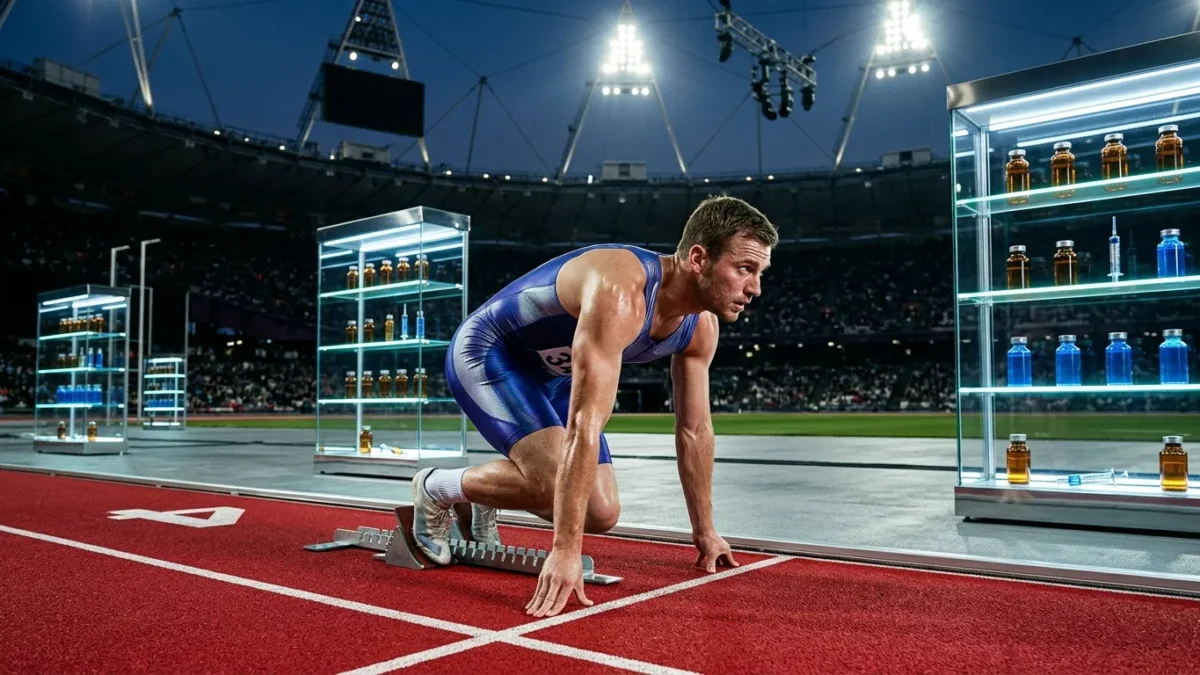
On Sunday, May 22, 2026, 42 athletes competed in the shadow of a Las Vegas casino in an event that has rattled the foundations of elite sport. Not because of a doping scandal — but because doping was the point. The Enhanced Games opened its doors with a simple, provocative premise : what if athletes could push human performance to its absolute limit, openly and legally ?
The Enhanced Games : when performance-enhancing drugs become the product
Founded by entrepreneur Aron D’Souza, a man who describes his mission as building “superhumanity,” the Enhanced Games didn’t emerge from nowhere. The event began attracting athletes shortly after the 2024 scandal involving Chinese swimmers who reportedly tested positive for banned substances before the Tokyo 2021 Olympics — yet competed anyway. That hypocrisy left a bitter taste for many competitors. Australian swimmer James Magnussen put it bluntly : he joined because, for the first time, he felt he was on a level playing field against other so-called “drug cheats.”
The financial architecture behind this venture is no small detail. Peter Thiel, the tech billionaire, and a venture fund backed by Donald Trump Jr. both invested in the project. In May 2026, it went public as the Enhanced Group, with plans to host live events and sell telehealth products, personalized testosterone, peptides and GLP-1s. The business logic is transparent : use elite athletic performances as the marketing engine for a broader performance medicine market.
Here’s what the drug protocol actually looked like for participating athletes. Those who chose to compete on PEDs — which was optional, not mandatory — followed a 12-week medically supervised trial conducted in Abu Dhabi. The approved substances fell into five categories :
- Testosterone esters and anabolic agents
- Peptides and growth factors
- Metabolic modulators
- Stimulants
- Human growth hormone
Of the 42 competing athletes, 36 enrolled in the trial. 34 of them used PEDs, and only 2 trained without. According to a clinical trial released by the Enhanced Games, 91% of doping athletes used testosterone or testosterone esters, while 79% used human growth hormone. The organizers insist this represents safe, clinically supervised enhancement — not reckless, indiscriminate doping.
The athletes who said yes — and what they risked
The competitor lineup is not made up of fringe figures. Olympic medalists such as U.S. swimmer Cody Miller, Irish swimmer Shane Ryan, British sprinter Ben Proud and American sprinter Fred Kerley all signed up. Their motivations are harder to dismiss than critics might prefer.
Shane Ryan, one of Ireland’s most decorated swimmers in history, was refreshingly direct in an interview with RTÉ Sport last fall : “I was on 18,000 euro — that’s below minimum wage for a whole year.” Cody Miller echoed this frustration, arguing that Olympic athletes have been systematically underpaid for years relative to the value they generate. The Enhanced Games dangles something the IOC never has : $250,000 for each event winner and a $1 million bonus for any world record broken. That prize structure is drawn from a promised $25 million pool.
| Prize category | Amount |
|---|---|
| Event winner | $250,000 |
| World record bonus | $1,000,000 |
| Total prize pool | $25,000,000 |
The $1 million record bonus is not hypothetical. Greek swimmer Kristian Gkolomeev already cashed it in at a private Enhanced Games event, breaking the 50-meter freestyle world record after competing on PEDs. That precedent made the event credible to skeptical athletes weighing their options.
Still, the personal costs have been real. Some athletes lost their agents after signing up. Barbadian sprinter Tristan Evelyn — an Olympian and national record holder in the 60 and 100 meters — faced immediate public condemnation from Dr. Adrian Lorde, chairman of the Barbados National Anti-Doping Commission. “We are disappointed and we advise persons not to take part,” Lorde told the Caribbean Broadcasting Corporation. The reputational stakes couldn’t be clearer.
What anti-doping bodies are really saying — and why it matters beyond sport
WADA President Witold Bańka didn’t mince words. He called the Enhanced Games “a dangerous and irresponsible concept” that sends a destructive message to young athletes worldwide who might want to replicate what they see. His statement questioned why any athlete, coach or medical professional would risk permanently tainting their reputation by associating with organized doping.
Athlete-led commissions representing both WADA and the International Olympic Committee went further in a joint condemnation, describing the promotion of performance-enhancing drugs as “a betrayal of everything that we stand for” — language that is unusually strong from bodies that typically favor measured diplomacy.
Frankly, the institutional outrage is understandable. But the Enhanced Games have exposed a tension that clean sport organizations have spent decades papering over : elite athletes are not paid fairly, the anti-doping system is inconsistently applied, and trust in clean competition was already eroded long before Sunday’s first race. When Cody Miller writes on social media that “the old rulebook is gone,” he’s not just making a provocative statement — he’s describing a credibility crisis that governing bodies helped create.
The real question the Enhanced Games force onto the table isn’t whether doping should be legal. It’s whether the current sport ecosystem can survive on promises of clean competition while athlete pay remains poverty-level and positive tests are quietly buried. That discomfort won’t disappear when the Las Vegas lights go out.
