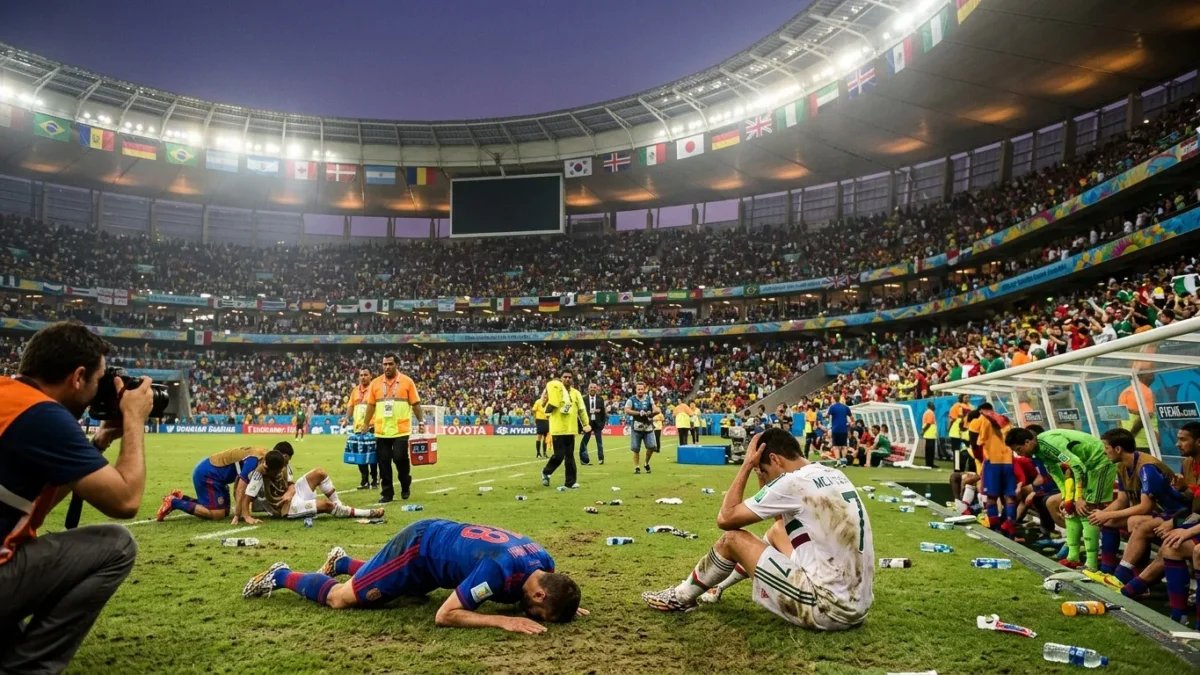
The 1982 World Cup left a stain that FIFA never forgot. West Germany beat Austria 1-0 in their final group game, a result that sent both European sides through at Algeria’s expense. The match was so suspiciously passive that it became known as the “Disgrace of Gijón.” FIFA responded by synchronising final group fixtures. A good fix, at the time. Fast forward to 2026, and a far messier structural problem is now impossible to ignore : expanding the tournament to 48 teams has created a format riddled with perverse incentives.
Why 48 never adds up in a World Cup
Thirty-two teams worked beautifully on paper. Eight groups of four, top two advance, straight into a clean knockout bracket of 16. The arithmetic was elegant. Add 16 more nations, and that elegance collapses. FIFA needed to reach a symmetrical last-32 knockout stage from an awkward starting number, and there was simply no clean way to do it.
The original proposal was blunt : 16 groups of three teams, top two from each qualify. On the surface, workable. In reality, a collusion nightmare waiting to happen. With only three teams per group, the final fixture becomes a closed equation. Both sides know exactly what result keeps them through. You cannot run those matches simultaneously in a meaningful way when there is only one game left. The ghost of Gijón looms immediately.
So FIFA pivoted. Twelve groups of four teams, same-time final fixtures, preserving at least that safeguard. But to fill a 32-team knockout bracket from 12 groups, simple maths forces an uncomfortable truth : eight of the 12 third-placed finishers must advance. That is not a side effect of the format. It is baked into its DNA. The bar to progress dropped so dramatically that, across several groups this week, finishing third is almost a formality rather than a failure.
Think about what that means for match intensity. At the 2022 World Cup in Qatar, the group stage finale was genuinely gripping because third place was a death sentence in most scenarios. Fans, players, coaches, everyone understood the stakes were binary. Win or go home. That clarity is gone in 2026. Being eliminated from the group stage now requires a specific combination of bad results that many sides can comfortably avoid by simply not losing badly.
The specific games that expose the flaw
Two fixtures this week make the structural weakness impossible to dismiss. On Thursday (03 :00 BST Friday), Australia face Paraguay in Group D. Both sides sit on three points, in second and third respectively. On Saturday (03 :00 BST Sunday), Austria meet Algeria in Group J, in an identical situation : three points each, second and third place.
Here is the cold arithmetic both sets of players understand perfectly well :
- Four points is almost certainly enough to claim one of the eight third-place qualifying spots.
- A draw gives both teams four points and a near-guaranteed passage to the last 32.
- A victory for either side offers no tangible benefit over a shared point, given the broader group standings.
- A defeat risks nothing catastrophic, but a draw risks nothing at all.
You do not need to be a cynical football observer to see what incentive structure that creates. A controlled, low-energy draw suits everyone. No one breaks the rules. No backroom deal is needed. The format itself does the work.
| Group | Teams in focus | Current points | Optimal result for both |
|---|---|---|---|
| Group D | Australia / Paraguay | 3 each | Draw (both reach 4 pts) |
| Group J | Austria / Algeria | 3 each | Draw (both reach 4 pts) |
| Group F | Japan (4 pts) / Sweden (3 pts) | 4 and 3 | Draw suits Sweden; Japan already safe |
| Group L | Ghana (4 pts) / Croatia (3 pts) | 4 and 3 | Draw enough for Croatia’s progression |
Groups F and L present a slightly different version of the same problem. Japan already hold four points, enough to qualify as a third-placed team regardless of the result against Sweden. There is zero competitive risk for Japan in that fixture. Ghana and Croatia mirror this exactly in Group L. Four groups, four matches where the competitive tension has been largely pre-solved by arithmetic.
Fixing the 48-team format before it defines the tournament
Frankly, the structural issue was flagged by analysts well before a ball was kicked at this World Cup. The expansion from 32 to 48 teams was driven by FIFA’s commercial and political logic, not by competitive design. More member associations rewarded with qualification spots, more broadcast markets activated, more revenue streams opened. The 2026 tournament generates an estimated $11 billion in commercial revenue across the United States, Canada and Mexico, according to FIFA projections. The incentive to expand was always financial, not sporting.
The 1982 lesson taught FIFA that incentive structures in group formats matter enormously. Rules alone are insufficient when the maths itself creates a safe harbour for both teams. Simultaneous kick-offs helped with four-team groups, but they cannot fix a scenario where a draw is rationally optimal for everyone involved.
One concrete adjustment worth considering : eliminate the best third-placed team mechanic entirely and return to 16 groups of three, but impose a points-difference tiebreak so aggressive that negative goal difference becomes existential. Alternatively, reduce the field back to 32. That will not happen. What could happen is pressure from broadcasters and fans forcing FIFA to restructure the tiebreak rules so that a draw carries a genuine cost in third-place qualification calculations. Until the format punishes passive football mathematically, the Gijón problem simply wears a different jersey.
