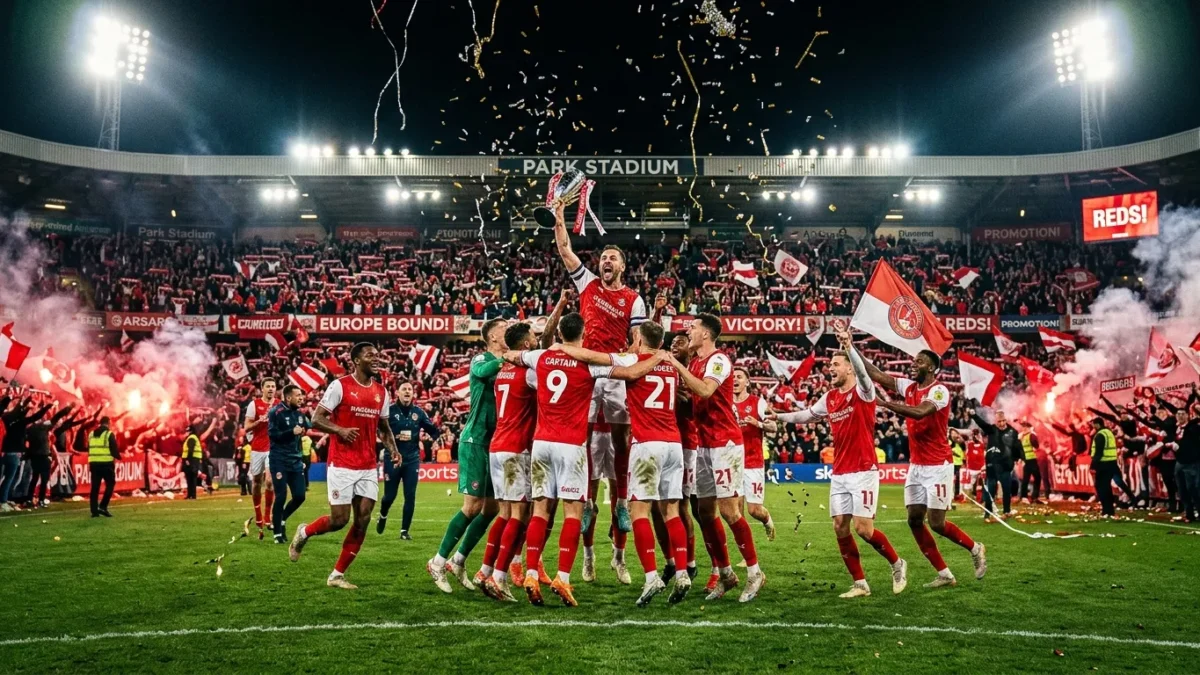
Torreense’s qualification for European football from the second tier of Portuguese football is a rare feat — but it’s far from a unique situation in the history of continental competition. Several clubs have made that same unlikely leap across Europe’s various leagues and cup competitions. What makes each story compelling is how different the path was for each of them.
Second division clubs in European competition : a real pattern
The Icelandic village club Vestri, based in a settlement of fewer than 3,000 inhabitants, will join Torreense in European qualifying next season after defeating Valur in the 2025 Icelandic Cup final. They enter the Europa League first qualifying round — a staggering achievement for a community of that size. Meanwhile, Liechtenstein’s FC Vaduz has spent most of this century competing in the Swiss second division, yet remains a regular Europa League qualifier, having won 21 of the last 22 editions of the Liechtenstein Cup. The 2025-26 season marks a change : Vaduz were crowned Swiss Challenge League champions and will return to the top flight.
These examples show that secondary league status doesn’t automatically close the door to Europe. Cup victories, fair play rankings, and unique national federation rules all create alternative pathways. Torreense’s situation fits squarely within this broader continental tradition.
Here are some of the routes through which second-tier or lower clubs have accessed European competition :
- National cup victory when the opponent already holds a European berth
- League cup success combined with top-flight relegation
- UEFA Fair Play ranking allocation
- Domestic cup win in a nation with limited top-tier clubs (e.g., Liechtenstein)
USV Eschen/Mauren took the Vaduz blueprint one step further in 2012, beating the Liechtenstein perennial cup winners while playing in the Swiss third division. They entered the Europa League first qualifying round — and lost — but the very fact they got there illustrates how elastic these qualification mechanisms can be.
From cup upsets to European nights : the English and German cases
English football produced two particularly striking examples. Millwall reached the 2004 FA Cup final, losing to Manchester United, yet still qualified for the UEFA Cup — because United were already guaranteed Champions League football. The Lions entered the first round proper, where Ferencvaros knocked them out 4-2 on aggregate. A painful exit, but a historic journey for a second-tier club.
Birmingham City’s League Cup victory over Arsenal in 2011 earned them a spot in the 2011-12 Europa League play-off round — only for the club to be relegated from the Premier League just months later. They still competed in Europe, defeating Nacional of Portugal 3-0 on aggregate before finishing third in their group with 10 points, agonizingly close to the knockout stage.
| Club | Country | Division at time | Competition | Best result |
|---|---|---|---|---|
| Millwall | England | Championship (2nd) | UEFA Cup | First round |
| Birmingham City | England | Premier League → relegated | Europa League | Group stage (3rd) |
| Wigan Athletic | England | Championship (2nd) | Europa League | Group stage (4th) |
| Alemannia Aachen | Germany | 2. Bundesliga | UEFA Cup | Last 32 |
| FC Zurich | Switzerland | Challenge League (2nd) | Europa League | Group stage |
Wigan Athletic’s story is perhaps the most dramatic of all. Roberto Martinez’s side beat Manchester City in the 2013 FA Cup final, securing European football for the first time in the club’s history — and were relegated from the Premier League days later. In the 2013-14 Europa League group stage, they managed just one win in six games, finishing bottom of a group with Rubin Kazan, Maribor, and Zulte Waregem.
Germany’s Alemannia Aachen had a far more impressive run. They lost the 2004 German Cup final to Werder Bremen, but qualified for the UEFA Cup because Bremen already had Champions League football secured. Playing from the second tier, Aachen navigated the first round and group stage before being eliminated in the last 32 by AZ Alkmaar — the Dutch side who went on to reach the semi-finals that year.
What Torreense can realistically expect from their European debut
History offers a mixed but instructive picture. FC Gueugnon of France stunned Paris Saint-Germain in the 1999-2000 League Cup final, then fell in the first round of the UEFA Cup the following season. Ipswich Town, relegated from the Premier League in 2002, actually reached the second round of the UEFA Cup via the UEFA Fair Play ranking — a route that no longer exists in its previous form. FC Zurich won the Swiss Cup in 2016 despite finishing bottom of the Super League, qualified for the Europa League group stage, and couldn’t progress past it.
Wisła Kraków and Corvinul Hunedoara of Romania have also navigated European qualifying rounds from outside their domestic top tier — proof that this phenomenon spans the entire continent, not just its wealthiest leagues.
Frankly, the early qualifying rounds of European competitions are brutal for sides with limited resources and match rhythm. Torreense will need tactical cohesion and physical readiness from the very first leg — there’s no warm-up period in knockout qualifying football. The clubs that performed best in these situations, like Aachen and Birmingham, combined tactical discipline with a clear game plan against opponents they’d thoroughly scouted. That preparation is the difference between an honourable exit and a genuine run.
