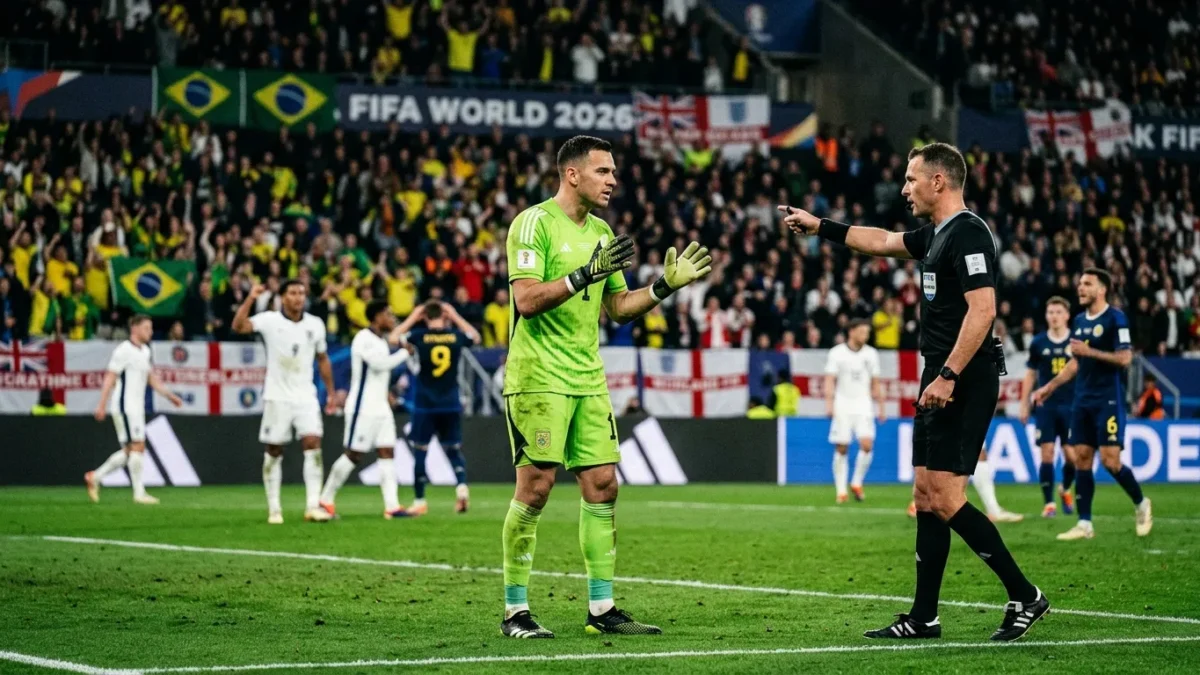
Football’s rulebook is getting a significant rewrite ahead of the 2026 World Cup. FIFA’s referees chief Pierluigi Collina has pushed through a series of changes that will reshape how matches are managed this summer — and some of them are frankly overdue.
Goalkeeper tactical timeouts are now off the table at the 2026 World Cup
One of the most discussed shifts heading into the tournament concerns goalkeepers deliberately wasting time. Tactical timeouts used by goalkeepers — those calculated pauses during set pieces, injury stoppages or dead-ball situations to disrupt the opponent’s rhythm — are now banned at the 2026 World Cup. This isn’t a minor tweak. It signals a clear intent from FIFA and the International Football Association Board (IFAB) to crack down on cynical time management that has plagued top-level football for years.
Referees will be equipped with specific data on each team’s tactical tendencies, including their approach inside the penalty area. Collina confirmed that officials will actively monitor grappling and holding during set pieces, with teams’ known patterns factored into decision-making before matches even kick off. That level of preparation is new — and it matters.
Here are the key rule changes that will apply at the 2026 World Cup :
- Goalkeeper tactical timeouts banned during active phases of play
- VAR can now review fouls that occur before the ball is in play on corners and free-kicks
- Covering the mouth during a confrontational exchange with an opponent is now a red card offense
- All changes will be reassessed after the tournament before any permanent adoption
These measures apply specifically to the World Cup and will be evaluated once the competition ends. Nothing is set in stone — but the intent is clear.
VAR gets new powers : fouls before the ball is even kicked
This is the rule change that will generate the most debate. VAR protocol previously had a blind spot : it could not review a foul that happened before a corner kick or free-kick was taken. That loophole is now closed, and the incident that triggered this change is worth knowing.
During England’s 1-1 draw against Uruguay at Wembley in March 2026, Cole Palmer delivered a corner into the area. Before the ball was even kicked, midfielder Adam Wharton blocked the run of José María Giménez, preventing the Uruguayan defender from tracking his man. The ball ran through to Harvey Barnes, whose shot was saved by Fernando Muslera, and Ben White tapped in from close range. The goal stood. Under the old protocol, VAR had no grounds to intervene — because the foul occurred before the corner was taken.
| Situation | Old VAR protocol | New VAR protocol (2026) |
|---|---|---|
| Foul before corner kick | Not reviewable | Reviewable if it directly impacts the outcome |
| Foul before free-kick | Not reviewable | Reviewable for goals, penalties or red cards |
| Defensive holding inside box | Case by case | Monitored with pre-match team data |
Collina was direct about his position : “We think this is very unfair, that the goal is given when the defender is prevented from being able to defend.” He described Wharton’s block as a clear, illegal move with a single purpose — stopping Giménez from doing his job. IFAB accepted the request, and the new rule states that any foul before the ball is in play that directly impacts a goal, a penalty, or a disciplinary decision can now be reviewed by VAR.
One important nuance : this applies exclusively to attacking fouls. Defensive holding or pulling inside the area during the same phase is treated separately. That distinction is deliberate — the focus here is on attackers illegally removing defensive cover before set pieces even begin.
Red card for covering your mouth : what the Prestianni-Vinicius incident changed
Covering your mouth with a hand, arm or shirt while speaking to an opponent now carries the risk of a straight red card. That’s a significant escalation, and it traces back to one specific moment from the 2025-26 Champions League season.
In February 2026, Gianluca Prestianni, Benfica’s winger, covered his mouth while in a confrontational exchange with Vinicius Jr of Real Madrid. UEFA subsequently handed Prestianni a six-game ban for homophobic conduct. The incident sparked an immediate conversation about how referees should handle similar situations on the pitch, in real time, without waiting for post-match investigations.
Collina drew a clear line between two scenarios. Friendly conversations between players where one covers their mouth — say, to pass on a tactical instruction without being lip-read — remain perfectly acceptable. The red card only applies when the exchange is confrontational. As Collina put it : “When the conversation is confrontational, covering the mouth means that you are doing something very wrong, potentially.”
Referees will now need to read body language and context on the spot. That’s a demanding ask, but the alternative — doing nothing while potential abuse goes unpunished during the match — is worse. For a tournament watched by an estimated 5 billion people across 104 matches, setting a firm standard here sends a message well beyond the pitch.
Whether this new framework survives contact with the intensity of a knockout-stage World Cup match remains to be seen. But frankly, the direction of travel is right — more accountability, fewer loopholes, and referees armed with better tools to make the calls that actually matter.
