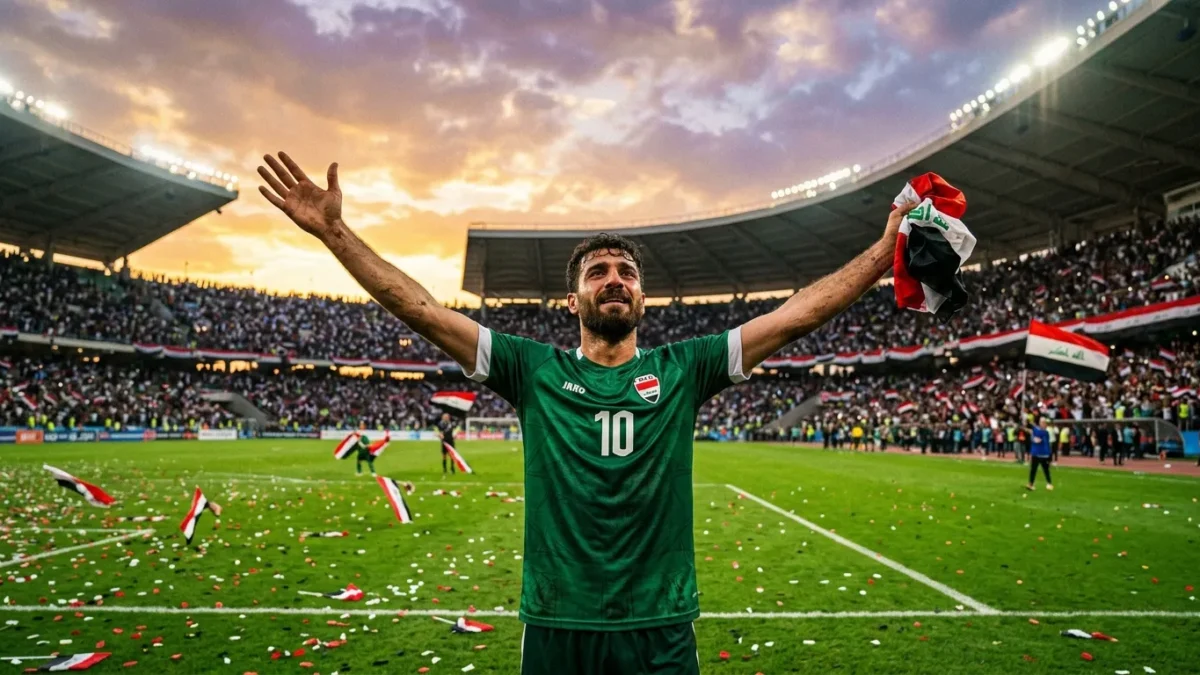
Forty years. That’s how long Iraq waited to return to football’s biggest stage. The Lions of Mesopotamia qualified for the 2026 World Cup by defeating Bolivia in Mexico — the very country where their first-ever World Cup appearance took place back in 1986. The symmetry is almost poetic.
A 40-year road back to the World Cup finals
In 1986, Iraq lost all three group-stage matches against Paraguay, Belgium and hosts Mexico. Karim Allawi was part of that squad, stepping onto the pitch as a player in his prime. Now 66 years old, he watches from the stands as a fan, carrying four decades of hope on his shoulders. “This is truly a group of death and tougher than 1986,” he told BBC Sport. “France are multiple-time world champions, Norway are one of the strongest developing European teams, and Senegal are African champions who have qualified for the World Cup several times.”
The path back wasn’t straightforward. Iraq navigated 21 qualifying matches across the third and fourth rounds of Asian qualification, plus a tense play-off victory against the United Arab Emirates, before that decisive win over Bolivia sealed their place at the finals. Qualification campaigns rarely come harder than that.
Iraq kicks off their tournament on 16 June against Norway in Boston — Erling Haaland’s side being arguably the most physically imposing team in the group. With France and Senegal also waiting, Allawi’s assessment carries real weight. Yet across Iraq’s 46 million football-passionate population, the mood is one of defiant optimism rather than quiet resignation. Expectations are grounded, but belief runs deep.
From European clubs to the Iraqi national squad
The 2026 version of this Iraq side looks nothing like the 1986 team. Ranked 57th in the world, the squad is packed with players forged in European competition — a far cry from the regionally-focused group that took the field in Mexico four decades ago.
| Player | Club | Country |
|---|---|---|
| Ali Al-Hamadi | Ipswich Town | England |
| Zidane Iqbal | Utrecht | Netherlands |
| Kevin Yakob | AGF | Denmark |
Kevin Yakob finished the 2025–26 season as a Danish champion with AGF. Zidane Iqbal, formerly on Manchester United’s books, now brings consistent Eredivisie experience to the midfield engine room. Ali Al-Hamadi has sharpened his game in the Championship with Ipswich Town. These aren’t fringe players accumulating caps — they are performers tested at a meaningful European level.
This depth of experience changes the conversation entirely. Iraq don’t arrive in the United States simply to make up the numbers. The squad carries genuine technical quality, and the players themselves understand that the expectations of an entire nation rest on their performances.
Graham Arnold’s impact on Iraq’s qualification campaign
When Iraq appointed Graham Arnold as head coach in 2025, the decision raised eyebrows internationally. Some questioned whether the 62-year-old Australian had the profile to manage a Middle Eastern programme with World Cup ambitions. The results answered that debate firmly.
Arnold is no stranger to high-pressure tournament football. He guided Australia through to the second round of the 2022 World Cup in Qatar, famously knocking out Denmark and pushing eventual finalists Argentina to a penalty shootout in the round of 16. That experience — managing a team punching above its weight on the grandest stage — translates directly to Iraq’s situation.
His influence on the qualification campaign was tangible. Here’s what Arnold delivered across the campaign :
- Steady tactical organisation through the demanding third and fourth qualification rounds
- A nervy but ultimately successful play-off win against the UAE
- A composed performance against Bolivia to clinch the final spot
- A squad culture built on European-style professionalism and collective discipline
TV sports reporter Nawar Faeq Al-Rikabi made a sharp comparison when speaking to the BBC : “In 2022, Argentina found it very hard to win against Australia. It will be the same with us.” That’s not blind patriotism — it’s a calculated read of Arnold’s tactical DNA. He builds teams that are difficult to beat, organised, compact and dangerous on the counter.
What Iraq genuinely needs to achieve at the 2026 World Cup
Strip away the emotion and the targets become clear. Allawi put it plainly : “To score more than one goal would be a new achievement, to win a game would be a great achievement, to qualify for the next stage would be terrific.” Iraq failed to score a single goal across their three 1986 group games. Any goal at this World Cup makes history.
Al-Rikabi added a perspective worth sitting with : “People may think we are the weakest team in the group, but anything could happen. There is no pressure on the Iraqi players — they just have to perform.” That mindset, free of expectation yet hungry for achievement, has historically produced upsets at World Cups. South Korea in 2002. Senegal in 2002. Morocco in 2022.
Iraq’s group opponents — Norway, France, Senegal — will not underestimate a side with this much European pedigree in the squad. And frankly, they shouldn’t. Arnold’s track record suggests Iraq will be organised, hard to break down, and capable of exposing defensive lapses at pace. The 46 million people watching at home on 16 June deserve at least that.
