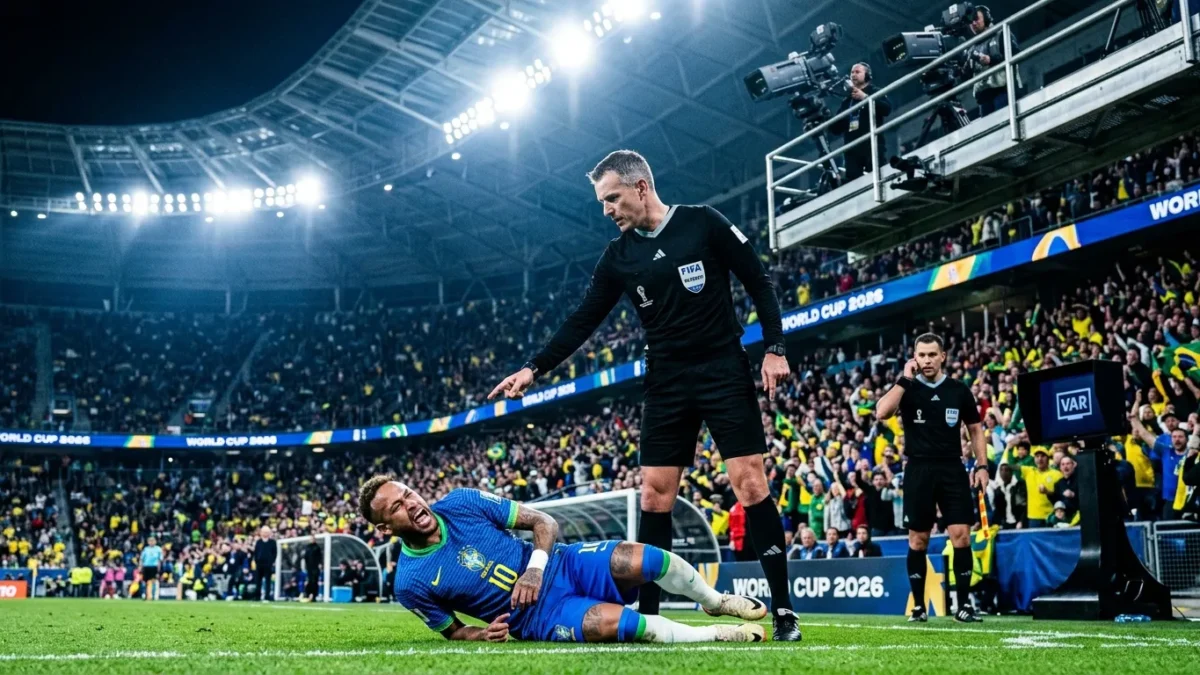
The hydration break rule at the 2026 World Cup arrived quietly. FIFA announced mandatory three-minute stoppages back in December 2025, framing them as a player welfare measure. Almost nobody paid attention. Now, halfway through the opening round of matches, those breaks are generating far more debate than the VAR diving decisions everyone expected to dominate the headlines.
Three minutes that change everything on the pitch
Former England defender Phil Jagielka put it bluntly : “It’s literally play for 25 minutes and stop for a bit.” His reaction captures the discomfort many feel about a rule that effectively divides matches into quarters. Three of the four opening games were played at temperatures just above 20°C, which makes the “welfare” justification hard to defend with a straight face.
USA head coach Mauricio Pochettino didn’t hide his scepticism before his side’s 4-1 demolition of Paraguay in Los Angeles. “I don’t like it,” he said plainly. “I only like it when the conditions are extreme. When the conditions are good, it is unnecessary.” Canada’s draw with Bosnia in Toronto was played at 26°C in the afternoon heat, arguably the warmest scenario so far. Even then, that figure is unremarkable by summer football standards.
Graham Potter, now head coach of Sweden ahead of their opening Group B fixture against Tunisia in Monterrey, lived through a near-identical situation in Chicago in July 2024. West Ham faced Bournemouth in the Premier League Summer Series at comparable temperatures, and Potter emerged for the second half wearing a jumper. His verdict at the time : “I have no idea why there was a water break. I assumed there wasn’t going to be one.” Not exactly a ringing endorsement of the system.
| Match | Location | Temperature (°C) |
|---|---|---|
| Mexico vs South Africa | Dallas | ~21°C |
| Canada vs Bosnia | Toronto | 26°C |
| USA vs Paraguay | Los Angeles | ~22°C |
Jagielka’s reading of the tactical dimension is sharp, though. He argues that those three minutes might actually matter more than the half-time interval. “If your team isn’t doing well and it’s a loud stadium, it’s nigh on impossible to get messages on,” he said. A coach who spots a structural problem at the 23-minute mark can now intervene directly, gather the squad, and redirect the pressing pattern or defensive shape before the damage compounds. That’s a significant shift in how the game is managed.
VAR, diving calls and the commercial elephant in the room
The hydration break controversy would be cleaner if money wasn’t sitting awkwardly in the middle of it. Broadcasters, particularly US network Fox, have been using the stoppages to run advertisements. Fox drew direct criticism after failing to return to live coverage before Mexico vs South Africa restarted. Whether FIFA designed the breaks partly with broadcast revenue in mind is a question the governing body hasn’t answered directly.
IFAB regulations do allow coaches to use electronic devices during the breaks, provided the device is “small” and used for tactical or welfare purposes. That’s a deliberately loose standard. In practice, it means assistants can relay real-time data, heat maps, and pressing stats directly to the manager mid-game. The line between a hydration stop and a structured tactical timeout is becoming very thin.
- Coaches can deliver direct tactical instructions to the full squad
- Electronic devices are permitted for coaching purposes under IFAB rules
- Broadcasters fill the gap with commercial breaks
- Fox was criticised for missing the restart of Mexico vs South Africa
- The break lasts three minutes regardless of weather conditions
The timing matters here. Jagielka’s point about underperforming teams is particularly sharp : “You could literally turn a game around in that break.” A manager who identifies a specific mismatch, say a winger being isolated or a midfielder getting bypassed repeatedly, can fix it in those 180 seconds with a clarity that no shouted touchline instruction can match. Half-time offers more time but less urgency. The hydration break hits differently when your team is a goal down at the 25-minute mark.
On the VAR diving decisions that the tournament was supposed to revolve around, the picture is murkier. The new rule framework promised stricter enforcement of simulation, with VAR empowered to review and punish dives retrospectively during the match. The problem is consistency. What reads as a clear dive from one camera angle looks like a legitimate contact claim from another. Referees are leaning on the technology, but the three-minute stoppage structure is actually compressing the timeframes in which VAR can intervene cleanly between phases of play.
Why coaches should treat these breaks as a competitive weapon
Stop thinking about hydration breaks as an interruption. Start treating them as the most underused tactical resource at this World Cup. Pochettino might dislike the rule, but his staff spent those three minutes against Paraguay resetting the press trigger lines. The result : a 4-1 win. Correlation isn’t causation, but coaches who dismiss the breaks as unnecessary clutter are leaving something real on the table.
Jagielka’s one-minute counter-proposal deserves serious consideration. If player welfare is genuinely the priority, a 60-second water distribution is physiologically sufficient in mild conditions. Stretching it to three minutes only makes sense if you accept that tactical coaching value and broadcast scheduling are part of the calculation. FIFA hasn’t admitted that yet, but the evidence from the opening fixtures is already stacking up. The next step is for coaches like Potter and Pochettino to stop lamenting the rule and start building it deliberately into their in-game management strategy before their opponents do it first.
