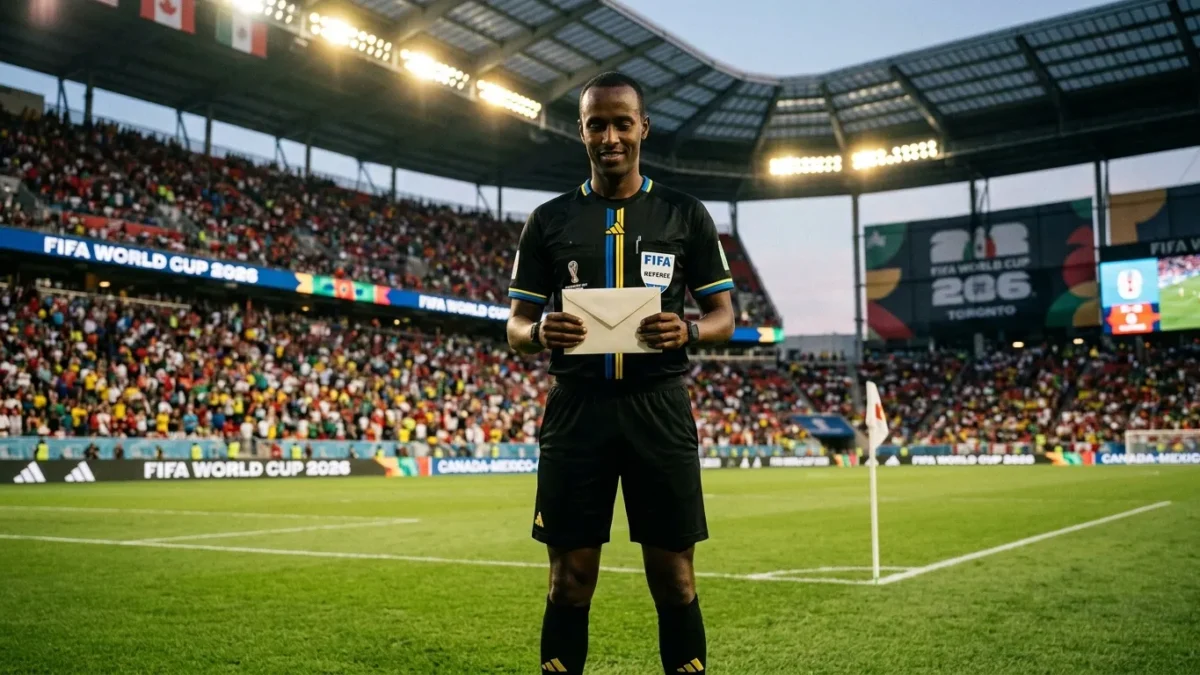
Omar Artan will not set foot on a World Cup pitch in 2026. Yet FIFA has confirmed it will pay him his full tournament fee, as if he had officiated every match assigned to him. This decision, rare and striking, puts the spotlight on a case that goes far beyond football.
Eleven hours of interrogation, then a flight back to Mogadishu
On Monday June 9, Omar Artan landed at Miami International Airport with everything required : a diplomatic passport and a valid single-entry US visa. What followed was an ordeal that lasted 11 hours. US immigration authorities interrogated the Somali referee extensively before informing him he would be denied entry into the country.
The stated reason was blunt. A US government official cited an alleged association with suspected members of terror organisations. Artan himself confirmed he was questioned specifically about his supposed links to Al Shabaab, the Somali militant group. His response was equally direct : he told border officials he had no knowledge of the organisation whatsoever.
“I had the right papers and everything. I had the right visa,” Artan said. “I’m just simply a referee who’s trying to live his dream, the biggest dream of my life, to come to the World Cup.” These words carry real weight. This was not a tourist or a casual traveller. This was a football official selected by FIFA to work the biggest sporting event on the planet.
After the lengthy interrogation, Artan was put back on a plane to Turkey. FIFA officials based in Istanbul stepped in to assist him before he boarded a connecting flight to Mogadishu. The organisation’s involvement at that stage was swift and practical. What came next, though, was the decision that truly set this case apart.
FIFA’s financial commitment : paying a referee who never blew a whistle
According to sources cited by BBC Sport, FIFA has committed to paying Omar Artan his full tournament salary, despite the fact he will play no part in the 2026 World Cup. This is not a symbolic gesture. It is a concrete financial decision with real implications for how football’s governing body handles situations beyond its control.
It is worth understanding how referee pay works at the World Cup :
- Referees are not informed of their exact fee before or during the tournament.
- Payment is made after the competition ends.
- The amount depends on the level of officiating involvement, though in this case FIFA has waived that condition entirely.
The fact that Artan receives the full fee without officiating a single game is significant. It signals that FIFA considers his exclusion from US territory to be entirely outside his responsibility. The organisation is, in effect, absorbing the cost of a political and administrative decision made by US border authorities.
| Detail | Information |
|---|---|
| Referee | Omar Artan (Somalia) |
| Entry denied at | Miami International Airport |
| Duration of interrogation | 11 hours |
| Reason given by US authorities | Alleged association with terror suspects |
| FIFA’s financial decision | Full tournament fee to be paid |
| Artan’s return destination | Mogadishu, via Istanbul |
From a governance standpoint, this is the right call. Artan was selected through FIFA’s standard vetting process. He arrived with valid documentation. Denying him entry was a unilateral act by US immigration, not a reflection of any failure on his part. Holding him financially accountable for that would have been deeply unjust.
What this case reveals about football, politics, and the 2026 World Cup
The 2026 FIFA World Cup is co-hosted by the United States, Canada, and Mexico. Sixty-four matches are scheduled across 16 host cities, with the majority played on US soil. That means any official, player, or delegate from a country with complicated relations with Washington faces a real risk of access issues. Artan’s case is the most visible example so far, but it is unlikely to be the only one.
Frankly, this situation exposes a structural tension that FIFA failed to fully anticipate when awarding hosting rights to the US in 2018. Diplomatic and immigration barriers can directly affect sporting operations, and football’s governing body now has a live case study to manage in real time.
Artan described the World Cup as “the biggest dream of my life.” That phrase matters. Referees at this level spend years building towards a tournament like this. The selection process is rigorous. Being told, after 11 hours of questioning, that you cannot enter the host country is not just an administrative setback. It is a personal and professional blow that no fee can fully compensate.
What FIFA should consider going forward is establishing a formal protocol for officials who face entry refusal. This could include pre-tournament visa verification, direct diplomatic liaison with host country immigration services, and a clear compensation framework. Paying Artan his full fee is a strong first step, but the sport needs clearer rules for when politics collides with the pitch. The 2026 World Cup has just handed FIFA its most compelling argument yet for that reform.
