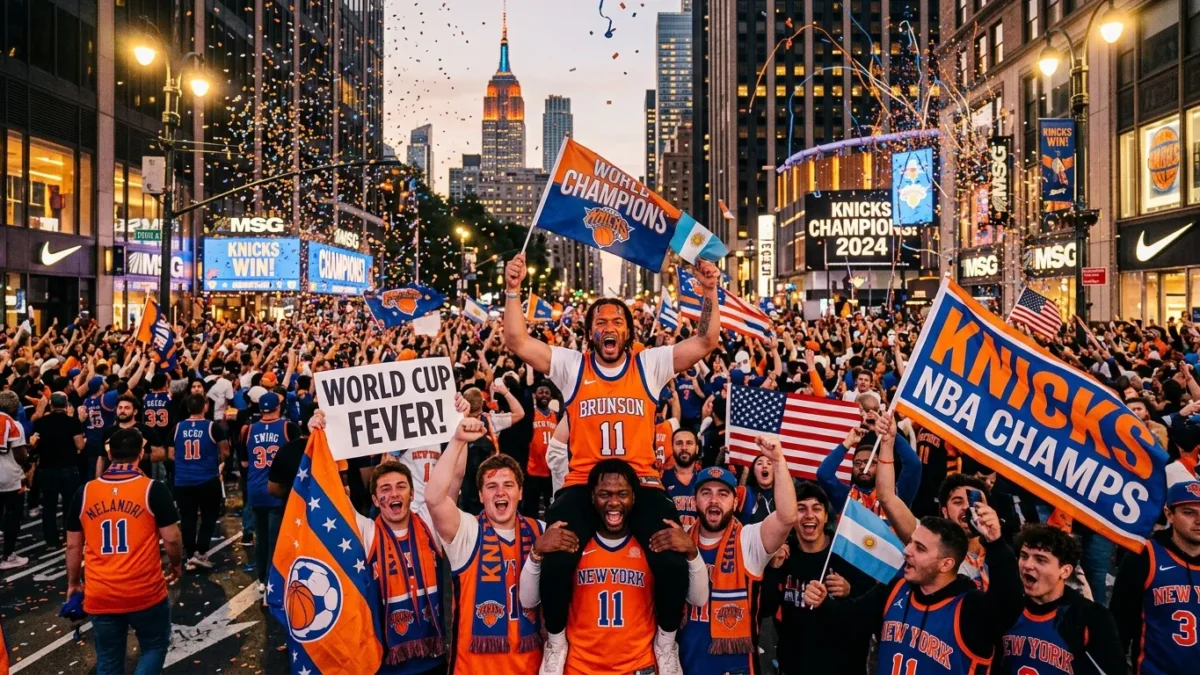
Saturday night in New York will go down as one of the most charged moments in the city’s sporting memory. The New York Knicks clinched their first NBA championship in 53 years, defeating the San Antonio Spurs 4-1 in the best-of-seven series, and the streets around Madison Square Garden erupted in a way no one had seen in decades. The timing was extraordinary : fewer than 10 miles away, Brazil and Morocco were meeting in a FIFA World Cup match, yet all eyes were fixed on the hardwood.
A city gripped by basketball, not football
New York is co-hosting the 2026 FIFA World Cup, and by any measure it should have dominated the city’s attention on June 14. It didn’t. Thousands of Knicks fans flooded the area around Madison Square Garden for an outdoor watch party, even though Game 5 was played in Texas. Bars overflowed. Strangers argued over every call. The World Cup, playing out just a few miles away, barely registered.
Raymond Yu, a lifelong Knicks supporter, put it bluntly to the BBC : “We care way more about the Knicks than the World Cup right now.” That single quote captured the mood of an entire borough. New York has historically maintained a stronger connection to football (soccer) than most American cities, largely because of its extraordinarily diverse immigrant communities. Yet on this particular night, none of that mattered.
The contrast between the two events happening simultaneously in the same city tells you something important about how sports loyalty actually works. It isn’t about geography or civic duty. It’s about a shared wound finally healing. The Knicks hadn’t won a title since 1973, and that weight had pressed on generations of fans for over half a century.
| Event | Location | Date | New York connection |
|---|---|---|---|
| NBA Finals Game 5 (Knicks vs Spurs) | Texas | June 14, 2026 | Watch parties across Manhattan |
| FIFA World Cup Group stage (Brazil vs Morocco) | New York area | June 14, 2026 | Co-host city, game played locally |
Madison Square Garden, long nicknamed “the mecca of basketball”, became the symbolic epicenter of the celebration even without hosting the game itself. That detail matters. Fans didn’t need the physical arena to feel the pull. They needed each other.
From the Molly Wee Pub to the streets : scenes of pure release
Inside the Molly Wee Pub, as a Knicks victory began to look inevitable, a young college student turned to his friends with disbelief written across his face : “Oh my god, I’m going to see the Knicks win the Finals. I can’t believe it.” The moment the final result was confirmed, the bar emptied into the street. Screaming, embracing strangers, euphoria in its rawest form.
The celebrations stretched well past midnight. What followed in the streets around the Garden was equal parts joy and controlled chaos :
- Fans climbed light poles despite police presence on foot and horseback
- Fireworks went off spontaneously in multiple neighborhoods
- Crowds spilled from bars onto sidewalks across Midtown Manhattan
- NYPD officers worked to contain the energy without escalating tensions
Matthew Sorbonne was among the thousands celebrating. His words to BBC Sport cut straight to the heart of what the night meant : “I watched them since I was a kid. This means everything to me. For 25 straight years they’ve been garbage. Finally we have a win.” Twenty-five years of frustration, condensed into one sentence. That’s not hyperbole. Between 2001 and 2025, the Knicks never advanced past the second round of the playoffs.
The generational dimension of this championship cannot be overstated. Many fans in those streets had never watched a Knicks title run in real time. Their parents had. Some of their grandparents had been in the building in 1973 when Walt Frazier and Willis Reed last lifted the trophy. For them, Saturday night was genuinely historic, not just in a casual sports sense, but in a deeply personal one.
What this Knicks title means beyond the confetti
Winning an NBA championship after 53 years changes a franchise’s identity permanently. The Knicks have spent decades as the league’s most high-profile underachievers, a team with one of the most valuable brands in professional sports (Forbes valued the franchise at approximately $7.5 billion in 2025) yet chronically unable to translate that market size into success on the court.
This title resets that narrative entirely. New York can now compete for free agents on the basis of legacy, not just finances. The psychological shift inside the locker room, inside the front office, and across the fanbase will compound over years. Championships attract talent. Talent attracts more championships.
For the city itself, the timing creates a fascinating cultural moment. The World Cup brought the planet’s most popular sport to New York’s doorstep in June 2026, yet it was basketball that stopped the city cold. That says something genuine about identity, about which stories a place tells itself when the stakes feel highest.
The World Cup will resume, and New York will play its part as a host city with real enthusiasm. But for anyone present on June 14, 2026, the memory that will last isn’t a goal scored nearby. It’s the roar that rose above Seventh Avenue when 53 years of waiting finally ended. The Knicks are NBA champions, and New York, for one electric night, belonged entirely to basketball.
