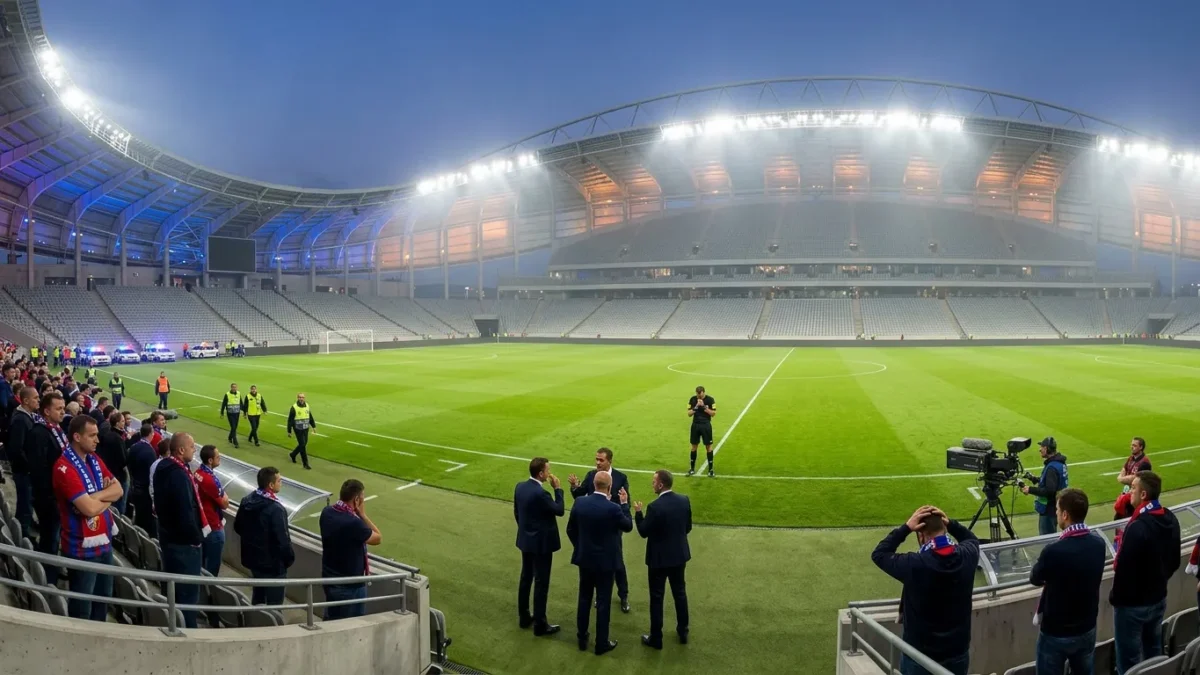
Ninety seconds. That’s how much time Haiti and Scotland lost before their World Cup 2026 opener even began. The Haitian squad wasn’t ready when the tunnel marshal called them, and a FIFA official was caught on the match feed visibly rushing the players along. It’s a small delay in absolute terms, but in the hyper-organized world of international football, it speaks to a much bigger challenge.
The exact science behind World Cup kickoff schedules
Most fans assume the referee blows the whistle at the listed time and that’s the end of it. Reality is considerably more complex. FIFA plans every pre-match minute with surgical precision, producing a dedicated running order for each fixture. This document, distributed to accredited media, specifies not just the kickoff time but every micro-event leading up to it.
Here’s what a typical matchday running order covers :
- The exact moment teams must assemble in the tunnel
- When players and match officials step onto the pitch
- The precise timing for national anthems
- Sponsor activations and ceremonial moments before the first whistle
For the Haiti vs. Scotland match, the running order specified that both sides should enter the field exactly 8 minutes and 40 seconds before kickoff. That’s not an approximation. That’s a hard deadline written into the official document. When the Haitian players weren’t in position at that moment, the entire sequence shifted.
Why does FIFA go to this level of detail ? Partly discipline, partly commerce. Broadcasters who air commercial breaks between pre-match segments rely on these timings to avoid cutting away during a national anthem or missing the team walk-out. A 90-second drift may sound trivial, but it can force a network to make split-second editorial decisions live on air, in front of audiences sometimes exceeding 20 million viewers per game.
| Pre-match stage | Typical timing before kickoff | Who is affected by delays |
|---|---|---|
| Teams assemble in tunnel | ~10 minutes | Match officials, FIFA staff |
| Teams walk onto the pitch | 8 min 40 sec (Haiti vs. Scotland) | Broadcasters, sponsors |
| National anthems played | ~6-7 minutes | TV networks, live audiences |
| Kickoff | 0 :00 | Everyone |
When players aren’t ready : what really happens on matchday
The Haiti-Scotland case wasn’t a dramatic crisis, but it was exactly the kind of friction FIFA obsesses over eliminating. Match footage showed Haitian players still in the dressing room corridor when the scheduled tunnel moment arrived. A FIFA official, clipboard likely in hand, was seen gesturing urgently. By the time both squads walked out together, the delay had accumulated to 90 seconds.
That gap matters more than it looks. Live broadcast timings are locked in hours before kickoff. Networks program commercial slots around the pre-match sequence, and a minute and a half of unexpected dead time creates a genuine production headache. Some broadcasters end up filling with studio chat or replay packages. Others simply miss the walk-out entirely, cutting back to find players already lined up.
From a sporting perspective, the delay itself rarely affects the game. But the organizational embarrassment is real. FIFA invests enormous resources into presenting the World Cup as a flawlessly run event. Every unprompted tunnel rush caught on camera chips slightly at that image.
It’s worth noting that this type of delay is flagged internally as an area for improvement. FIFA’s event management teams conduct detailed post-match reviews, and even minor timing slippages end up documented. The organization doesn’t publicly criticize national teams for this kind of issue, but the expectation is that it gets corrected across future games in the same tournament.
What FIFA and broadcasters should do differently going forward
Frankly, the current system puts too much trust in informal communication. A FIFA official rushing players through a corridor is not a robust protocol. Teams should receive mandatory tunnel call times at least 15 minutes before the scheduled walk-out, with a second formal notification five minutes prior. Relying on a single cue, especially with squads that may speak different languages and operate under different cultural attitudes toward timekeeping, is a structural weakness.
Broadcasters, for their part, could build slightly more buffer into their commercial scheduling around the pre-match sequence. A 60-second flex window costs almost nothing in airtime value but would absorb the kind of delay Haiti triggered without any visible disruption.
There’s also a broader conversation to have about how national teams prepare for tournament logistics, not just tactics. Arriving at a World Cup means operating inside FIFA’s machinery, and that machine runs on very precise timing. Staff at national federations who have never managed a tournament of this scale can genuinely underestimate how rigid the schedule is. Some teams bring dedicated logistics coordinators to handle exactly this; others don’t. That gap in preparation shows up in moments like the Haiti-Scotland delay, small on screen, significant in the operational record.
