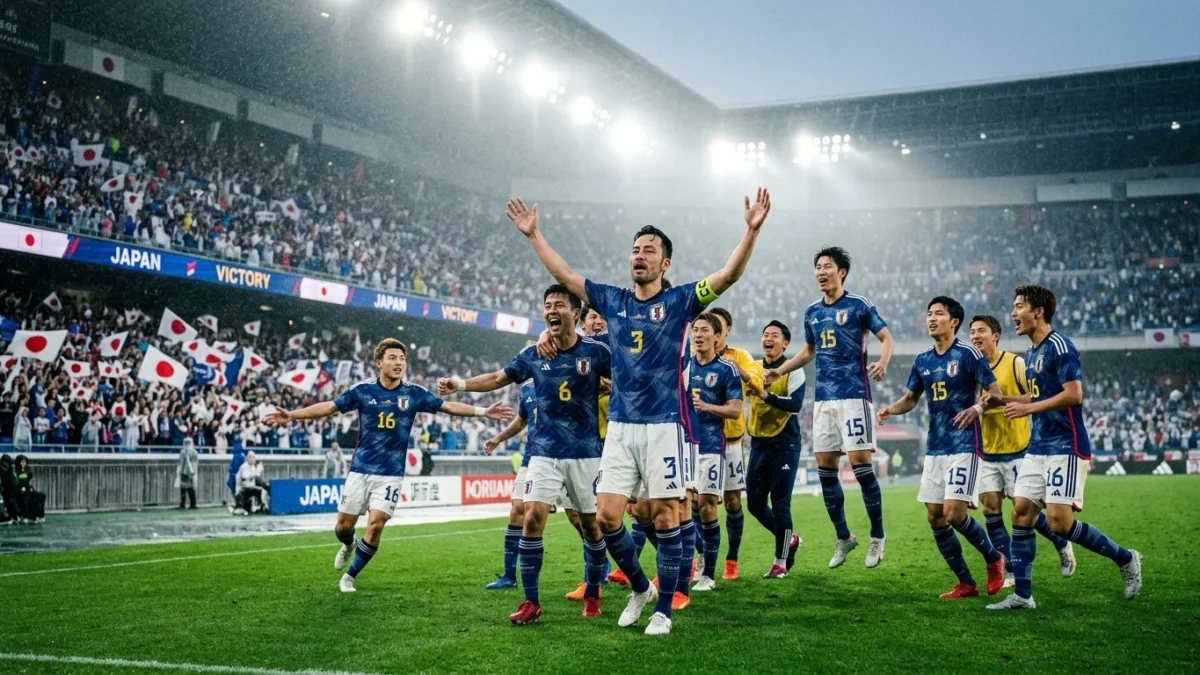
Japan finished their World Cup 2026 qualifying campaign as the first non-host nation to clinch a spot at this summer’s tournament. Not with a narrow escape, not with last-minute drama, but with a near-flawless run through Asian qualification. That kind of dominance doesn’t happen by accident, and frankly, anyone still writing off the Samurai Blue as a lightweight contender hasn’t been paying close attention.
A squad built on European experience
The transformation of Japanese football over the past decade is remarkable when you look at the numbers. Maya Yoshida, capped 127 times for his country and one of the most respected voices in the squad, put it bluntly : the daily grind of competing in Europe’s elite leagues has fundamentally changed what Japanese players are capable of. When you face a Champions League defender on a Tuesday and a World Cup rival on a Saturday, your level rises whether you like it or not.
Yoshida himself started at VVV Venlo, a club battling at the bottom of the Dutch league. He admits it openly. That modest first step, which served him well at the time, is now the exception rather than the rule for Japanese internationals. Today’s generation lands directly in the deep end : top-flight football in the toughest competitions in the world. Players like Daichi Kamada of Crystal Palace and Ao Tanaka of Leeds United train and compete at the highest level week in, week out.
Here’s what that European pipeline looks like in practice :
- Daichi Kamada, Crystal Palace (Premier League)
- Ao Tanaka, Leeds United (Premier League)
- Multiple squad members active in Germany’s Bundesliga and other top-five European leagues
- A generation where weekly opposition includes World Cup-level players as standard
Yoshida also made a point that often gets glossed over in these conversations : none of this started with the current generation. Hidetoshi Nakata, Shunsuke Nakamura, Shinji Ono, those were the pioneers who forced European clubs to take Japanese football seriously in the first place. They opened the door. Today’s players walked through it, and now that door is wide open.
Results that demand respect from World Cup favorites
Since their round-of-16 exit at Qatar 2022, Japan have beaten England, Germany and Brazil. Read that again. Three of the most storied footballing nations on the planet, and Japan defeated all three in competitive or high-profile friendly fixtures. If a European side had that record, we’d be talking about them as genuine contenders. Japan deserves the same conversation.
| Opponent | FIFA ranking (approx.) | Result for Japan |
|---|---|---|
| England | Top 5 | Win |
| Germany | Top 15 | Win |
| Brazil | Top 5 | Win |
Coach Hajime Moriyasu, 57 years old and entering the tournament with clear ambitions, told World Soccer Magazine before the competition : “My goal is for the team to be one of the best of the best.” That’s not a vague motivational quote. Moriyasu built a qualifying campaign around that target and delivered a squad that backed it up with results on the pitch.
One detail Moriyasu highlighted stands out : 19 of the 26 players who featured at Qatar 2022 were at their first World Cup. That same core group then drove the Asian qualifying campaign for 2026. They didn’t just survive a major tournament and retreat. They used it as a springboard, kept the ambition burning, and aimed higher from day one of the next cycle. That kind of mentality is what separates squads that peak early from those that grow into contenders.
Moriyasu also addressed injury concerns directly, refusing to use them as an excuse : “We do have a lot of injuries, but we have also proven that we have the squad to produce our best regardless of who plays.” That squad depth, built on a wide European base, is precisely what makes Japan dangerous in a tournament format where attrition and rotation matter enormously.
Why Japan could genuinely trouble the top seeds in 2026
Forget the dark horse label for a moment. Labels like that often carry a hint of condescension, as if we’re surprised that a non-European, non-South American side can compete. Japan’s trajectory over the past four years isn’t a fluke or a lucky run of results. It’s a structural shift in how Japanese players develop and compete at the highest level.
The mental framework matters too. Moriyasu built a squad that, from the very start of qualifying, had winning the World Cup as a stated goal, not a private dream but an open target. That kind of psychological boldness, combined with real technical quality forged in Europe’s top five leagues, produces sides that don’t freeze under pressure against elite opponents.
My honest read : Japan in 2026 is not just a feel-good story. If you’re building a bracket and assuming they’ll fold in the knockout rounds, you’re making the same mistake analysts made at Qatar 2022, right before Japan knocked Germany out of the group stage. The Samurai Blue thrive when they’re underestimated. The smart move this summer is to stop giving them that advantage entirely.
