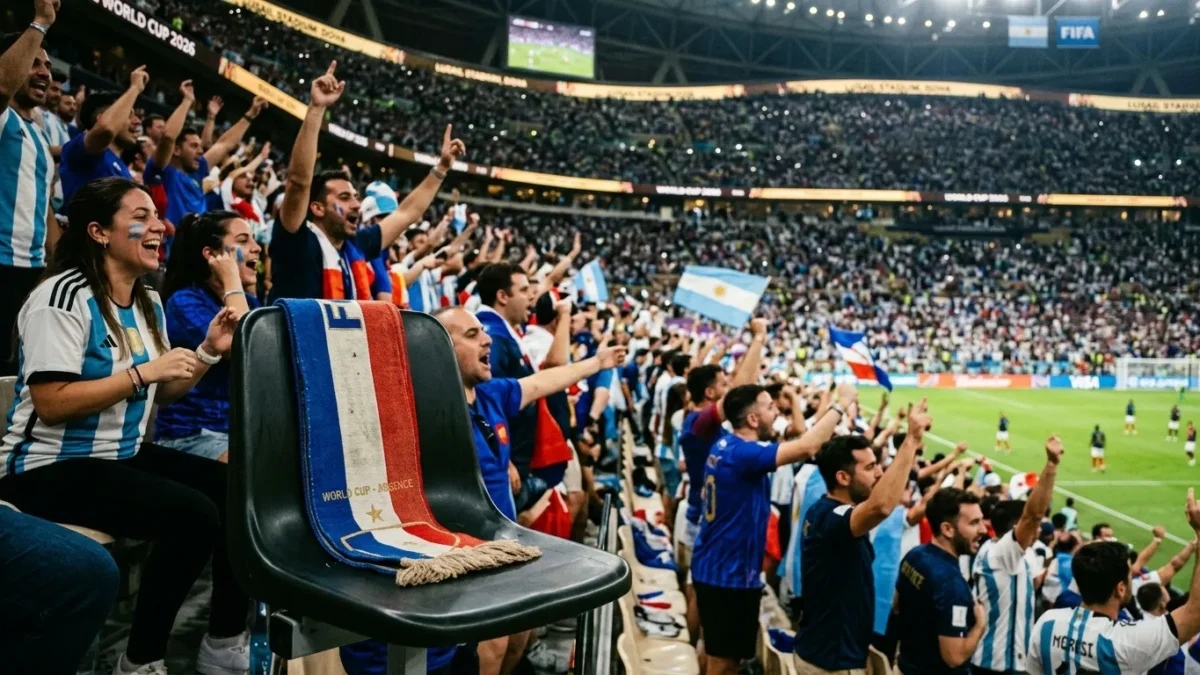
A symbolic empty chair. At the 2026 World Cup, that gesture carries more weight than any goal celebration. French sports journalist Said Mekbel, wait, the man at the center of this story is Lamine Gleizes, a French reporter currently behind bars in Algeria while football’s biggest tournament unfolds without him.
A journalist imprisoned for doing his job
Lamine Gleizes was arrested in May 2024 after travelling to Algeria to cover a story about Jeunesse Sportive de Kabylie (JSK), a football club based in Tizi Ouzou. What began as a routine sports assignment turned into a legal nightmare. Algerian authorities convicted him on charges related to having exchanges with an advocate of self-determination for the Kabyle minority, a group seeking greater autonomy in the Kabylie region.
The case immediately drew fierce condemnation from the French press. Around 40 French media organizations issued a joint statement following his sentencing, declaring that “the imprisonment of a journalist for carrying out his profession is a red line that must never be crossed.” That phrase landed hard. It was not a diplomatic formulation; it was a direct challenge to a government that locked up a man for asking questions.
Gleizes has now been held for over two years. His family waits. His colleagues cover for him. And meanwhile, a World Cup is being played.
| Key fact | Detail |
|---|---|
| Date of arrest | May 2024 |
| Reason for travel to Algeria | Reporting on football club JSK (Tizi Ouzou) |
| Conviction basis | Contact with a Kabyle self-determination advocate |
| French media outlets in solidarity | Approximately 40 |
An empty seat that speaks louder than words
The French football federation and media have chosen a visible act of solidarity over silence. At every France press conference during this World Cup, one chair remains unoccupied, specifically reserved for Gleizes. The same applies in the press box : a seat sits empty, a constant reminder that a colleague is missing not because of illness or logistics, but because he exercised his profession.
It is a powerful symbolic choice. Sports journalism rarely intersects with political imprisonment, so when it does, the contrast is jarring. Reporters who cover transfer windows and match tactics are suddenly confronting something far heavier : the vulnerability of their own craft when practiced in certain countries.
The gesture has a practical dimension too. At a press briefing on Monday June 15, Vincent Duluc, journalist at L’Équipe, the iconic French daily sports newspaper, stepped forward to ask a question on Gleizes’s behalf. He directed it to France head coach Didier Deschamps, raising the topic of hydration breaks during matches. A mundane football question, delivered in place of a man who cannot ask it himself.
Deschamps’s response was measured but unmistakably human. “I hope for his sake and his family’s that he can be here as soon as possible and ask his questions himself,” the France manager said. Those words carry weight coming from a man usually focused entirely on tactics and squad rotation.
Why this case matters beyond the tournament
Gleizes’s situation is not unique in global terms, but it is rare within the specific context of sports journalism. Most reporters covering football operate with a basic assumption of safety. His arrest challenges that assumption directly. Here is what this case highlights about the risks faced by journalists working in certain regions :
- Sports reporters can become targets when their work touches on politically sensitive communities
- A seemingly neutral assignment, covering a local football club, can expose a journalist to criminal prosecution
- Solidarity from press organizations, while morally significant, has so far failed to secure his release
- The Kabyle minority issue in Algeria remains a deeply sensitive political flashpoint
Frankly, the framing of his conviction is alarming. Being found guilty of “holding exchanges” with someone who advocates for a minority group’s rights would not constitute a criminal offense in any European democracy. The charge reveals more about the political climate in Algeria than about anything Gleizes actually did.
For the French sports media, this World Cup cannot be purely a celebration. Every time a reporter sits down in that press room and glances at the empty chair beside them, the discomfort is intentional. That discomfort is the point.
Solidarity in action : what the French press is doing now
Beyond the symbolic empty seat, the collective mobilization of French media deserves closer attention. Forty newsrooms speaking with one voice is not common. In an industry often fragmented by competition and commercial pressures, that degree of unity signals something serious.
Vincent Duluc’s decision to ask a question on Gleizes’s behalf during a live World Cup press conference was also a deliberate act of visibility. L’Équipe, founded in 1946 and still France’s most widely read sports daily, carries genuine authority in this space. When its journalists act in solidarity, the gesture reaches far beyond activist circles.
The Gleizes case should also prompt a broader conversation about what protections sports journalists need when covering stories that cross into politically charged territory. Many reporters travel to cover clubs, athletes or events in countries where press freedom rankings are deeply troubling. According to Reporters Without Borders, Algeria ranked 121st out of 180 countries in their 2024 World Press Freedom Index. That context matters enormously.
For now, Gleizes remains imprisoned. His colleagues continue to leave his chair empty. And every question asked in his name at this World Cup is a small, stubborn refusal to let the world forget him.
