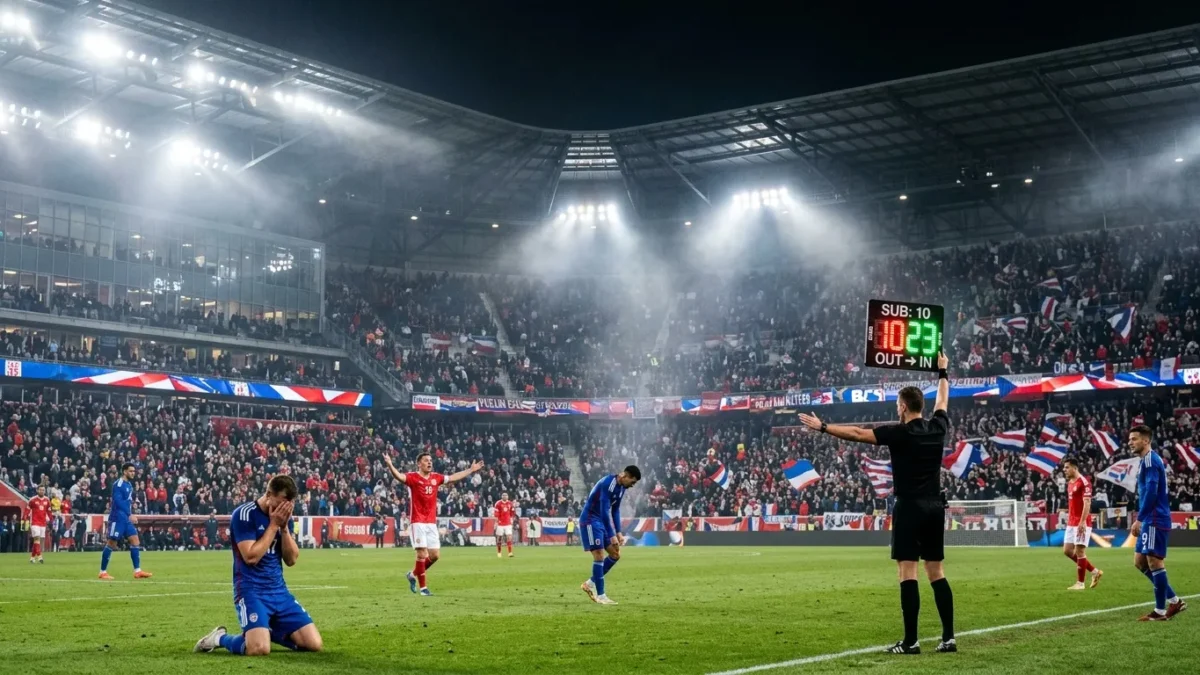
At the 2026 World Cup, stoppage time has become one of the most debated topics in football. Pierluigi Collina, president of FIFA’s Referees Committee, pushed hard for a crackdown on time-wasting and a more honest reflection of actual playing time. The early numbers from this summer’s tournament suggest his strategy is delivering results, though perhaps not in the way most fans expected.
Shorter matches, but smarter stoppage time at the 2026 World Cup
The first thing that jumps out when you look at the data is this : matches at this World Cup are running shorter than they did in Qatar. The average game length in the group stage sits at 96 minutes and 8 seconds. Compare that to Qatar 2022, where the first round of matches averaged a staggering 102 minutes and 43 seconds. That’s a difference of more than six minutes per game, which adds up fast across a full tournament.
Russia 2018 averaged 96 minutes and 54 seconds per match, which puts this edition just slightly below that benchmark. So in terms of raw match length, the 2026 tournament is actually the leanest of the three recent World Cups. One specific change contributed directly to this : the automatic six-minute allowance previously applied for hydration breaks has been scrapped. That block of time was never really “football”, and removing it from stoppage time calculations is a more honest way to measure the game.
Something else worth noting : all three tournaments recorded an average of four on-field VAR reviews per match. That variable hasn’t changed, so it can’t explain the difference in game length. The reduction is almost entirely down to the new approach to stoppage time management.
| Tournament | Average match length | Ball-in-play time | Ball-in-play % |
|---|---|---|---|
| Russia 2018 | 96 min 54 sec | 54 min 50 sec | 56.25% |
| Qatar 2022 | 102 min 43 sec | 58 min 08 sec | 56.86% |
| USA/Canada/Mexico 2026 | 96 min 08 sec | 57 min 22 sec | 59.38% |
The real metric : how much of each match is actual football ?
Raw match length is one thing. But the figure that really matters is ball-in-play time, and specifically what percentage of total match duration it represents. This is where the 2026 World Cup makes its clearest case.
In Russia, the ball was in play for just 54 minutes and 50 seconds per game on average. Qatar pushed that number up to 58 minutes and 8 seconds, partly because the sheer volume of stoppage time meant more minutes were available for actual play. Yet despite all those extra minutes, the ball-in-play percentage barely moved, sitting at 56.86% compared to 56.25% in Russia.
At this summer’s tournament, ball-in-play time drops slightly to 57 minutes and 22 seconds in absolute terms. On paper, that looks like a step backward. But the percentage tells a completely different story : 59.38% of total match time features live football in 2026. That’s the highest figure across all three tournaments, and it matters far more than the raw minutes.
Here’s how to think about it : fewer interruptions, less dead time, and a more continuous game. The goal was never to play football for three hours; it was to make the time on the pitch count. On that measure, Collina’s approach is working. The key drivers behind this improvement include :
- Stricter enforcement of time-wasting penalties by referees
- Removal of the automatic hydration-break stoppage time
- More consistent application of the clock by fourth officials
- Faster restarts encouraged through referee pressure
FIFA set a target of 60 minutes of ball-in-play time per match as the gold standard. Even with everything done in Qatar, they only reached 58 minutes and 3 seconds. Getting to 59 minutes and 22 seconds of effective football in a shorter match is genuinely significant progress, even if the 60-minute target still remains out of reach.
Will these stoppage time rules survive beyond the World Cup ?
The 2026 group stage results are encouraging, but let’s be honest : a World Cup is a controlled environment. Every referee is briefed, every match is under maximum scrutiny, and every team knows the rules will be enforced. Replicating these outcomes across a domestic league season is a completely different challenge.
The Premier League, for example, runs 380 matches per season, with varying referee standards, wildly different stakes, and teams that are far more experienced at milking the clock than any World Cup side. Applying Collina’s framework there would require not just clear rules, but genuine consistency from officials who work in a far more pressurised domestic context.
There’s also the question of fan experience. Shorter matches with higher ball-in-play percentages are objectively better football. But habits die hard : players, managers, and even broadcasters have built entire tactical and commercial systems around the rhythm of a 96-minute game with regular stoppages. Changing that culture takes longer than one summer tournament.
My view ? The data from this World Cup should be used as a direct blueprint for domestic football reform. The numbers prove that tighter stoppage time management doesn’t reduce the quality or volume of actual play; it improves it. The real test isn’t whether this works at a World Cup. It’s whether football’s governing bodies have the discipline to enforce it when the cameras aren’t all pointing at the same game.
