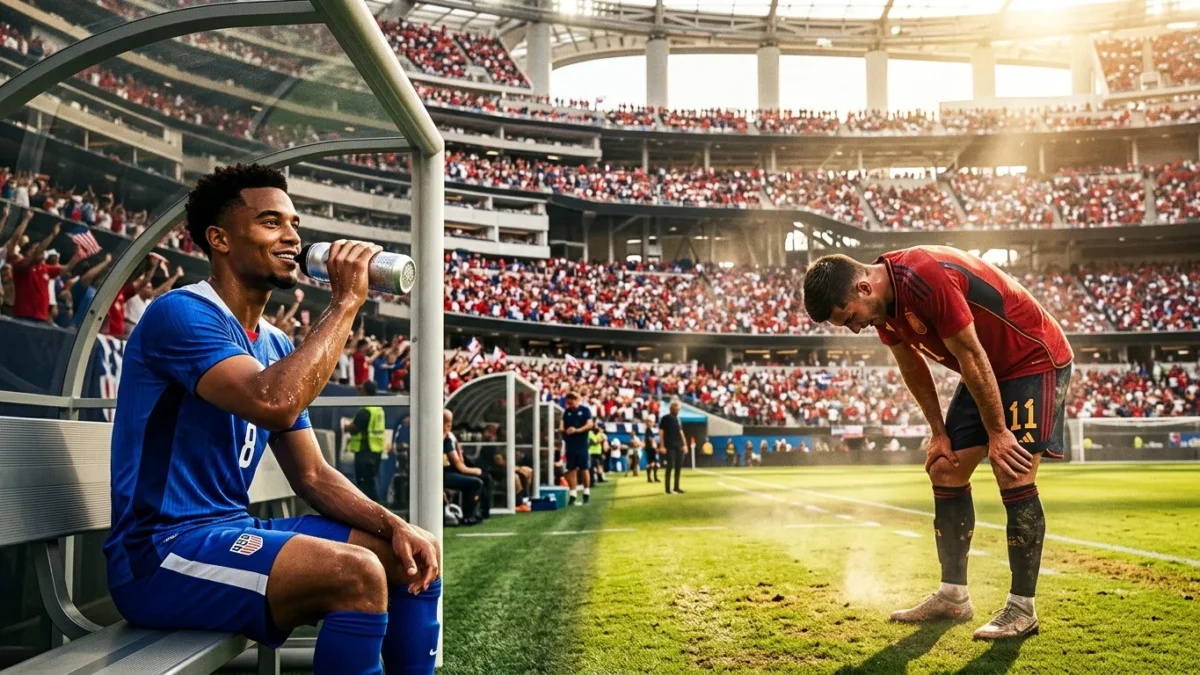
Curacao were floating. One-all against Germany, the smallest nation ever to feature at a World Cup had just equalised in Houston. Then came the drinks break. When play resumed, the fairy tale collapsed : the final score read 7-1 to Germany, a stunning reversal that raises an uncomfortable question about what those 90 seconds of stoppage actually do to the rhythm of a match.
When hydration breaks change everything
The pattern emerged fast at this World Cup. Three separate matches in the opening weekend produced momentum swings that coincided directly with the scheduled water stoppages, and the timing is too consistent to ignore entirely.
The Czech Republic had South Korea pinned back throughout the first half, building pressure systematically and looking the sharper side. The break arrived, the Koreans regrouped, and the Czechs never recovered that dominance. They had led 1-0. They lost 2-1. That kind of collapse does not happen by accident.
Sunday in Arlington told a similar story. The Netherlands held a 2-1 lead over Japan heading into the second-half stoppage. Comfortable enough, or so it seemed. Japan used those minutes to reset tactically, came back with renewed intensity and salvaged a 2-2 draw. The Dutch, who had controlled large parts of the game, ended up frustrated.
| Match | Score before break | Final score | Team losing momentum |
|---|---|---|---|
| Germany vs Curacao | 1-1 | 7-1 | Curacao |
| Czech Republic vs South Korea | 1-0 (CZE leading) | 1-2 | Czech Republic |
| Netherlands vs Japan | 2-1 (NED leading) | 2-2 | Netherlands |
To be fair, hydration breaks are not always the direct cause of these shifts. Fatigue, individual errors and tactical adjustments all play their part. But when three games in 48 hours produce the same pattern, the conversation becomes unavoidable. As the tournament progresses and the sample size grows, it will become much clearer whether these interruptions are genuinely distorting results.
The real debate : player welfare or prime-time adverts ?
Former Arsenal and England striker Ian Wright did not mince his words. His view : the breaks serve the broadcasters more than the players. “I just think it’s another way of getting adverts into it from an American point of view,” he said bluntly. He went further : “They’ve used the fact that it’s for the players, but it’s not for me.”
Wright’s scepticism gained immediate credibility when US broadcaster Fox overran commercial breaks during a hydration stoppage in the opening match between Mexico and South Africa. The footage of players standing around waiting for the signal to restart, while adverts rolled on American television, made his point more eloquently than any punditry could.
The commercial angle matters. The World Cup is, among other things, a multi-billion dollar broadcasting event, and the American market has historically demanded natural breaks for advertising. Packaging those breaks as player welfare measures is a neat solution, but it does invite exactly the kind of scrutiny Wright applied.
- Players receive approximately 90 seconds to drink and receive instructions
- Breaks occur once per half when temperatures and humidity exceed set thresholds
- Broadcast partners can use the stoppage to air scheduled commercial content
- Coaches routinely deliver tactical adjustments during the pause
That last point is the crux of the debate. A break designed to prevent heatstroke simultaneously hands every manager a free tactical timeout, something that does not exist in the standard laws of football. For a team under pressure, that is an invaluable lifeline. For the team doing the pressing, it is a disruption that can erase fifteen minutes of hard work.
Spain’s approach and what conditions actually demand
Not everyone shares Wright’s frustration. Spain head coach Luis de la Fuente came out clearly in favour ahead of his side’s opener against Cape Verde in Atlanta. “I am always interested in the health of my players. I think it’s the right measure, a pause, freshen up and continue,” he said on Sunday.
His reasoning carried weight given the context. Temperatures across several host cities have been extreme in the opening days of the tournament, with humidity levels that push the physical demands well beyond a typical European fixture. “Throughout the week, we’ve seen huge temperatures. It’s very difficult to be exposed to these temperatures for so long when you’re working,” De la Fuente added.
Atlanta provided a specific contrast. The venue hosting Spain versus Cape Verde features a retractable roof and full climate control, meaning the stadium temperature was managed independently of the outside heat. De la Fuente acknowledged this directly : “Tomorrow, it’s chilled temperatures in the stadium.” He still welcomed the break, framing it as an opportunity for brief tactical instruction rather than pure hydration : “one or two minutes to give them a couple of directions.”
That candid admission cuts to the heart of the whole argument. When a coach openly describes the water break as coaching time, the player welfare justification becomes thinner. The break may well be genuinely necessary in Dallas at 32 degrees Celsius, but in a climate-controlled Atlanta stadium, it functions as something rather different : a structured timeout dressed in a medical costume.
Whether FIFA addresses this inconsistency as the tournament reaches the knockout rounds remains to be seen. One practical step worth considering : standardise the conditions that trigger a break with a transparent, publicly visible heat index threshold, published before kick-off. That would at least remove the suspicion that the stoppages are scheduled rather than reactive. Fans who paid premium prices for uninterrupted football deserve that level of transparency.
