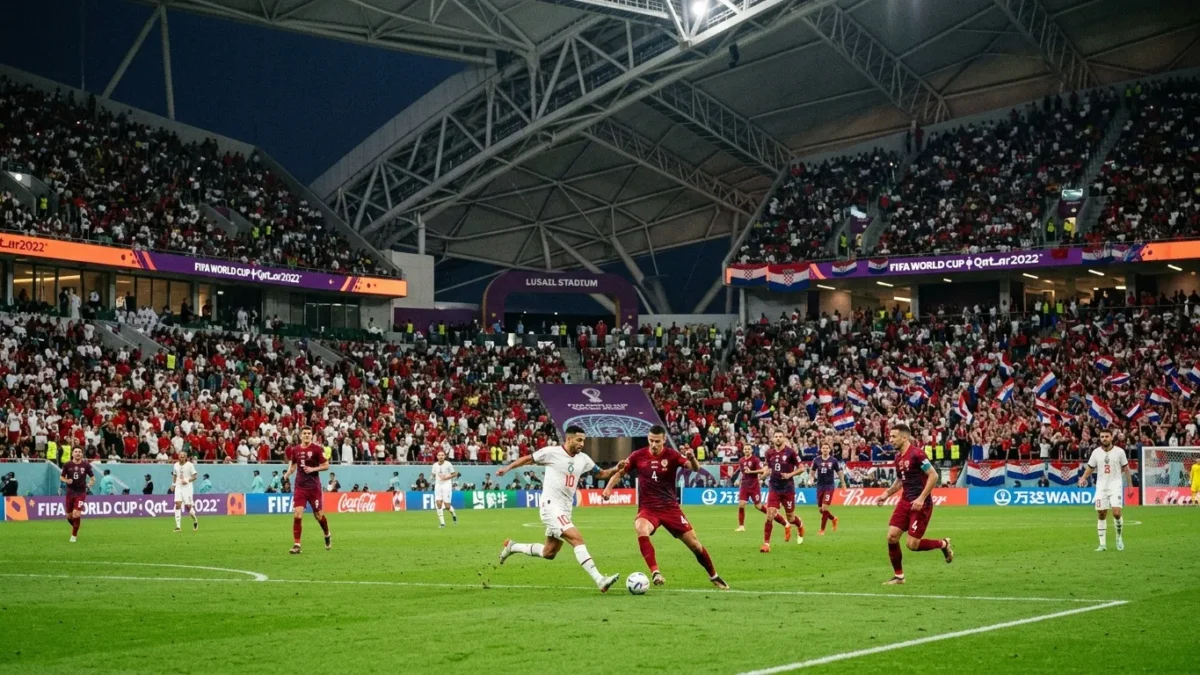
Japan demolished Tunisia 4-0 at Monterrey Stadium on June 21, 2026, in a Group F fixture that felt one-sided from the opening whistle. Hajime Moriyasu’s side were clinical, disciplined, and frankly a class above their opponents. Tunisia, on the other hand, never got going. Not once did they register a single shot on target, which tells you everything you need to know about this match.
The context surrounding Tunisia made this game even more dramatic before a ball was kicked. Following a 5-1 thrashing by Sweden, the Tunisian federation sacked head coach Sabri Lamouchi and rushed in Hervé Renard, the experienced French coach formerly in charge of Saudi Arabia. It was his very first game in the role, and it could not have gone worse.
Japan strike early and often : a complete tactical demolition
Less than four minutes into the match, Japan were ahead. Daichi Kamada, the Crystal Palace midfielder, finished from close range after a sharp counter-attack cut Tunisia open with almost embarrassing ease. The goal came before Tunisia had time to settle, and they never recovered mentally or tactically.
The second goal followed the same pattern. Ayase Ueda produced a composed, technically excellent finish, threading the ball through a defender’s legs from the edge of the box and into the far corner. Tunisia’s defensive shape crumbled under Japan’s quick combinations and intelligent movement off the ball.
Here is how the goals unfolded chronologically :
- Minute 4 : Daichi Kamada taps in after a rapid counter-attack
- Ueda’s first : a precise low finish through a defender’s legs into the far corner
- Junya Ito rolls the ball past goalkeeper Aymen Dahmen after being played through one-on-one
- Ueda’s second : a looping header tucked into the far corner to seal the rout
Japan’s possession stats told the full story : 62.1% of the ball, 583 total passes at an 89.4% accuracy rate. Their xG (expected goals) reached an astonishing 2.0668, compared to Tunisia’s 0.0456. That gap is not a coincidence. It reflects a systematic difference in quality, preparation, and collective organization.
Tunisia completed only 354 passes at 80.2% accuracy and managed just one shot off target in the entire game. With 8 touches inside Japan’s penalty area versus Japan’s 17, this was not a contest. It was a statement.
Tunisia’s group stage exit confirmed : ratings, lineups, and what the stats reveal
With this result, Tunisia were mathematically eliminated from the FIFA World Cup. They finish Group F bottom, with zero points and no goals scored. Their final game against the Netherlands, group leaders at the time, was rendered entirely meaningless in competitive terms.
Japan, by contrast, moved to four points, level with the Netherlands at the top of Group F. Their next match against Sweden offered a genuine shot at finishing as group winners and securing a guaranteed place in the last 32.
The player ratings from this match, as averaged across BBC Sport user submissions, were damning for Tunisia and glowing for Japan :
| Player | Team | Rating |
|---|---|---|
| A. Tanaka | Japan | 8.56 |
| A. Ueda | Japan | 8.53 |
| D. Kamada | Japan | 8.49 |
| J. Ito | Japan | 8.43 |
| O. Rekik | Tunisia | 4.28 |
| H. Mejbri | Tunisia | 4.24 |
| E. Achouari | Tunisia | 3.29 |
Both sides lined up in a 3-4-2-1 formation. Moriyasu’s structural clarity allowed Japan to dominate aerial duels (14 won versus Tunisia’s 4) and maintain relentless defensive pressure, committing 15 fouls compared to Tunisia’s 8, a sign of their aggressive and hungry pressing game. Referee István Kovács managed the game with VAR support from Fedayi San.
Frankly, Tunisia’s pedestrian performance was shocking even accounting for the managerial chaos that preceded it. Renard had barely 48 hours to implement anything coherent. But the individual quality was also simply absent on the day. No creativity, no pressing intensity, no threat. Japan neutralized every Tunisian attack without breaking a sweat.
What this result means for Japan’s World Cup trajectory
Japan’s free-flowing, possession-based football was genuinely impressive here. This was not a lucky win inflated by a weak opponent’s collapse. The xG of over 2.0 suggests they created real, high-quality chances consistently throughout the 90 minutes. Goalkeeper Zion Suzuki was barely tested, making just one save all game.
The Blue Samurai are now a serious proposition in this tournament. Moriyasu’s tactical system, built around intelligent pressing, rapid transitions, and technical midfield control through players like Ao Tanaka (rated player of the match with 8.56), is sustainable against stronger opponents. Sweden awaits in the final group game, and Japan will go into it with serious momentum and full confidence.
For any neutral watching this World Cup, Japan deserve close attention going forward. A team capable of scoring four goals with an xG above 2.0 while keeping a clean sheet is no fluke. Watch Kamada, watch Ueda, and watch how Japan press defensively as a unit. That coordination could cause problems even for European heavyweights in the knockout rounds.
