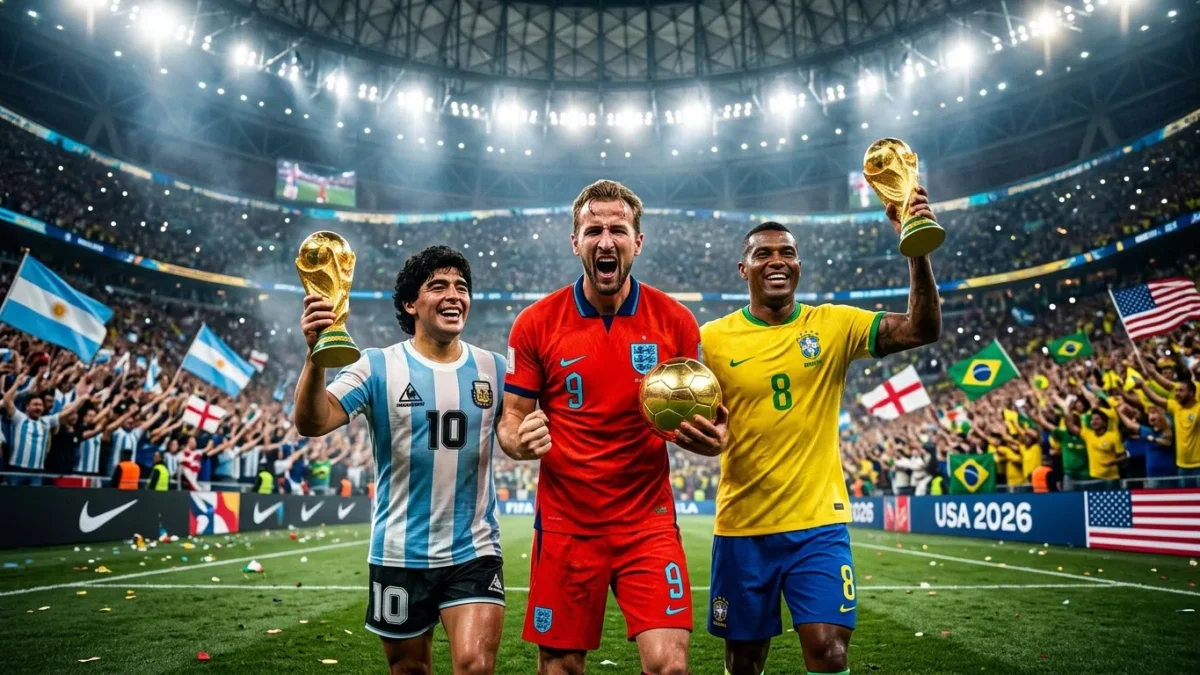
Ten days. That’s all it took for the 2026 World Cup to start rewriting football’s history books. With 48 nations competing for the first time, the sheer volume of matches has created a perfect storm for record-breaking moments, and the sport’s biggest names have wasted absolutely no time stepping up.
Messi, Ronaldo and the race to rewrite World Cup history
Let’s start with the headline act. Lionel Messi’s hat-trick against Algeria in Argentina’s opening 3-0 victory did something nobody had managed since 2014 : it moved the Argentine level with Miroslav Klose’s all-time World Cup goals record of 16. The German legend reached that tally in 24 games; Messi needed 27. Frankly, the three extra matches matter very little when you consider the scale of what he’s achieved.
Messi now stands alone at the summit of World Cup scoring history, and with Austria next up in Group J, the question isn’t whether he’ll break the record, it’s by how much. At 38, he continues to defy every reasonable expectation placed on a footballer at this stage of his career.
Cristiano Ronaldo’s story at this tournament cuts a slightly different figure. Portugal’s 1-1 draw with DR Congo was, by his own standards, underwhelming. Yet a record still fell. By stepping onto the pitch in Houston, Ronaldo became the oldest outfield player to start a World Cup match, aged 41 years and 132 days, surpassing Canada’s Atiba Hutchinson, who held the mark at 39 years and 296 days from the 2022 edition. Ronaldo also joined Messi as only the second player to appear at six World Cup tournaments.
There’s more on the horizon for the Portuguese captain. He already holds the record for scoring at the most separate World Cup tournaments, having netted in five consecutive editions from 2006 to 2022. One goal at this tournament makes it six. That would be genuinely unreachable for anyone currently playing.
| Player | World Cup goals | World Cups scored in |
|---|---|---|
| Lionel Messi | 16 | 5 |
| Miroslav Klose | 16 | 4 |
| Kylian Mbappe | 14 | 3 |
| Cristiano Ronaldo | 8 | 5 |
| Harry Kane | 10 | 3 |
Kane, Haaland and Mbappe : a three-way battle for Golden Boot glory
Harry Kane’s performance against Croatia answered every doubter who wondered if England’s captain could handle the pressure while others stole the spotlight. Two goals in Dallas, a 4-2 win, and suddenly Kane sits level with Gary Lineker as England’s all-time leading World Cup scorer on 10 goals. That’s a record that has stood since 1990, and it could fall against Ghana.
That same match brought another milestone : Kane became just the second England player to score at three different World Cup tournaments, joining Sir David Beckham, who achieved the feat across 1998, 2002 and 2006. His 115th cap also drew him level with Beckham among England’s most-capped players. One match, three separate historical benchmarks.
Kylian Mbappe, meanwhile, has already cemented his place in French football history. His 58th international goal made him France’s all-time leading scorer, overtaking Thierry Henry’s mark that stood for years. With 14 World Cup goals total, he sits just two behind Messi and Klose’s joint record. For someone still in his mid-twenties, that number is extraordinary.
Then there’s Erling Haaland, who needed precisely 20 touches to score twice on his World Cup debut against Iraq, a 4-1 Norway win. In doing so, he became the first player to score a brace for Norway at a World Cup, and levelled with Kjetil Rekdal as the country’s joint all-time leading scorer at the finals. Against Senegal, he can move clear on his own.
The Golden Boot race shapes up like this, with Messi, Germany’s Denis Undav and Canada’s Jonathan David currently leading on three goals, while Kane, Haaland and Mbappe sit one behind. Here’s what makes this particularly compelling :
- Mbappe won the 2022 Golden Boot with eight goals in Qatar
- Kane won the 2018 Golden Boot with six goals in Russia
- No player has ever won the award twice
- Both Mbappe and Kane are genuine contenders to make that history
Beyond the superstars : records the tournament itself is already breaking
This World Cup isn’t just about individual legends. The tournament’s structural changes and sheer scale are producing record moments at every level. Cape Verde goalkeeper Vozinha, aged 40 years and 12 days, became the oldest player to appear in a nation’s World Cup debut, keeping out European champions Spain in a remarkable 0-0 draw with seven crucial saves. He also broke the record for the oldest goalkeeper to keep a clean sheet on his finals debut.
France manager Didier Deschamps sits one win away from equalling Helmut Schon’s all-time record of 16 managerial victories at the World Cup. A win over Iraq would draw him level; the final group game against Norway could give him 17, an outright record he’d carry into the knockout rounds.
Disciplinary figures are also trending in a record direction. The 28 red cards shown across the entire 2006 tournament represent the historical peak. This edition has already produced six in the opening days, three of them during Mexico’s win over South Africa alone. Bosnia-Herzegovina’s Tarik Muharemovic and Qatar’s Assim Omer Madibo and Homam el Amin added to the tally shortly after. For context, the previous two tournaments combined showed just four red cards total.
With dozens of group stage matches still to play before a single knockout game kicks off, this record is firmly within reach. The 2026 World Cup is shaping up as the most statistically significant edition the sport has ever staged, and we’re barely past the opening week.
