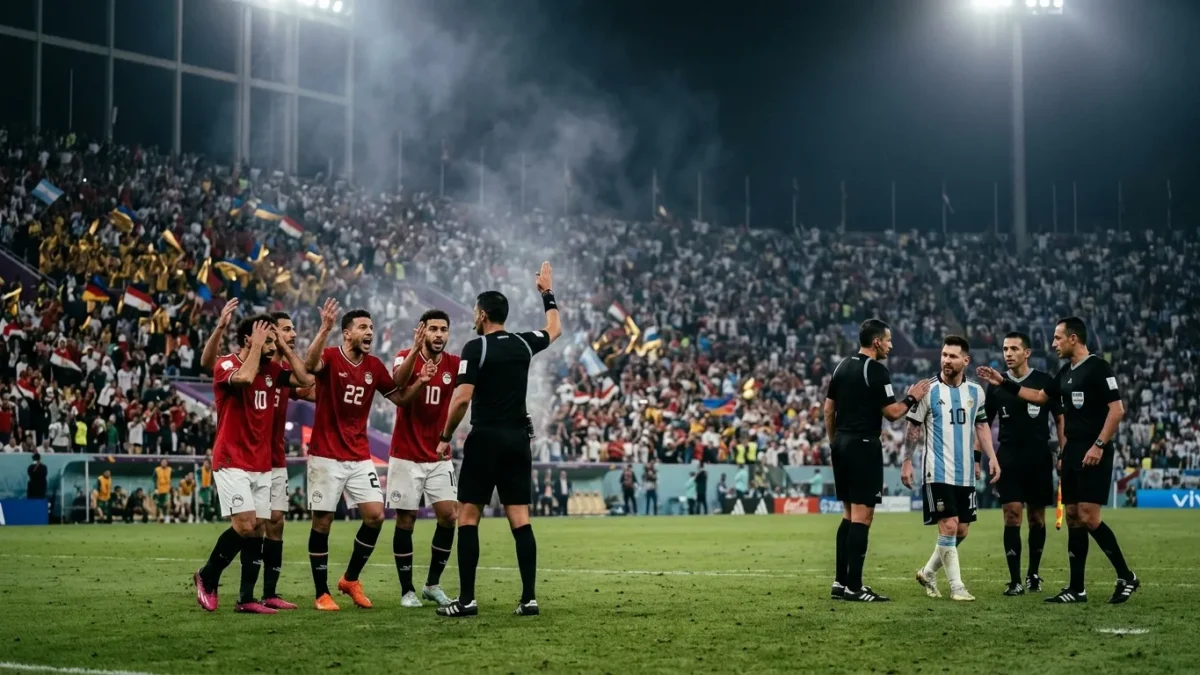
Egypt’s World Cup 2026 campaign ended in one of the most emotionally charged exits the tournament has ever seen. Trailing 0-2 with barely 12 minutes left in normal time against Argentina at Atlanta Stadium on July 7, the Pharaohs were seconds away from a historic quarter-final. Then everything collapsed, spectacularly and bitterly.
A comeback that will haunt Egyptian football
Yasser Ibrahim gave Egypt a dream start, heading home in the 15th minute to put the reigning world champions on the back foot. The Pharaohs then survived a major scare when goalkeeper Mostafa Shobeir produced a stunning penalty save to deny Lionel Messi, a moment that seemed to confirm this was Egypt’s night. Mostafa Zico added a second goal that sent Egyptian fans worldwide into delirium. Briefly.
Cristian Romero pulled one back for Argentina in the 79th minute. Four minutes later, Messi levelled at 2-2. Then, in the second minute of stoppage time, Enzo Fernandez headed home to complete one of the most dramatic reversals in World Cup history. No extra time needed. Argentina, down 0-2 with 12 minutes remaining, walked away with three points.
For context, only two teams in World Cup history had previously overturned a two-goal deficit in the final 15 minutes of normal time to win. This performance places Argentina among the most resilient sides ever to lift the trophy, while Egypt were left processing a defeat that felt, to many, like something far worse than bad luck.
The contrast in reactions at full time told the whole story. Argentina’s players celebrated wildly. Egypt’s slumped to the turf in disbelief, several in tears, as French referee François Letexier signalled the end.
VAR, Messi favouritism and the furious accusations from Egypt’s camp
The refereeing decisions in this match deserve serious scrutiny. Two specific moments fuelled Egypt’s accusations of institutional bias and provoked coach Hossam Hassan into an explosive post-match statement.
First : Zico’s disallowed goal. Midfielder Marwan Attia was penalised for a minor step on Lisandro Martinez’s toe and a very light shirt tug, roughly 17 seconds before Zico struck. VAR intervened to cancel the goal. The problem ? This World Cup has averaged 22.6 fouls per game, down from 25 in 2022 and 27 in 2018, precisely because FIFA instructed referees to let more contact go. Pierluigi Collina, FIFA’s head of referees, confirmed this directive just days before the match. Ruling out Zico’s goal for exactly the kind of contact officials had been told to ignore looks, at best, inconsistent.
Second : the potential foul on Mohamed Salah in Argentina’s penalty area, moments before Fernandez’s winner. Salah went down claiming Julian Alvarez tripped him. No VAR check followed. The counterargument from analysts is that a penalty requires a higher threshold than a standard foul. Since there was reportedly not enough evidence for a spot-kick, Argentina’s winner stood. Technically defensible. Politically explosive.
| Incident | VAR intervention ? | Outcome |
|---|---|---|
| Zico goal (Attia foul on Martinez) | Yes | Goal disallowed |
| Salah foul claim (Alvarez challenge) | No | Argentina goal stands |
| Messi penalty | N/A | Saved by Shobeir |
Hassan did not hold back in his post-match interview. “Perhaps they wanted to keep the world champion in the competition,” he said directly. “Perhaps they wanted Messi to stay in the running. The world champion received support at every level.” Forward Zico was equally direct : “The injustice was clear from the start of the match.” BBC Sport contacted FIFA for a response; no comment had been received at time of publication.
There was also a surreal moment when Hassan was booked for crossing his arms in front of him after Argentina’s winner, a gesture officially backed by FIFA as a signal to flag racist incidents. The irony was not lost on Egyptian supporters.
Salah’s World Cup future and Africa’s remaining hope
Mohamed Salah’s personal tournament ends with a single goal, scored against New Zealand on June 22. Against Argentina, Egypt’s captain failed to register a shot or a key pass. For a player of his calibre, that’s a stark stat. The debate now centres on whether this was his last World Cup.
Salah turns 38 before the 2030 World Cup, which will be hosted across Morocco, Portugal and Spain. Compare that to :
- Cristiano Ronaldo, who played his final World Cup match at 41
- Luka Modric, who bowed out at 40
- Messi himself, still competing at 38 in 2026
Age alone does not close the door. Whether Salah has the appetite, and the physical condition, for one more cycle remains an open question. His former Liverpool teammate Alexis Mac Allister embraced him at full time, a human moment amid all the bitterness. Supporters from Cairo to Alexandria watched that embrace with complicated feelings.
Egypt’s exit means Morocco now carries Africa’s flag alone at this tournament. The Atlas Lions, who made history in 2022 by becoming the first African side to reach a World Cup semi-final, face France in the quarter-finals at Boston Stadium. That match carries the weight of an entire continent’s ambitions.
For those tracking stunning upsets in elite football, this game belongs in the same conversation as any shock result the sport has produced in recent years. Egypt played like equals, not underdogs. Their tournament motto, “Mekameleen” (we’ll keep going), resonated long after the final whistle. The real question now is whether FIFA addresses the refereeing inconsistencies that marred this extraordinary match.
