Sunday, July 2026. Norway beat Brazil at the World Cup. A nation of 5.5 million people defeated the five-time world champions to reach a first-ever quarter-final. The arithmetic, as one observer put it, felt wrong. But if you understand what Norway did to its youth sport system nearly two decades ago, nothing about that result surprises you.
The eight rights that changed everything
In 2007, the Norges idrettsforbund (NIF), Norway’s national governing body for sport, revised a set of principles first established in 1987. These eight “rights” were designed to protect every child’s participation, safety and enjoyment in sport. They are mandatory for every coach and every club affiliated with the NIF. Read them alongside the talent-funnel culture dominant in Brazil, England or France, and they sound almost radical.
The framework works in clear stages :
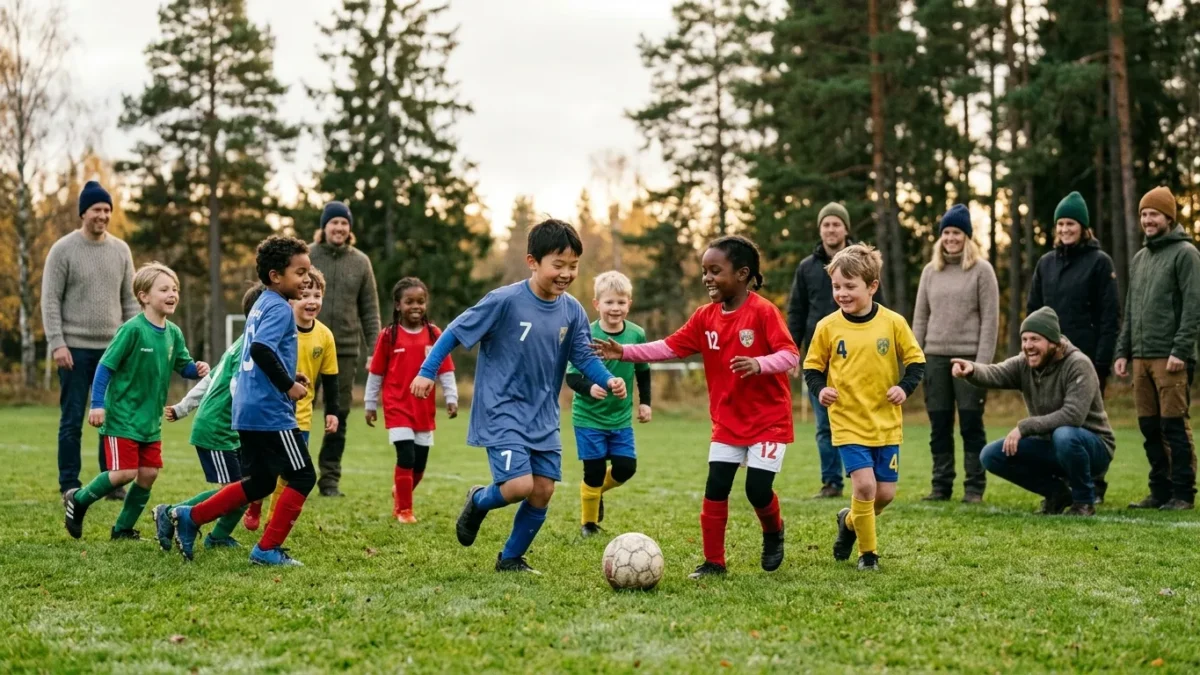
- Under age 9 : local club matches only, no results, no league tables, no trophies
- Age 11 : regional competition opens, but scores and rankings remain off limits
- Age 13 : the first access to anything resembling a national championship
Two of the eight rights cut hardest against mainstream sporting culture : mastery and freedom to choose. A child has the right to try multiple sports rather than being funnelled into a single discipline before they are old enough to have chosen it themselves. No performance metrics. No early selection. No pressure to commit before the brain and body are ready.
Erik Thorstvedt, the former Norway and Tottenham goalkeeper, captured the spirit of it plainly : “The most important thing is, don’t put too much pressure on the kids.” He described the goal as helping children enjoy football enough to make it their favourite thing in life. That is a very different target from producing a prodigy by age twelve.
Compare that with Brazil’s model, where Neymar, Vinícius Júnior and Matheus Cunha all came through systems built around early identification and single-sport academies. The results that model has produced are undeniable. Beautiful football, extraordinary individuals. But Norway’s victory over Brazil prompts a serious question : which pathway actually develops better athletes over time ?
What Haaland’s childhood actually looked like
Erling Haaland is the NIF framework’s most famous product. He was six years old when the revised rules came into force. According to his father, Alf-Inge, who spoke about it on Manchester City’s official website, Erling spent the following eight years moving between handball, athletics, cross-country skiing and football. Norway’s handball setup reportedly wanted to keep him. He chose football at 14.
| Player | Sports practised as a child | Age when committed to football |
|---|---|---|
| Erling Haaland | Football, handball, athletics, cross-country skiing | 14 |
| Alexander Sørloth | Football, handball, speed skating | Mid-teens |
| Ørjan Håskjold Nyland | Football, handball, alpine skiing | Late teens |
Watch Haaland’s goals with that history in mind. His leap for a header carries the spring of someone who spent years releasing shots in handball goal areas, where jumping is fundamental. His striking technique has a coiled, unhurried power, the kind built by years of learning to generate force efficiently on skis, where wasted movement costs you seconds you cannot recover. The football training since age 14 explains his finishing. The sports before that explain his body.
Alexander Sørloth, who leads the line alongside Haaland, grew up in Trondheim moving between football, handball and speed skating. His father played for Norway at the 1994 World Cup; his mother competed at handball. Two of Norway’s most physically dominant forwards reached football only after years spent learning to move in fundamentally different ways. That is not coincidence. That is a system working exactly as intended.
Goalkeeper Ørjan Håskjold Nyland was 17 when the rules arrived, technically too old to have been shaped by them. Yet he grew up practising handball and alpine skiing alongside football anyway, long before any law said he should. Against Brazil, it showed. A penalty saved with the lateral spring of a skier. A deflection clawed away mid-air with the contorted athleticism of a handball keeper. The NIF didn’t invent that instinct. It formalised what some Norwegian families already understood.
Patience as a competitive strategy
Norway’s approach to children’s sport is not only about football. In February 2026, Norway topped the Winter Olympics medal table for the fourth consecutive Games, taking home a record 18 gold medals. They outperformed countries more than 60 times their size. This is what patient, multi-sport development produces at scale : versatile, resilient athletes who arrive at their chosen discipline physically literate in ways that single-sport specialists simply are not.
Most countries run a version of Brazil’s model : spot the gift early, build the pathway around the position, push the child toward specialism before adolescence is even finished. Norway made a different bet. Protecting a child’s right to choose their own sport, in their own time, turns out to produce extraordinary athletes. Not despite the lack of early pressure, but partly because of it.
The eight rights were never written to win a World Cup. They were written so a nine-year-old good enough for the first team could still just be a nine-year-old. No league table to top. No trophy to chase. No parent on the touchline measuring worth in goals scored. Just kids playing, wandering between sports, getting things wrong without embarrassment, building a relationship with movement that no academy syllabus can manufacture.
If you run a junior club, coach a school team, or simply stand at a touchline every Saturday morning, the Norwegian model hands you one direct, actionable idea : resist the ranking. Let the child try the other sport. The table can wait. The athlete cannot.
