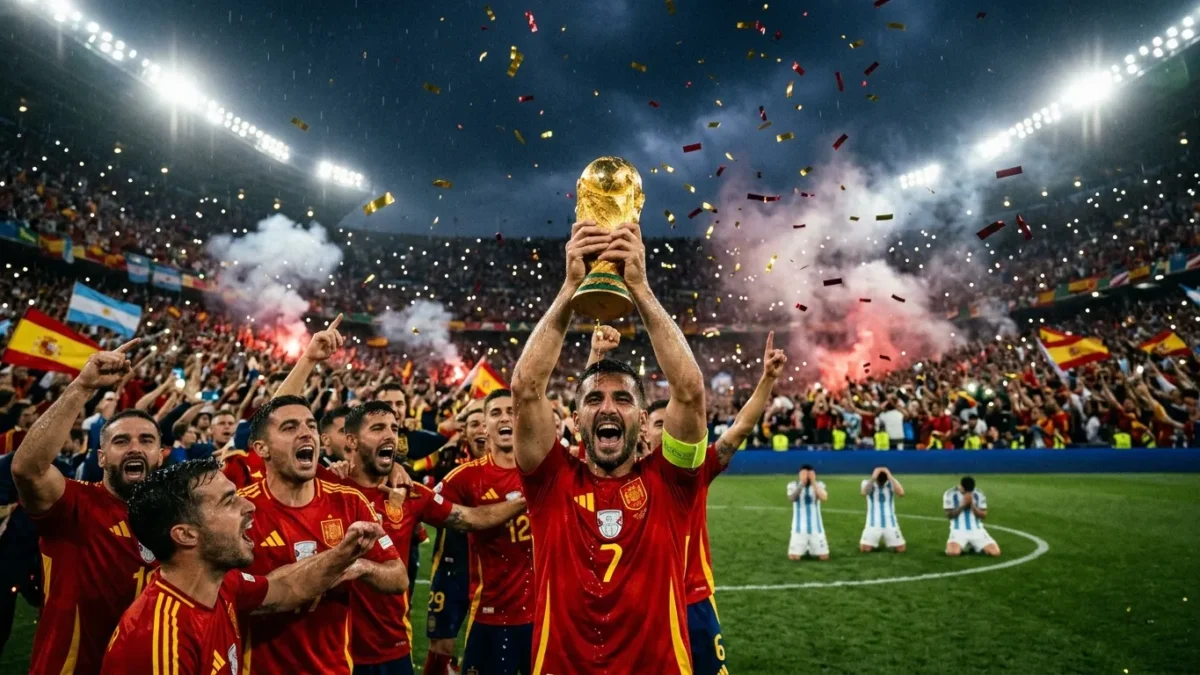
Ferran Torres buried the extra-time winner in the 106th minute, Rodri lifted the trophy above his head in New Jersey, and very few neutrals felt any sympathy for Argentina. Spain’s victory at the 2026 World Cup final was more than a scoreline. It was a statement about how football should be played, defended, and won.
A masterclass in possession and control
The numbers tell the story bluntly. Spain finished with 65% possession, 20 shots on goal (11 on target), and an expected goals figure of 1.94. Argentina, by contrast, scraped together just 464 passes across 120 minutes, compared to Spain’s 852. These are not minor statistical margins. They represent a total footballing domination rarely seen in a World Cup final.
Two Spain players achieved something extraordinary in that final. Rodri completed 101 passes, Pau Cubarsi reached 121, making them two of only three players in recorded World Cup history to complete 100 or more passes in a final. The third ? Also a Spain player, from a previous tournament. That detail alone underlines just how deeply this squad understands possession-based football.
Alan Shearer, former England captain, was unambiguous on BBC One : “There is no doubt that the right team won. From start to finish, Spain controlled possession. They were the ones looking to play football, create chances and get in behind.” It is hard to argue with that reading of the game.
In goal, Unai Simon claimed the Golden Glove for best goalkeeper of the tournament, keeping a clean sheet in the final and recording seven clean sheets across eight matches. More telling still : Spain conceded just one goal throughout the entire 2026 World Cup, the fewest ever by any winning team in the competition’s history.
Argentina’s approach, and what it cost them
Argentina arrived at this final with a well-established reputation for disruption. Leandro Paredes set the tone early, with Enzo Fernandez following closely. Four Argentine players collected bookings during the match, and many observers felt that count should have been higher given the frequency of cynical fouls and time-wasting.
| Stat | Spain | Argentina |
|---|---|---|
| Possession | 65% | 35% |
| Total passes | 852 | 464 |
| Shots on target | 11 | 1 (from 117′) |
| Goalkeeper saves | N/A | 11 (Martínez) |
Emiliano Martínez made 11 saves, the most by any goalkeeper on record in a World Cup final. That figure reflects less a heroic performance than a side pinned back from the first whistle. Argentina became the first team in World Cup history to register zero shots during 90 minutes of a final. Lionel Messi’s attempt in the 117th minute was their first touch of any attacking ambition.
Argentina’s manager Lionel Scaloni, visibly emotional at the post-match press conference, acknowledged the outcome : “They deserved the victory, that is the reality.” He suggested the game might have felt different had Fernandez not been sent off in the 90th minute following a reckless challenge on Cubarsi. Frankly, that argument doesn’t hold up when your team hadn’t managed a single shot in open play before that moment.
After the final whistle, things deteriorated further. Paredes clashed with Rodri, Gavi, and Borja Iglesias. Nahuel Molina threw a punch at a Spain player. Fernandez received a second yellow, then a red, for a challenge that sent Cubarsi airborne. Wayne Rooney, commenting for BBC, called it “embarrassing”, while former England goalkeeper Joe Hart used the word “disgusting” without hesitation.
Spain’s generational dominance, and what comes next
This Spain squad is not at its peak. That might be the most unsettling thought for every rival nation. The current generation holds the men’s World Cup, the Olympic title, and the European Championship, alongside the women’s World Cup. The men’s team has now gone 38 matches unbeaten across all competitions, the longest such run ever recorded by a European national team.
Consider what that squad contains in terms of youth :
- Pau Cubarsi, 19, named young player of the tournament
- Lamine Yamal, 19 years and six days old at the time of the final, becoming the third-youngest player ever to appear in a World Cup final, behind Pelé in 1958 and Giuseppe Bergomi in 1982
- Yamal is now also the third-youngest World Cup winner in history
Spain did stumble at the group stage, drawing 0-0 with Cape Verde in their opener. Interestingly, this mirrors their 2010 campaign, when they lost their first game 1-0 against Switzerland before going on to win the title. History repeated itself, and nobody seemed to care by Sunday night in New Jersey.
The tactical blueprint Spain used throughout this tournament deserves serious study by any coach working at international level. High pressing, relentless recycling of possession, and a defensive structure so compact that opponents rarely found a line to break through. With Yamal and Cubarsi likely representing Spain for another decade, the rest of the world faces a straightforward and uncomfortable truth : this Spain era is only just beginning. Any team hoping to dethrone them at the 2030 World Cup will need to build something fundamentally different from what Argentina attempted here.
