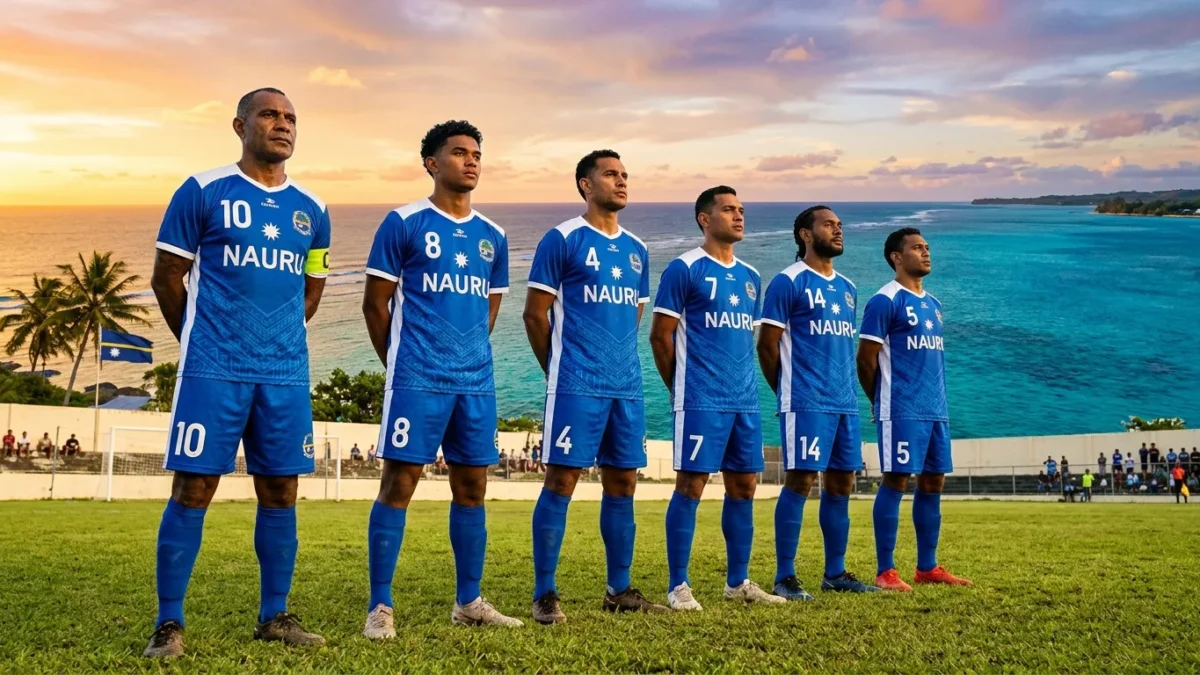
Nauru sits 2,500 miles northeast of Australia, barely 21 square kilometres of land surrounded by the Pacific Ocean. It is, statistically, one of the most remote and least-known nations on Earth. Yet as the 2026 World Cup reshapes global football conversations, this tiny island is being asked a pointed question : will it finally commit to the beautiful game ?
A land shaped by phosphate, obesity and rising seas
To understand why Nauru’s football journey has barely started, you need to grasp what happened to the island itself. Its wealth once came from an unlikely source : phosphate deposits formed over millennia from fossilised bird droppings. Mining operations intensified through the late 20th century, and by the time the minerals were exhausted, vast portions of the island’s interior had become uninhabitable wasteland. Independence came in 1968, but prosperity didn’t last long after.
Today, around 12,000 people live on Nauru, most of them squeezed along the coastal edges because the central plateau is simply too barren to use. More than 90% of the food consumed on the island is imported, and much of it is heavily processed. The health consequences are staggering : 69% of the population is classified as obese, and approximately 40% live with type 2 diabetes. Those figures aren’t just alarming health statistics. They’re a direct argument for why sport, any sport, matters urgently here.
Climate change compounds everything. Rising sea levels are literally shrinking the island. Nauru’s government has even explored purchasing land in Fiji as a contingency plan. It is hard to prioritise a football pitch when your country’s physical existence is under threat.
One of the island’s main income streams today comes from housing an Australian immigration detention centre, a controversial arrangement that has drawn international criticism. Nauru’s story is complicated, layered and far from the carefree Pacific island image that tourism brochures might sell.
| Indicator | Nauru | Global average |
|---|---|---|
| Obesity rate | 69% | ~13% |
| Type 2 diabetes prevalence | ~40% | ~6% |
| Food import dependency | >90% | Varies widely |
| Land area | 21 km² | N/A |
Football on Nauru : a sport that never quite landed
Aussie rules football dominates here. Roughly 30% of Nauruans play it, and the sport is deeply embedded in local culture. Athletics and weightlifting also have genuine roots, with Nauru having competed in both at the Olympic Games. Association football, by contrast, has barely registered.
The closest Nauru has come to an international football match were two deeply informal encounters : a game against a Solomon Islands expatriate team in 1994, and another against a refugee side in 2014. That’s the full international record. No official FIFA matches, no qualifying campaigns, no registered results. For context, even the smallest UEFA nations have played hundreds of competitive fixtures.
The obstacles are real and they are specific :
- Barely any flat, usable space for pitches on a 21 km² island
- A population whose health challenges make sustained physical activity difficult
- Limited infrastructure for importing sports equipment
- A sporting culture built around Aussie rules, not association football
- No established football federation with international recognition
Getting actual footballs onto the island is, genuinely, one of the first practical hurdles the small team developing the sport faces. That detail says everything about where things stand.
The man from Stevenage trying to change the game
Behind Nauru’s tentative football ambitions stands Pomroy, technical director for Nauru Soccer and one of just eight volunteers working to develop the sport on the island. He’s originally from Stevenage, the Hertfordshire town whose club memorably reached the English Football League after years in non-league. Pomroy worked there during those non-league days, so he knows what building something from scratch actually looks like.
His track record elsewhere is hard to dismiss. In Siem Reap, Cambodia, he built what started as a charity project and eventually became a professional academy. To date, that academy has produced 47 players who went on to play professionally within the Cambodian football system. He also runs football programmes in India targeting underserved communities. Each context brings different challenges. Nauru is, by his own admission, the most logistically demanding of all.
His motivation is straightforward, and I respect that clarity. Football is the tool he knows best. But the goal is broader : a healthier, more confident Nauru, one that the world sees as something more than the punchline of a geography quiz. “They want people to see the country in a more positive light rather than the punchline of a joke,” Pomroy has said directly.
Nauru is scheduled to host the Micronesian Games in 2028, a multi-sport event that includes football. It’s a concrete milestone, a deadline that gives the project urgency. Whether football will be ready to represent something meaningful by then remains genuinely open.
Why the 2026 World Cup moment matters for Pacific football
The 2026 FIFA World Cup, hosted across the United States, Canada and Mexico, expanded to 48 teams precisely to bring more of the footballing world into the conversation. The OFC (Oceania Football Confederation), which covers the Pacific region, still has limited direct qualification slots. But the broader attention the tournament generates has a real trickle-down effect on nations like Nauru that are watching from the outside.
If there is one actionable step that could shift things fast, it is this : formal recognition and OFC membership would unlock development funding, coaching resources and structured competition pathways. Nauru Soccer’s eight volunteers are doing what they can, but sustainable development requires institutional support, not just goodwill. The 2028 Micronesian Games offer a visible stage. Using it well could be the moment Nauru stops being a footnote in Pacific sport and starts writing its own story.
