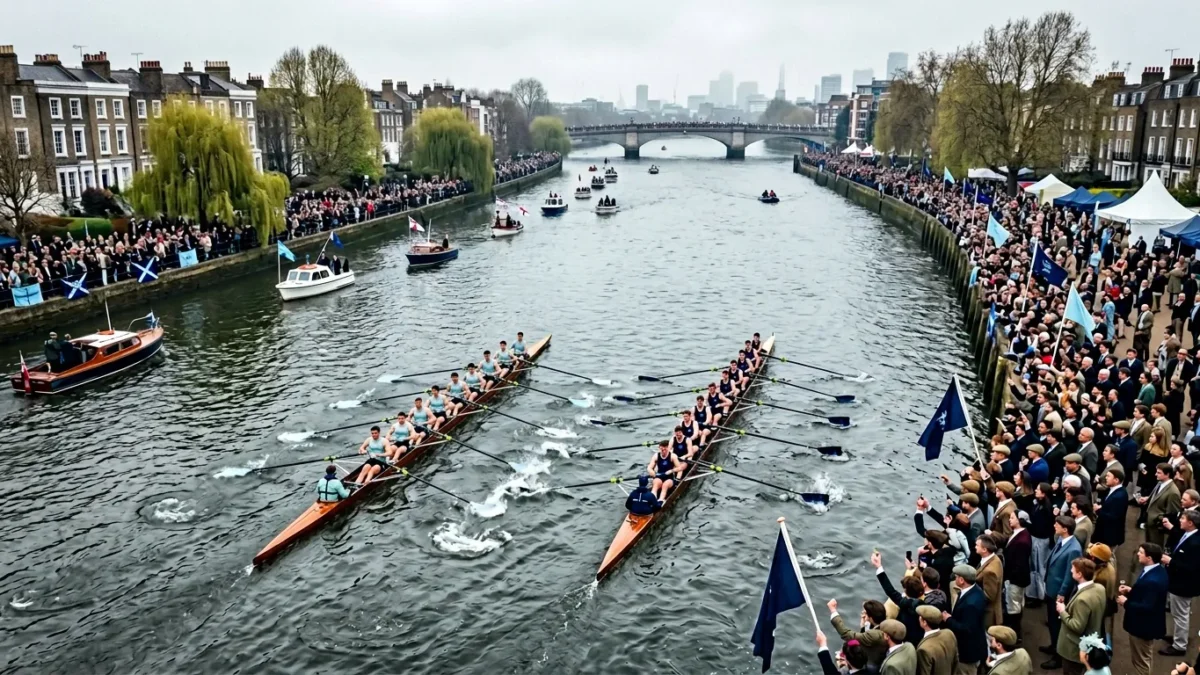
Every spring, more than 200,000 spectators pack the banks of the River Thames to watch two boats race 4.2 miles from Putney to Mortlake. The Oxford-Cambridge Boat Race turns 197 years old in 2026, yet it still stops traffic — both literally and culturally. Few sporting events carry so much history while simultaneously sparking such sharp debate about who British sport really belongs to.
A living tradition born from a student rivalry
The race traces its origins to 1829, when two friends — both named Charles — organised the first contest between Oxford and Cambridge. What started as a personal challenge between undergraduates has grown into one of the most-watched annual sporting events in the United Kingdom. The men’s competition has run continuously since 1856, making this year’s edition the 171st. The women’s race, now in its 80th edition, only joined the same Thames Tideway course and race day as the men in 2015 — the same year it was broadcast live for the first time.
The format remains stubbornly unchanged. Two crews of eight rowers and one cox per boat, one light blue for Cambridge, one dark blue for Oxford. This year, Cambridge took the men’s title — their seventh win in eight years, bringing their overall tally to 89 victories. Oxford’s women claimed the trophy for the first time since 2016, crossing the Chiswick Bridge finish line in just under 19 minutes in testing winds and choppy conditions.
For those who compete, the emotional weight is hard to overstate. Annie Anezakis, an Australian medical student who rowed for Oxford across five seasons, described her women’s victory as the hardest-fought win of her career. “It has taken the most hours, the most sacrifice,” she said, holding a magnum of champagne at the Mortlake Anglian and Alpha Boat Club moments after the trophy presentation. Simon Hatcher, a 25-year-old engineering student from Portland, Oregon, who rowed for the winning Cambridge men’s crew, put it more simply : “You really become brothers with every person in your boat.”
International athletes like Hatcher are increasingly common. Oxford’s winning women’s president, Heidi Long, claimed bronze for Great Britain at the Paris 2024 Olympics. Cambridge’s women’s president, Carys Earl, had been helping deliver babies on a hospital placement in the weeks before the race — she only took up rowing after arriving at Cambridge, having previously played rugby.
Elitism, identity and the fight for a broader audience
Ade Adepitan, 53, presents the race for Channel 4 and won Paralympic bronze in wheelchair basketball at Athens 2004. He moved from Nigeria to east London at the age of three and grew up in a working-class household. His perspective on the event is frank : for many people outside west and southwest London, the Boat Race barely registers. “When you hear about the Oxford and Cambridge boat race and you come from east London, you’re like : ‘How does this even work ?'” he said. Rowing isn’t a school sport in most parts of the country. The two universities involved are, by any measure, selective institutions. These are not trivial objections.
Yet Adepitan sees the event’s cultural moment as an opportunity rather than a dead end. Below are four ways Channel 4 and production company FilmNova are working to widen the race’s appeal :
- Bringing in new presenting voices with broader reach, including TV personality Jamie Laing, known from Made In Chelsea and as a Radio 1 presenter
- Producing the short documentary series Turning The Tide, released on YouTube to attract younger viewers
- Streaming the event globally via Overnight, a platform specialising in rowing and water polo
- Emphasising athletes’ personal stories to humanise the competition beyond its Oxbridge setting
The broadcast figures suggest there is real appetite. When the BBC last aired the race, it drew 2.5 million UK viewers. Channel 4’s 2026 coverage reached three million people, with a peak of two million watching the men’s race climax — and 23.5% of that audience fell in the 16–34 age bracket. The broadcaster holds rights through to the race’s 200th edition in 2029.
Kath Pocock, who captained Cambridge’s winning women’s crew in 1984 with British Sugar as their sole sponsor, notices how much the commercial landscape has shifted. The event now carries partnerships with Chanel, Fortnum & Mason, Chapel Down wine and Le Chameau — a very different world from a single sugar company. “The essence is still the same,” Pocock said. “If you’re with Cambridge, the idea is to beat Oxford.” Her concern isn’t the sponsorship money; it’s that the race doesn’t lose sight of what it actually is. “I don’t want it to go like you have to be doing handstands to get in the boat.”
What the Boat Race could teach British sport about reinvention
The real challenge isn’t whether the Oxford-Cambridge race survives — the viewing numbers make that question redundant. The challenge is whether it can expand its cultural footprint without hollowing out its identity. Adepitan frames it in terms of national belonging : “We are at a fascinating point in UK history where we’re trying to work out who we are identity-wise.” Taking a tradition and opening it up, he argues, is the only meaningful path forward.
| Race | Winner 2026 | Edition | Notable fact |
|---|---|---|---|
| Men’s | Cambridge | 171st | 7th win in 8 years |
| Women’s | Oxford | 80th | First win since 2016 |
Hatcher, watching the world tune in from his Cambridge boat, captured something genuine : “It’s so much fun to think about people around the world watching.” Whether you see the Boat Race as a cherished institution or a gilded anachronism, that global reach is real — and so is the question of who gets to feel part of it. The smartest thing the event could do now is answer that question before 2029 answers it for them.
