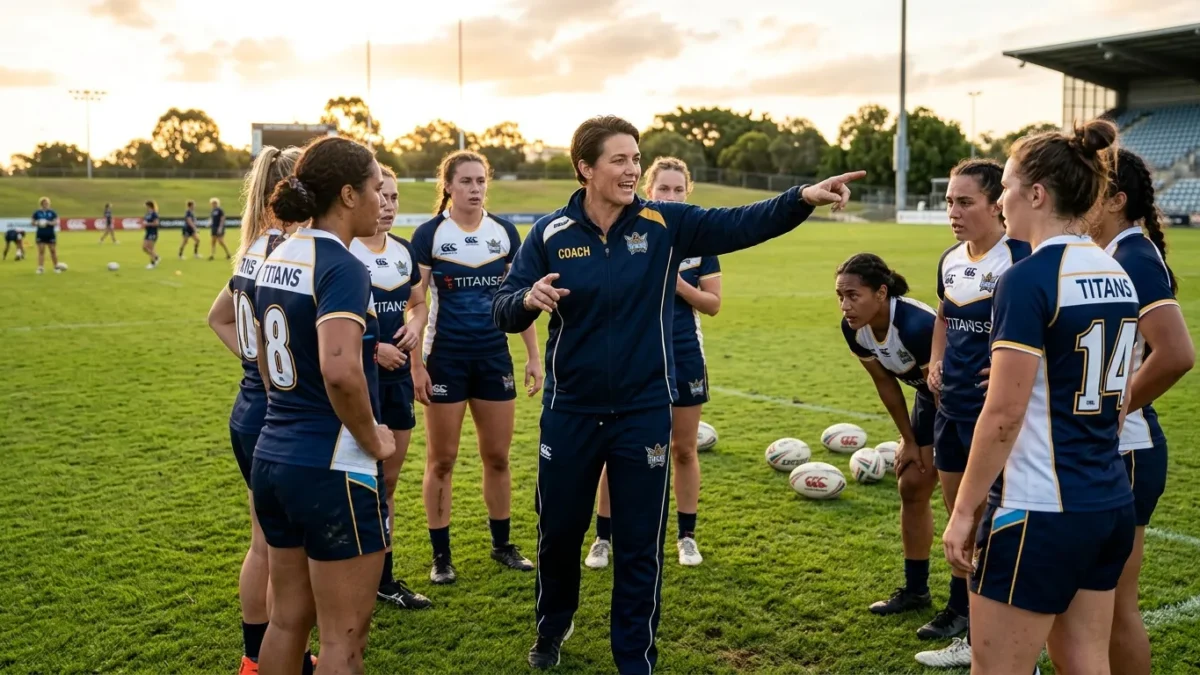
Only three female head coaches led their nations at the last Rugby World Cup — France, Australia, and Japan. Three, out of a full tournament field. That number alone tells you everything about where women’s coaching currently stands, and why voices like Emily Scarratt’s matter so much right now.
Why female coaches are a game-changer for women’s rugby
Scarratt has been refreshingly direct on the subject. She believes women in coaching positions send a powerful signal to the next generation — not just as role models, but as proof that the pathway exists. Seeing female coaches in charge of top squads normalises ambition at every level of the sport, from grassroots clubs to elite international setups.
Her current England head coach, John Mitchell, shares that conviction. When asked whether Scarratt and fellow veteran Marlie Hunter — who together hold a combined 260 international caps — could realistically take charge of England ahead of the 2033 Rugby World Cup, he didn’t hesitate. “Most definitely,” he said, adding with a laugh that he’d probably be well into his 70s by then. His confidence isn’t just polite. It’s rooted in what he’s observed about their approach to the game.
Mitchell described both players as exceptionally curious and deeply committed to understanding rugby at its highest level. Curiosity, he argued, separates good players from great future coaches. You don’t earn over 100 Test caps, or become the most-capped English women’s player in history, without an obsessive work ethic and a constant desire to improve. Those same qualities translate directly into coaching.
| Player | International caps | Notable achievement |
|---|---|---|
| Emily Scarratt | 130+ | Most-capped English women’s player in history |
| Marlie Hunter | 130+ | Former England captain, tipped for head coach role since 2018 |
Back in 2018, Simon Middleton — Hunter’s former head coach with England — already identified her as a future leader at the top level. That kind of early recognition matters. It plants a seed, and it tells a player that coaching isn’t just a possibility, it’s an expectation.
Navigating old friendships in a new coaching role
Stepping into a coaching position within the squad you’ve played in for years is one of the trickiest transitions in team sport. Scarratt knows it intimately. Scrum-half Natasha Hunt, one of her closest friends and a regular co-host on Scarratt’s podcast The Good, the Scaz and the Rugby, was her former room-mate during England camps. Now, the dynamic has shifted.
Scarratt joked that Hunt “tried pretty hard” to keep their old rooming arrangement alive during the Six Nations. It didn’t stick. Hunt now rooms with Marlie Packer, which Scarratt reassured listeners about with characteristic humour : “She is safe and well looked after.” The lightness matters — it shows she hasn’t lost herself in the role.
- Podcast episodes with Hunt were pre-recorded so Scarratt could stay fully focused on her coaching duties during the Six Nations.
- Scarratt acknowledged she can no longer share certain tactical or squad information with Hunt, given their player-coach relationship.
- She’s clear that pretending old friendships don’t exist would be counterproductive — and frankly, stranger than acknowledging them.
“There is no point trying to pretend we are not friends,” she said. Forcing a cold distance would ring false to every player in the squad. Authentic relationships, handled with clear professional boundaries, are far more effective than manufactured detachment. This balance — warm but boundaried — is something Hunter has already had to work through, and her experience gives Scarratt a useful reference point as she finds her footing.
Building more accessible pathways for women in rugby coaching
Scarratt is measured about her own future. She’s not ready to talk about one day becoming a head coach — there’s work to do first, lessons to absorb at this level. But her commitment to expanding opportunities for women across coaching structures is unambiguous and urgent.
The gap is structural, not motivational. Scarratt points to three interconnected problems : a shortage of qualified female coaches available to fill roles, a lack of visibility of women already doing the job, and barriers to access that limit who can even begin the journey. Fix the pipeline, and the talent will follow. Right now, the pipeline is narrow.
“Fundamentally, we need to do a better job,” she said — whether that means upskilling existing candidates, making coaching education more accessible, or simply putting female coaches in front of cameras so young women can see themselves reflected in those positions. All three matter. Visibility without accessibility is incomplete, and accessibility without upskilling leaves coaches underprepared.
The reliance on former elite players to fill coaching vacancies is understandable but insufficient as a long-term strategy. Not every great rugby mind played at international level. Broadening recruitment beyond ex-professionals would immediately deepen the coaching pool and bring in perspectives that pure playing experience can’t always provide.
One practical step several rugby unions have begun exploring is creating part-time or flexible coaching qualifications that don’t require candidates to walk away from existing careers. England Rugby, for instance, has invested in development programmes aimed at women entering coaching for the first time. These initiatives are a start — but the scale of ambition needs to match the scale of the challenge. With the 2033 Rugby World Cup now the next horizon, there’s a real window to reshape who stands on the touchline at the highest level of the women’s game.
