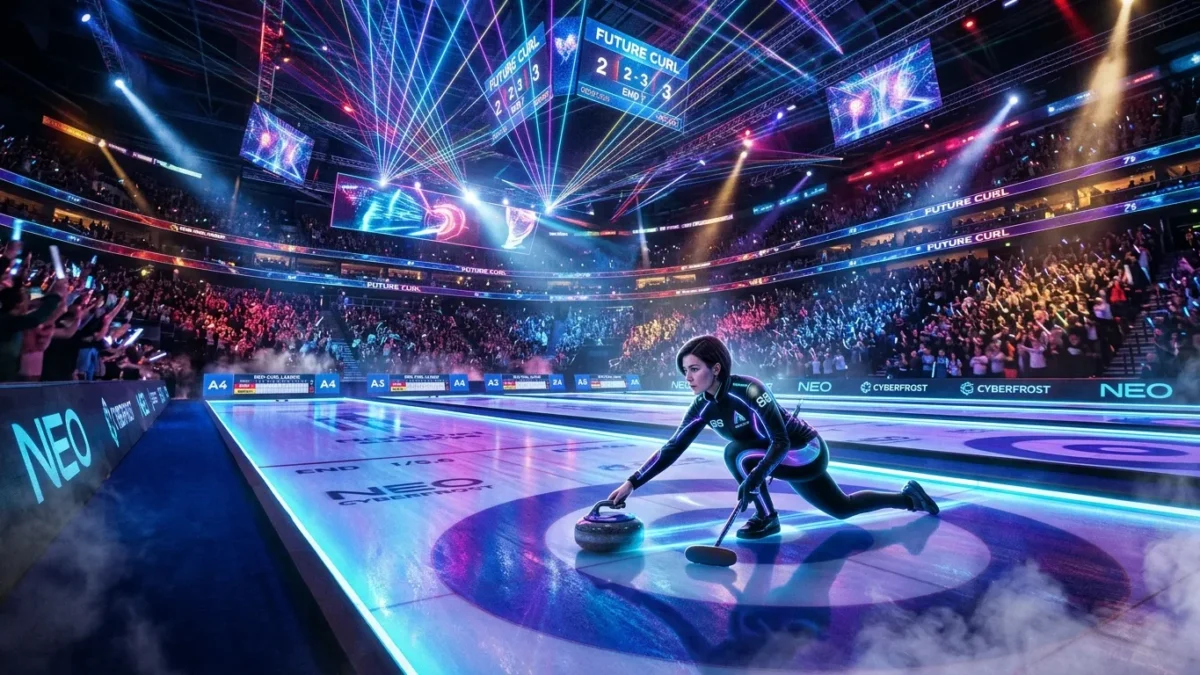
The Rock League is making serious noise in the curling world — and for good reason. This new entertainment-driven format is shaking up a sport that, frankly, has sometimes struggled to capture mainstream attention. With franchises spanning four continents and a roster packed with Olympic medallists, the question isn’t just whether this concept works. It’s whether it represents the direction curling must take to survive and thrive.
A bold new format built around star power
The Rock League’s franchise model is deliberately designed to mix nationalities, personalities, and playing styles under one roof. Think less traditional national federation event, more global sports league with real commercial ambition. Seven Scottish curlers feature prominently in the inaugural edition — five of whom competed at the Winter Olympics in Cortina, with two others fresh from the recent World Championship.
The headline name is hard to miss. Bruce Mouat, one of Britain’s most decorated curlers, skips the Northern Shield franchise. He’s joined by Olympic mixed doubles partner Jen Dodds and fellow Scot Robin Brydone. That combination alone brings significant pedigree to the table.
Here’s a snapshot of where the key Scottish players are competing across the Rock League franchises :
| Player | Franchise | Notable background |
|---|---|---|
| Bruce Mouat | Northern Shield | Olympic medallist, World Champion |
| Jen Dodds | Northern Shield | Olympic mixed doubles partner of Mouat |
| Robin Brydone | Northern Shield | Recent World Championship participant |
| Eve Muirhead | Alpine Curling Club (GM) | 2022 Olympic gold medallist |
| Hammy McMillan | Alpine Curling Club | Elite-level Scottish curler |
| Grant Hardie | Frontier Curling Club | Olympic gold medallist |
| Ross Whyte | Maple United | World Championship competitor |
| Bobby Lammie | Typhoon Curling Club | Olympic medallist |
Eve Muirhead, the 2022 Olympic gold medallist who also served as Team GB’s chef de mission at the most recent Winter Games, steps into a general manager role with Alpine Curling Club alongside Hammy McMillan. It’s a smart move — Muirhead brings credibility, leadership, and a profile that resonates well beyond the curling community.
When sport meets entertainment : the Rock League’s real challenge
Let’s be honest : the Rock League’s success hinges on more than just athletic quality. Plenty of elite competitions already deliver that. What this format is selling is something different — cross-cultural team dynamics, unexpected pairings, and the kind of human stories that casual fans actually care about.
The most compelling example ? Bobby Lammie competing for Typhoon Curling Club, the Asian franchise, alongside his girlfriend Seol Ye-eun. Lammie himself acknowledged the obvious to BBC Sport Scotland : “That could be an interesting dynamic. I’m looking forward to it, but hopefully we don’t fall out.” It’s exactly the kind of candid, relatable moment that makes sports entertainment work.
Beyond the romantic subplot, Lammie flagged a more structural challenge that gets to the heart of what makes the Rock League genuinely innovative — and genuinely complicated :
- Chinese players communicating across language lines
- Japanese and Korean athletes adapting to a mixed team environment
- New Zealand and Swedish curlers bridging entirely different sporting cultures
“The main challenge for us, in the Asian franchise, is going to be the language barrier,” Lammie explained. A team spanning Chinese, Japanese, Korean, New Zealand, and Swedish players has to find a shared rhythm — on the ice and off it. His attitude, though, is refreshingly direct : “That’s part of the fun.” That mindset is exactly what this format needs from its participants to succeed.
Meanwhile, Grant Hardie lines up with American outfit Frontier Curling Club, while Ross Whyte joins the Canadian team Maple United. These pairings aren’t accidental — they’re designed to give each franchise a local identity and fan base while keeping the playing standards consistently high. Between the Scottish contingent alone, five Olympic medals from the Cortina Games are represented. As Muirhead put it : “I think we’ve five Olympic medals between us from this recent Games, which is pretty incredible.”
Rock League’s entertainment model could redefine curling’s future audience
Curling’s viewership numbers at major championship level remain modest compared to team sports with global footprints. The entertainment-led league format being trialled here is a direct response to that reality. Rather than waiting for casual fans to discover curling through traditional pathways, the Rock League is going out to meet them.
The franchise structure borrows from models that have worked elsewhere — notably in cricket’s IPL and rugby’s emerging league formats — where international stars compete under city or regional banners rather than national flags. The emotional investment shifts. Fans follow players, not just countries.
For curling specifically, this matters because the sport’s international growth outside its traditional strongholds in Scotland, Canada, and Scandinavia depends on exactly this kind of access point. The Typhoon franchise, with its multilingual roster and Asian identity, isn’t just a logistical challenge for Bobby Lammie. It’s a statement about where curling wants to plant its flag next.
The real test for the Rock League won’t come from the quality of the sweeping or the precision of the stones. It will come from whether broadcasters, sponsors, and new audiences engage with the product across a full season. The talent is clearly there — with Olympic gold, silver, and bronze medallists on the ice simultaneously, the on-ice product is credible. What remains to be seen is whether the entertainment format can convert that credibility into genuine mainstream momentum for the sport.
