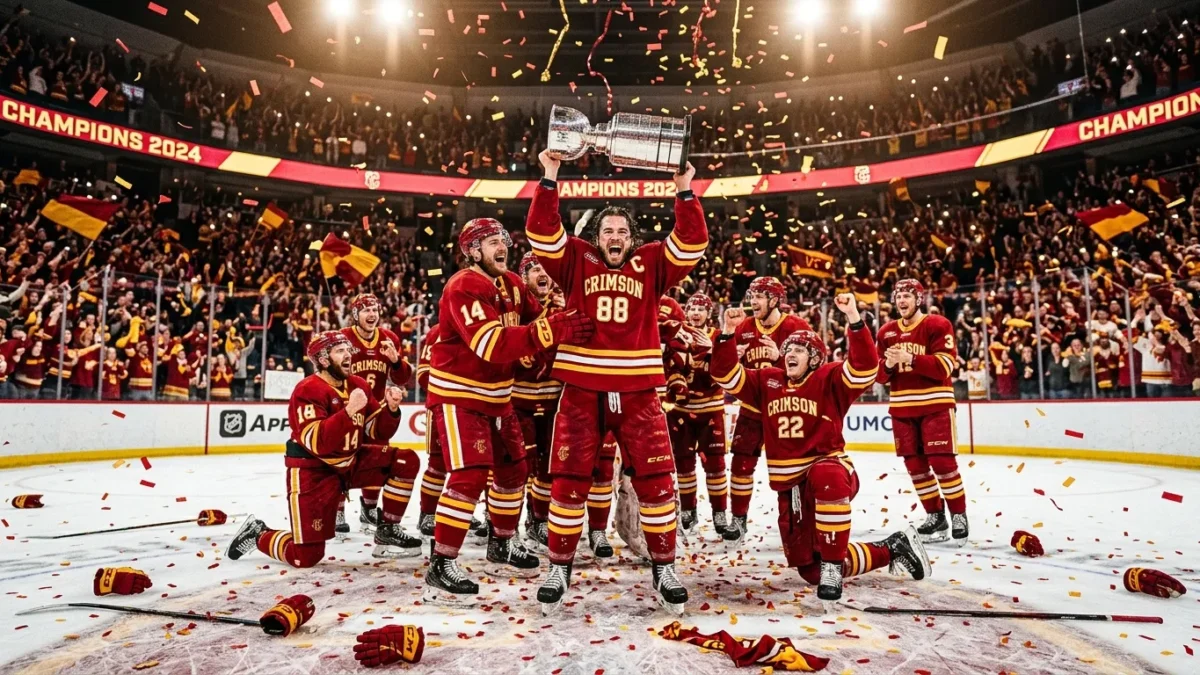
Las Vegas witnessed something special on April 12, 2026. The Denver Pioneers defeated the Wisconsin Badgers 2-1 in the NCAA Men’s Hockey Championship, clinching their third national title in five years and pushing their all-time record to an unmatched 11 national championships. This wasn’t a dominant performance on paper — but frankly, dominance on the scoresheet has never been the Pioneers’ calling card this season.
Johnny Hicks : the wall that Wisconsin couldn’t crack
Let’s be direct : Denver wins this championship because of Johnny Hicks. Full stop. The goaltender made 29 saves against Wisconsin, two days after a jaw-dropping personal-best 49-save performance against Michigan in the semifinals. At that point, you’re not watching a goalie — you’re watching something else entirely.
Hicks entered the final leading the entire nation with a 1.20 goals-against average and a .957 save percentage. His regular-season record after taking over as starter ? A staggering 16-0-1, without a single loss in regulation. The Most Outstanding Player award — which he also received in Denver’s conference and regional tournaments — was never in doubt.
“I was just playing off instinct,” Hicks said after the game, with characteristic understatement. When asked about the team’s journey, emotion broke through : “I’m so happy that we could get it done with this group. We’ve gone through so much adversity, and I’m just so proud of this group.”
Wisconsin’s Daniel Hauser, by contrast, faced far less work — the Badgers outshooting Denver 21-5 through the first two periods. Hauser stopped 13 shots overall. The numbers paint a lopsided picture, but hockey doesn’t always reward the team with more shots. Denver knows this better than anyone.
How the Pioneers scored when it mattered most
Wisconsin drew first blood. Vasily Zelenov’s blast from the left circle, off a rush with 6 :24 left in the first period, put the Badgers up 1-0 — a lead that held for over 33 minutes of game time. Denver, meanwhile, recorded just two shots on goal in the first period. For context, that last happened in a championship game for the Pioneers back in 1963 against North Dakota.
Here’s how the comeback unfolded in the third period :
- 7 :31 — Rieger Lorenz ties it up : Kristian Epperson fed defenseman Garrett Brown at the left point, whose shot created a rebound that Lorenz buried into the open net around Hauser.
- 14 :08 — Kyle Chyzowski wins it : Boston Buckberger fired a one-timer from the right point, and Chyzowski deflected the puck past Hauser with 5 :52 remaining, completing the rally.
That tipped goal was the kind of play that separates championship teams from contenders. Chyzowski barely needed to touch the puck — Buckberger’s shot was already heading in — but the redirect sealed the deal and sent the Pioneers into celebration mode.
Eleven titles and a dynasty that refuses to fade
For Wisconsin, the loss stings. The Badgers were hunting their seventh national championship and their first since 2006. Twenty years is a long drought, and coming this close — leading for most of the game — makes it harder.
| Team | Total NCAA titles | Last title |
|---|---|---|
| Denver Pioneers | 11 | 2026 |
| Wisconsin Badgers | 6 | 2006 |
| Michigan Wolverines | 9 | 1964 |
| North Dakota Fighting Hawks | 8 | 2016 |
Denver’s third title in five years also reinforces something worth stating plainly : the National Collegiate Hockey Conference is the most dominant force in college hockey. Eight of the past 10 national champions have come from the NCHC. The Big Ten Conference had a remarkable academic year — Indiana in football, Michigan in men’s basketball, UCLA in women’s basketball — but the NCHC’s grip on the frozen crown remains firm.
The semifinal against Michigan told a similar story to Saturday’s final. The Wolverines outshot Denver 52-26 across regulation and overtime, yet the Pioneers forced a double-overtime situation and won 4-3. Getting outshot by a historic margin and still winning — twice in the same tournament — is either incredible luck or a reflection of elite goaltending and ruthless efficiency in front of the net. With Hicks between the pipes, it’s clearly the latter.
What this run reveals about Denver’s championship identity
Strip away the emotion and look at what Denver actually did in this tournament : they consistently surrendered shot advantages, relied on Hicks to make extraordinary saves, and converted their limited opportunities with cold precision. Against Michigan, they faced 52 shots. Against Wisconsin, they managed just five shots through 40 minutes. Neither performance looked like a champion-in-the-making — until the final buzzer.
This raises a question worth sitting with : does shot volume define quality in college hockey, or does this Pioneers squad expose the limits of that metric entirely ? For coaching staffs across the country, Denver’s approach — built on elite goaltending, structured defense, and opportunistic offense — offers a genuine blueprint worth studying.
Minnesota was the last team to record as few shots as Denver did in a single period of a title game, and that happened just three years ago. The Pioneers have turned low-event hockey into a winning formula at the highest level. Eleven national championships don’t lie.
