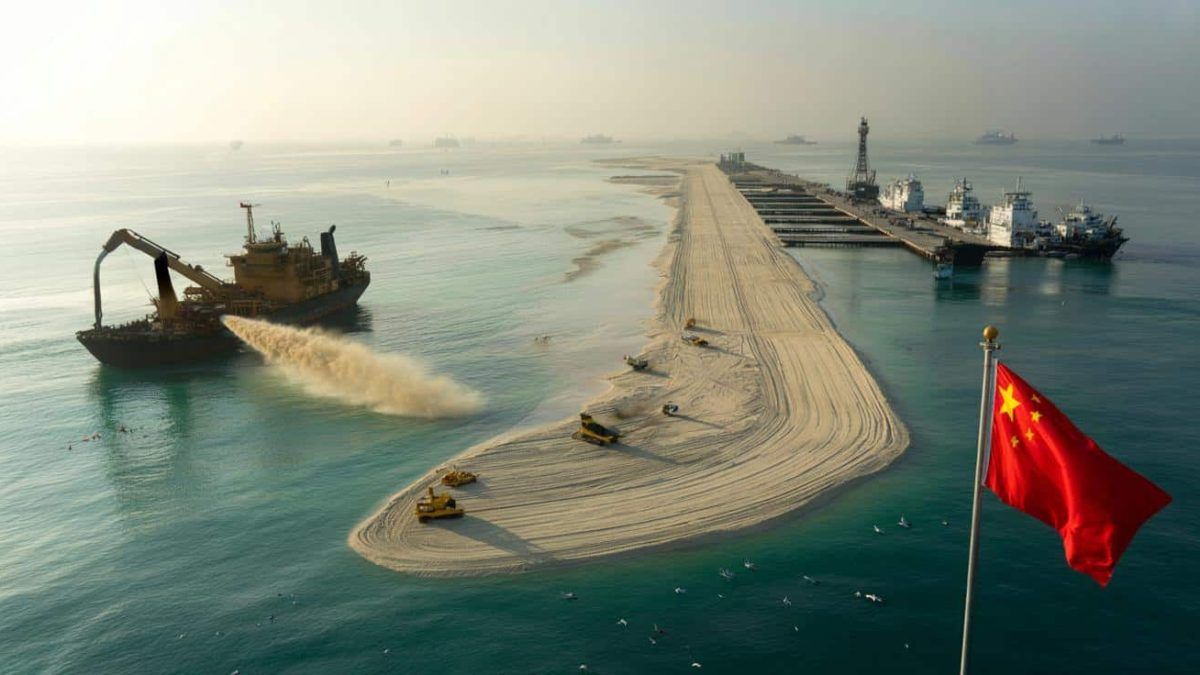
Between 2013 and 2017, China added approximately 3,200 acres of brand-new land to the South China Sea — land that simply did not exist before. Not reclaimed coastline. Not reinforced shoreline. Entirely fabricated terrain, built reef by reef, using industrial-scale sand pumping operations that ran continuously for years. This is one of the most audacious feats of geoengineering ever attempted, and its consequences stretch well beyond the disputed waters where it happened.
How China engineered artificial islands on top of living coral reefs
The process begins with what engineers call cutter suction dredging. Massive vessels scrape sand and rubble directly from nearby seabeds, then pump the resulting slurry onto low-tide reef features — platforms that barely break the surface at high tide. Mischief Reef, Subi Reef, and Fiery Cross Reef were among the primary construction sites. Bulldozers compacted the deposited material, while concrete retaining walls were erected to prevent wave erosion from undoing months of work.
A 2016 study using Landsat satellite imagery quantified what this looked like from orbit : more than 15 square kilometers of submerged coral reef were converted into artificial land between mid-2013 and late 2015. That figure represents thousands of football fields of living reef foundation replaced by fill and concrete. Think about that scale for a moment.
Once the basic landmass stabilized, construction crews installed :
- Power generation plants and fuel storage depots
- Desalination units to supply fresh water
- Runways long enough to accommodate military aircraft
- Radar domes and port infrastructure
- Patches of imported soil planted with trees for visual effect
Frankly, the logistical achievement here is staggering. But what lies beneath those runways is smothered coral — buried, not preserved. Imported soil and a few palm trees do not change that reality.
Sediment plumes and the underwater damage nobody sees from space
The ecological destruction does not stop at the new shoreline. It spreads outward through massive turbidity plumes — clouds of suspended sediment that radiate from construction zones like slow-motion explosions. The same 2016 Landsat-based study detected plumes covering more than 4,300 square kilometers of surrounding ocean. That is roughly the size of the state of Rhode Island blanketed in murky, sediment-laden water.
A 2019 case study focused specifically on Mischief Reef went deeper. Researchers used ocean color satellite data and measured backscatter increases of up to 350 percent in adjacent waters. Their analysis estimated that dredging and construction activities affected more than 1,200 square kilometers of reef habitat over time. The numbers are hard to dismiss.
| Metric | Finding | Source |
|---|---|---|
| Reef area converted to land (2013–2015) | >15 km² | 2016 Landsat study |
| Total new land created (2013–2017) | ~3,200 acres | Scientific Reports |
| Turbidity plume coverage | >4,300 km² | 2016 satellite analysis |
| Backscatter increase near Mischief Reef | Up to 350% | 2019 case study |
Suspended sediment behaves like a permanent dust storm beneath the surface. It blocks sunlight from reaching coral polyps, clogs their feeding mechanisms, and settles onto seagrass beds. Chlorophyll signals around construction zones dropped, pointing to declining biological productivity. Fish lose the three-dimensional structure reefs provide — shelter, feeding grounds, spawning habitat. A once-thriving underwater city becomes a flat, muddy wasteland.
Geopolitics, global trade, and what these islands actually mean for you
Here is where the story stops being just about coral. Roughly one-third of global maritime trade by volume passes through the South China Sea. Smartphones, grain, oil, electronics — all of it moves through these contested waters. China’s artificial islands effectively extend its physical presence across a region it claims almost entirely under its so-called nine-dash line, a boundary rejected by a 2016 Permanent Court of Arbitration ruling that Beijing has consistently ignored.
Biologically, the South China Sea borders the Coral Triangle — the planet’s most biodiverse marine region. Hundreds of reef-forming coral species and thousands of fish species depend on these habitats. For coastal communities across Vietnam, the Philippines, Malaysia, and Indonesia, these reefs represent direct food security and fishing income. Destroyed nursery grounds affect fish stocks that entire communities rely on for protein.
Unlike natural islands that co-evolve with surrounding ecosystems, these manufactured platforms offer zero ecological resilience. They do not grow with the reef — because the reef is gone. As climate-driven bleaching events intensify and ocean acidification accelerates, the surrounding ecosystem loses natural buffers precisely when it needs them most. The construction pressure stacks on top of warming seas and heavy fishing activity, compressing multiple stressors into one region simultaneously.
My take ? Satellite monitoring alone is not enough. Scientists publishing in Scientific Reports have called for strict limits on further dredging and meaningful regional conservation frameworks. Without enforceable agreements, the remaining healthy reefs in the South China Sea face a trajectory that leading marine biologists describe as long-term collapse. A disruption in these fisheries and shipping lanes would eventually surface in freight costs and seafood prices far from Asia — including in supermarkets that have never heard of Fiery Cross Reef.
