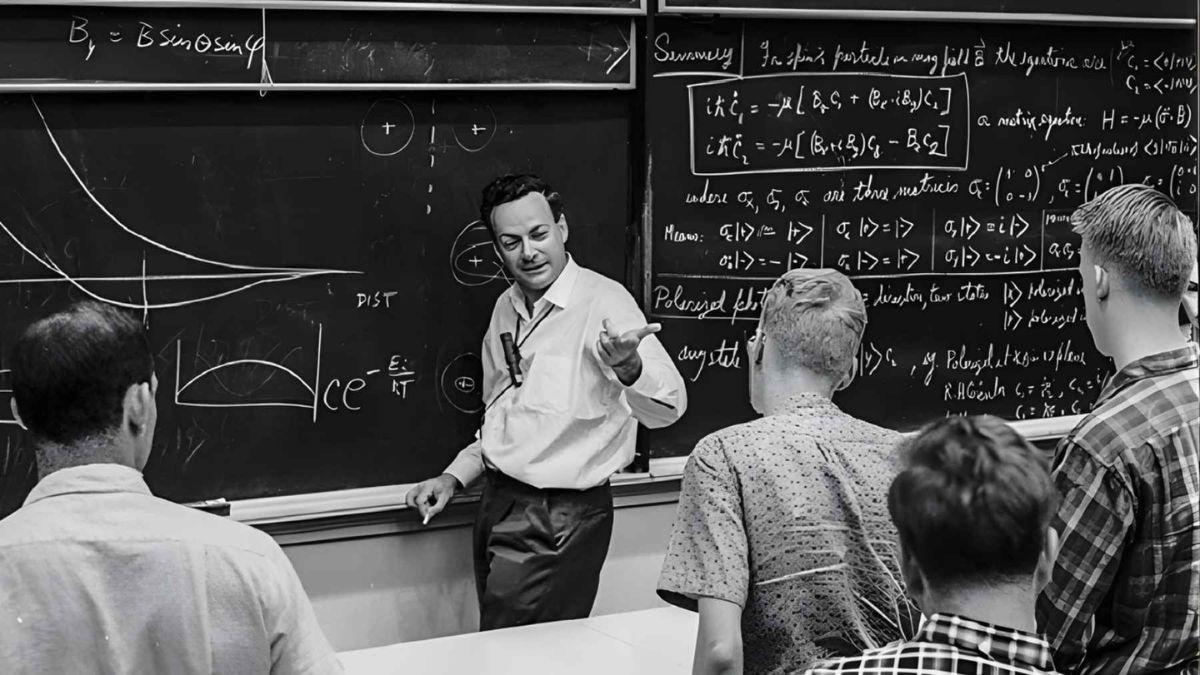
December 29, 1959. Richard Feynman steps up at the annual meeting of the American Physical Society, hosted at Caltech in Pasadena, and drops a line that will echo for decades : the entire Encyclopaedia Britannica could, in theory, fit on the head of a pin. Not as a magic trick. Not as a metaphor. As a hard, physics-backed argument.
What Feynman actually said — and why it wasn’t science fiction
The talk, later published in the February 1960 issue of Engineering & Science under the title There’s Plenty of Room at the Bottom, wasn’t speculative poetry. Feynman made a precise calculation : reduce the text by roughly 25,000 times, and the full 24 volumes of the Encyclopaedia Britannica fit on a pinhead — still readable under an electron microscope. A pinhead is about one-sixteenth of an inch across. The math checks out.
He didn’t stop there. Pulling numbers from the Library of Congress, the British Museum Library, and France’s national library, he estimated around 24 million volumes of genuine interest across human civilization. His conclusion ? Stack them all together and they’d occupy roughly a million pinheads — a few square yards of material, small enough to carry like a folded pamphlet. That’s not poetry. That’s engineering logic.
The sharpest line in the talk was a direct challenge to the audience : “We are not doing it simply because we have not yet gotten around to it.” No new laws of physics required. The door to extreme miniaturization was wide open. Humanity just hadn’t walked through it yet.
Two $1,000 bets that turned ideas into milestones
Feynman wasn’t content with theory. He put cash on the table — twice. First, he offered $1,000 to the first person who could shrink the text of a book page by 25,000 times. Second, another $1,000 for a working electric motor small enough to fit inside a cube one sixty-fourth of an inch on each side. These weren’t vague challenges; they were precise, verifiable engineering targets.
The motor prize fell fast. In 1960, William McLellan claimed it — using a microscope, a watchmaker’s lathe, and a toothpick to handle the parts. No exotic science. Just extraordinary craftmanship pushed to its limit. The episode makes a point worth sitting with : miniaturization often demands patience and precision far more than it demands breakthroughs.
The writing challenge took 25 more years. In November 1985, Tom Newman, then a graduate student at Stanford University, used electron-beam lithography — writing with a focused beam of electrons — to shrink a page down to a square measuring just 0.00023 inches per side. His adviser, R. Fabian Pease, called it a brutal technology exercise. The prize letter read : “Congratulations to you and your colleagues.” Simple words for a genuinely remarkable achievement.
| Challenge | Winner | Year claimed | Method used |
|---|---|---|---|
| Miniature electric motor | William McLellan | 1960 | Watchmaker’s lathe, microscope, toothpick |
| Shrinking a page 25,000× | Tom Newman (Stanford) | 1985 | Electron-beam lithography |
From pinheads to atoms : how the vision became a field
The word “nanotechnology” didn’t exist in 1959. Japanese engineer Norio Taniguchi coined it in 1974 — fifteen years after Feynman planted the conceptual seed. A nanometer is one-billionth of a meter. At that scale, materials stop behaving the way they do at human-visible sizes : electrical conductivity shifts, chemical reactivity changes, optical properties transform. Feynman had sensed this territory was accessible long before the vocabulary existed to name it.
He also pushed hard on one specific bottleneck : imaging. “What you should do in order for us to make more rapid progress is to make the electron microscope 100 times better,” he told the audience. Build as small as you want — but if you can’t inspect your work reliably, you’re flying blind. That constraint proved prophetic. The 1986 Nobel Prize in Physics went partly to the development of the scanning tunneling microscope, a tool capable of mapping surfaces atom by atom. Science rewarded exactly what Feynman had identified as the missing link.
Biology featured prominently in the talk too. Feynman pointed to DNA as proof that nature already stores vast information in microscopic space — no special pleading needed. He also floated, half-seriously, an idea from his colleague Albert R. Hibbs : a miniaturized “mechanical surgeon” swallowed by a patient, navigating blood vessels to repair a faulty heart valve. Fantastical in 1959, perhaps. Less so now.
Here’s what separates serious progress in this field from noise :
- Stable fabrication at nanometer scale, not just one-off demonstrations
- Reliable imaging and inspection tools to verify the work
- Materials that behave predictably at atomic dimensions
- Energy efficiency — tiny machines must run without generating destructive heat
Atomic memory and the next frontier Feynman couldn’t name
In 2016, researchers Floris Kalff and Adriaan Otte at Delft University of Technology published a paper in Nature Nanotechnology describing a rewritable atomic memory storing one kilobyte — 8,000 bits — at a density of 502 terabits per square inch. Stability held up to 77 kelvin (around minus 321°F). That’s not a product you’ll buy next year, but the density figure is staggering compared to anything available commercially.
Feynman’s 1959 talk didn’t predict smartphones or solid-state drives. What it did was remove the psychological ceiling that made extreme miniaturization seem inherently impossible. He reframed the question : not “can physics allow this ?” but “what engineering problems are actually in the way ?” That shift in framing — from theoretical barrier to practical challenge — is arguably the most durable contribution of the whole talk.
If you want to think like Feynman about any frontier technology today, start with that exact move. Identify what physics genuinely forbids, then separate that from what engineers simply haven’t built yet. The gap between those two things is where every real breakthrough lives.
