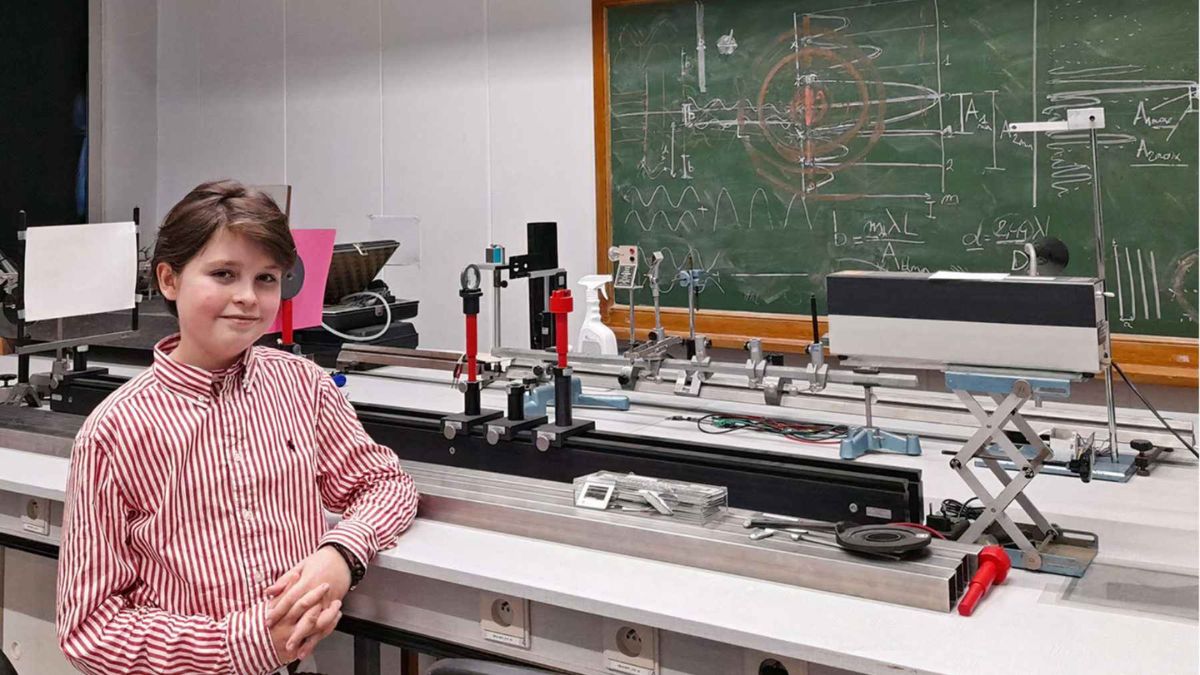
At 15, Laurent Simons has already done what most researchers spend entire careers working toward. He defended a PhD in quantum physics at the University of Antwerp — his thesis titled “Bose polarons in superfluids and supersolids” — and moved almost immediately to Munich to begin a second doctorate, this time in medical science. His stated goal ? defeating aging using artificial intelligence. Not slowing it down. Defeating it.
A scientific trajectory that defies every normal timeline
Most people finish secondary school around 18. Laurent Simons completed his at age 8. He then tore through bachelor’s and master’s degrees in physics at a pace that left academic institutions scrambling to keep up. Before his teenage years were over, he had already interned at the Max Planck Institute for Quantum Optics in Germany, one of the world’s leading research centers for quantum science.
His PhD work in Antwerp was far from elementary. Bose-Einstein condensates represent an exotic state of matter where atoms are cooled to near absolute zero and begin behaving as a single coherent quantum wave. Studying how lone impurity particles move through these systems — so-called Bose polarons — helps physicists model complex quantum interactions that could one day power next-generation quantum computers and ultra-precise sensors. It’s foundational, rigorous, and genuinely difficult work.
Then came the pivot. Quantum physics to biomedicine might seem like an abrupt leap, but the logic holds : advanced computational tools built on quantum-inspired methods and AI now allow scientists to simulate biological tissues and disease processes entirely on computers. This is what researchers call in silico bioengineering. No human test subjects at this stage — just algorithms, massive datasets, and simulation environments. Simons stepped straight into this frontier in Munich, where his lab applies AI-driven modeling to design new therapies and reimagine how human biology ages.
The longevity race : who else is betting on defeating aging
Simons is not working in a vacuum. The longevity sector has exploded with private investment over the past several years. Companies like Altos Labs and Retro Biosciences are pouring hundreds of millions into cell rejuvenation research. Jeff Bezos personally backed Altos Labs at its 2022 launch with a reported $3 billion commitment. The science of extending healthy human lifespan has gone from fringe speculation to a competitive research field with serious institutional weight behind it.
Here’s where Simons’ dual expertise becomes genuinely interesting. His background in quantum physics feeds directly into the AI models he now uses in biomedical research. The pathway from frozen atom behavior to cellular aging mechanisms runs through computational modeling — and few researchers his age, or frankly any age, straddle both domains with formal credentials in each.
| Research area | Key method | Potential application |
|---|---|---|
| Quantum physics (Antwerp PhD) | Bose-Einstein condensates | Quantum computing, precision sensors |
| Medical AI (Munich PhD) | In silico bioengineering | Therapy design, aging reversal |
His explicit ambition of “creating superhumans” sits at the heart of a bioethics debate that typically involves seasoned academics and institutional review boards — not teenagers. European universities mandate strict ethical oversight for any research touching human subjects or genetic modification. None of the documented work around Simons’ current program indicates clinical trials or radical experimentation. But the framing matters : when a 15-year-old publicly declares he wants to conquer human aging, the conversation shifts from academic to societal fast.
Real costs behind the superhuman dream
There’s an inconvenient side to this story that deserves a direct look. The AI systems powering in silico bioengineering are not free — not financially, and certainly not ecologically. Global data centers consumed approximately 415 terawatt-hours of electricity in 2024, accounting for roughly 1.5% of worldwide energy demand. Projections suggest that figure could more than double by 2030. The hardware behind these models depends on rare minerals, and the cooling systems require substantial water consumption.
The environmental stakes of longevity science go further still. A world where people live significantly longer while maintaining current consumption patterns would place additional pressure on resources, ecosystems, and carbon budgets. This isn’t a reason to stop the research — but it’s a reason to take the broader context seriously. Consider the compounding challenges this work sits inside :
- Rising global energy demand from AI infrastructure
- Increased lifetime resource consumption from extended lifespans
- Unequal access to advanced medical treatments
- Ethical governance gaps around enhancement technologies
Frankly, the most important questions here aren’t being asked loudly enough. Who gets access to life-extension therapies if they ever work ? If these treatments remain expensive and scarce, the gap between those who age and those who don’t could become the sharpest social divide in human history. The science is moving faster than the governance frameworks designed to manage it.
What a 15-year-old PhD holder reveals about where science is heading
Simons’ trajectory is not just an individual story — it’s a signal. Quantum research feeding into AI, AI feeding into biomedicine : this convergence is already reshaping how scientists approach the hardest problems in biology. The infrastructure enabling it — server farms, rare earth supply chains, energy grids — connects laboratory ambitions to the physical world in ways researchers rarely acknowledge publicly.
For anyone following the future of human longevity research, the practical takeaway is this : watch not just the science, but the systems that make it run. The next breakthrough in aging research may come from a model trained on data centers powered by renewable energy — or it may come saddled with a climate cost nobody fully accounted for. Laurent Simons is working at the sharpest edge of what’s possible. The rest of us need to decide what kind of world we want that edge to cut into.
