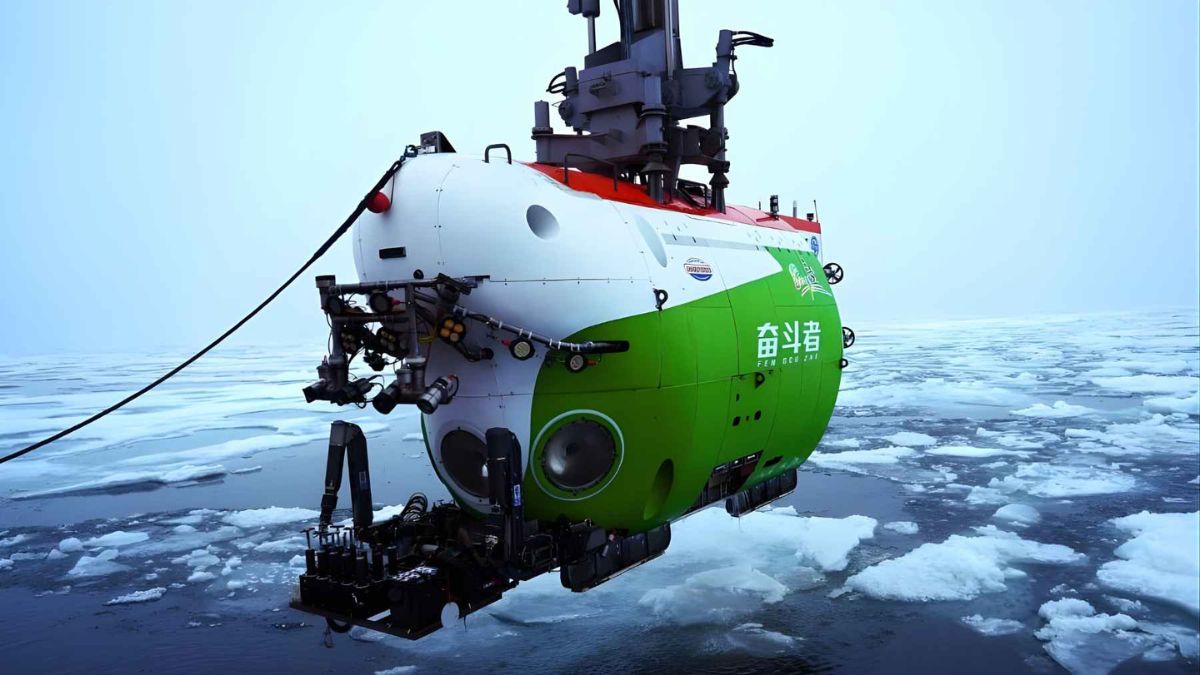
5,277 meters below the Arctic Ocean, where no crewed vessel had ever gone before, a Chinese submersible touched down on one of the most geologically significant seafloors on Earth. This wasn’t a stunt. The Fendouzhe mission to the eastern Gakkel Ridge represents a genuine scientific leap — the kind that forces researchers to redraw both maps and theories about how our planet works beneath its frozen surface.
The Gakkel Ridge : Earth’s most inaccessible underwater mountain range
Stretched between Greenland and Siberia, the Gakkel Ridge forms part of the global mid-ocean ridge system — the vast underwater network where tectonic plates pull apart and new oceanic crust continuously emerges from the mantle below. Most people picture volcanoes as things that erupt on land. The Gakkel Ridge does something quieter and, frankly, more fascinating : it reshapes the ocean floor in almost total darkness, under kilometers of seawater and a permanent ceiling of pack ice.
For decades, scientists could only observe this ridge through sonar maps and a handful of brief surveys using uncrewed autonomous vehicles. The western section yielded a crucial discovery in 2003, when a Nature study confirmed the presence of hydrothermal vents — underwater hot springs sustaining ecosystems that don’t rely on sunlight, but on chemical energy. The eastern section, however, remained completely off-limits. Huang, the expedition’s lead researcher, referred to it bluntly as the last piece of the puzzle. That description tells you everything about how significant this blind spot was.
The logistical problem wasn’t scientific ignorance — it was ice. More than 80% of the water surface in that area stays permanently covered. No crewed submersible had ever operated under such conditions until the Chinese Academy of Sciences and the Ministry of Natural Resources mounted this joint mission in 2026.
How the Fendouzhe team cracked the ice problem
Getting a crewed submersible beneath Arctic pack ice requires solving an engineering puzzle that has no elegant solution — only a practical one. The expedition deployed two vessels together : the deep-sea submersible Fendouzhe and the ice-capable research ship Tan Suo San Hao. Their coordination method was methodical and deliberate.
Before each dive, Tan Suo San Hao broke open a temporary pool in the ice to allow Fendouzhe to enter the water. The dive itself was one challenge; surfacing safely was another. Rather than simply ascending, Fendouzhe paused beneath the surface and used sonar and cameras to locate open water gaps, then either rose through a natural opening or waited for the ship to clear one. The submersible Jiaolong joined some dives to test cooperative underwater operations, adding a layer of redundancy in an environment where a single miscalculation can be catastrophic.
Across the three-month voyage, the team completed 43 total dives, with 32 conducted specifically under heavy ice cover. That number matters. It demonstrates that sustained crewed operations beneath Arctic pack ice are operationally viable — something that had never been proven at this scale before.
| Key metric | Value |
|---|---|
| Maximum dive depth | 5,277 meters |
| Total dives completed | 43 |
| Dives under heavy ice cover | 32 |
| Mission duration | ~100 days |
| Ice surface coverage | >80% |
What the submersible actually collected — and why it matters
Raw data from the seafloor doesn’t announce its significance immediately. The samples gathered during these 100 days at sea — sediment cores, rock samples, seawater, and biological specimens — will spend years in laboratories before yielding definitive conclusions. But the immediate findings already carry weight.
The cameras and sonar systems aboard Fendouzhe replaced the blurred outlines of earlier sonar maps with high-resolution footage of actual seafloor terrain : underwater hills, canyons, geological formations that no human eye had ever observed. This alone justifies the mission.
The scientific priorities driving the sample collection were clear :
- Determine whether hydrothermal vents exist on the eastern Gakkel Ridge, mirroring what a 2022 Nature Communications study confirmed on the western section
- Identify biological communities that may survive on chemical energy, independent of sunlight
- Gather geological data to refine models of crustal formation in ultra-slow spreading environments
- Collect baseline oceanographic data relevant to Arctic climate modeling
The potential discovery of hydrothermal vent ecosystems on the eastern ridge carries implications that extend well beyond Arctic geology. Scientists studying icy moons like Europa — Jupiter’s moon with a subsurface ocean — use Earth’s chemosynthetic ecosystems as reference models for where extraterrestrial life might exist. A confirmed hydrothermal ecosystem beneath Arctic ice would strengthen that analogy considerably.
The broader picture : Arctic seafloor data in a warming world
Mid-ocean ridges aren’t isolated geological features. They actively participate in the circulation of heat and dissolved chemicals through the deep ocean, influencing climate patterns that eventually manifest as the cold snaps and mild winters people experience on land. The Arctic is warming roughly four times faster than the global average — a figure that makes detailed seafloor data from this region genuinely urgent for climate modeling.
Better models mean sharper projections. Sharper projections inform decisions about coastal flood defenses, urban infrastructure, and long-term resource planning. The Gakkel Ridge data feeds into that chain, even if the connection isn’t obvious when you’re scraping ice from your car windshield on a January morning.
Frankly, what this mission has proven extends beyond any single scientific result. The operational framework developed here — pairing an icebreaking surface vessel with a crewed deep-sea submersible to work systematically under heavy ice — creates a repeatable methodology. Other research teams, other nations, other questions can now build on what the Chinese Academy of Sciences demonstrated. The eastern Gakkel Ridge is no longer the last unseen piece. It’s the newest starting point.
