Buried under forested hills in Pingjiang County, Hunan Province, a geological discovery is forcing the mining world to reconsider its assumptions about what still lies beneath our feet. Chinese geologists have identified what could become one of the largest gold deposits ever recorded — right beneath a field that was already known for its gold-bearing rock.
A gold deposit of staggering proportions beneath Hunan
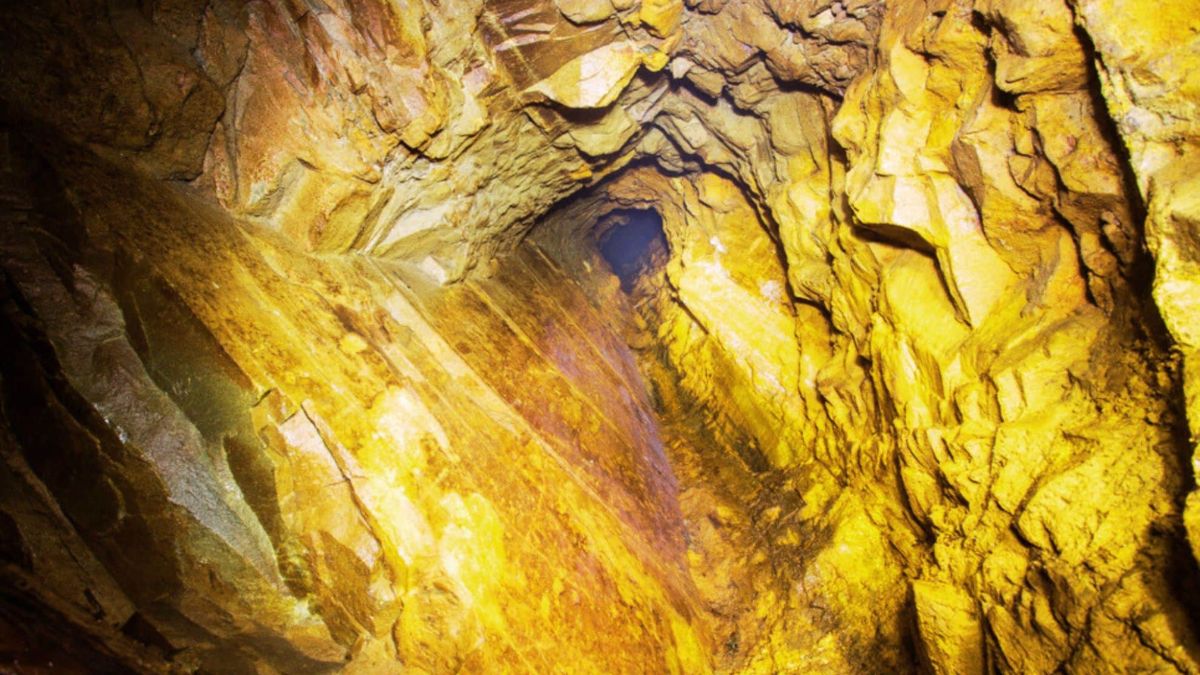
The Wangu gold field is not new territory. The Geological Bureau of Hunan Province has been drilling there for years, methodically boring through layers of ordinary rock in search of precious metal. What emerged from that patient work is anything but ordinary. Geologists have now mapped more than 40 gold-bearing veins within the first 2,000 meters — and those veins already contain an estimated 300 metric tons of gold.
The real headline, though, is what the models suggest lies deeper. Extend the drilling to 3,000 meters underground, and computer projections point to a total resource exceeding 1,000 metric tons of gold. At current market valuations, that translates to roughly 600 billion yuan, or approximately $85.9 billion. Those are preliminary numbers, but they are big enough to make any mining executive sit up straight.
Liu Yongjun, deputy head of the bureau, confirmed that the team relied on three-dimensional geological modeling to trace the veins at depth and position each new borehole with precision. Core samples from the outer edges of the field also show gold mineralization, which hints that the system could extend well beyond the boundaries mapped so far. The exploration is far from over.
| Depth range | Estimated gold resource | Key method |
|---|---|---|
| 0 – 2,000 m | ~300 metric tons | Physical drilling, core sampling |
| 0 – 3,000 m | >1,000 metric tons (projected) | 3D geological modeling |
Why this find matters for the global gold industry
Gold feels omnipresent in jewelry stores and news reports about central bank reserves, yet the actual supply is surprisingly finite. According to the United States Geological Survey and the World Gold Council, humanity has extracted roughly 200,000 metric tons of gold throughout history, with only around 60,000 metric tons remaining in economically viable known reserves. A single site that may hold more than 1,000 metric tons is therefore a genuinely significant fraction of what is left.
Grade matters as much as volume. Most underground gold operations are considered high-performing when ore averages 8 to 10 grams of gold per metric ton. Samples from Wangu have reportedly hit peaks near 138 grams per metric ton — a level that miners categorize as bonanza-grade. That is not a routine find. For comparison, South Africa’s South Deep mine, one of the world’s deepest and largest gold operations, operates at far lower average grades, which makes Wangu’s reported figures remarkable even if the final numbers shift during further drilling.
Here are the key factors that explain why the Wangu discovery stands out :
- Ore grade reaching up to 138 g/t, far above industry average
- Potential resource exceeding 1,000 metric tons — rare for a single deposit
- Edge samples confirming mineralization beyond known boundaries
- 55 boreholes totaling roughly 65 kilometers already drilled
- A dedicated state enterprise, Hunan Mineral Resources Group, coordinating exploration
The geology behind extreme gold concentrations
Gold does not accumulate in rock by chance. The most widely supported explanation involves hot, mineral-rich hydrothermal fluids that once moved through deep fractures in Earth’s crust. As those fluids encountered changes in pressure and temperature, dissolved gold dropped out of solution and lined the cracks with quartz and metal over geological timescales.
Research published in Nature Geoscience showed that earthquakes accelerate this process dramatically. Seismic activity expands cavities within fault zones, causing trapped fluids to flash into vapor almost instantaneously — and dumping their dissolved gold in what geologists describe as a geological instant. Further work by researchers at Monash University in Australia added another layer : seismic compression can generate electric fields inside quartz crystals that actively pull gold out of solution, helping build the dense vein networks that miners later chase. That framework fits what the drill cores at Wangu are revealing.
From resource estimate to working mine — the road ahead
Frankly, the gap between a promising resource estimate and an actual producing mine is wider than most headlines acknowledge. Early tallies regularly shift as drilling fills in the spaces between spectacular intervals. Lower-grade rock between the rich veins can drag down the average grade, and the final tonnage figure could move in either direction. Depth alone adds enormous cost and engineering complexity — extracting ore from 3,000 meters underground is a fundamentally different challenge from a shallow open-pit operation.
Provincial authorities have confirmed that exploration drilling continues across the site, with Hunan Mineral Resources Group overseeing what they describe as integrated exploration. The official announcement came through Xinhua, China’s state news agency, signaling clear government backing for the project. Even with that institutional weight behind it, moving from drill cores to refined gold bars will take years and billions in capital investment.
What the Wangu discovery does change, right now, is the conversation around peak gold — the idea that the world’s best deposits are already found and depleted. This find suggests the crust still holds surprises at depth, particularly where advanced 3D modeling and seismic analysis guide exploration. For any mining geologist, that is the most actionable takeaway : looking deeper, with better tools, may rewrite the reserve maps we thought were nearly complete.
