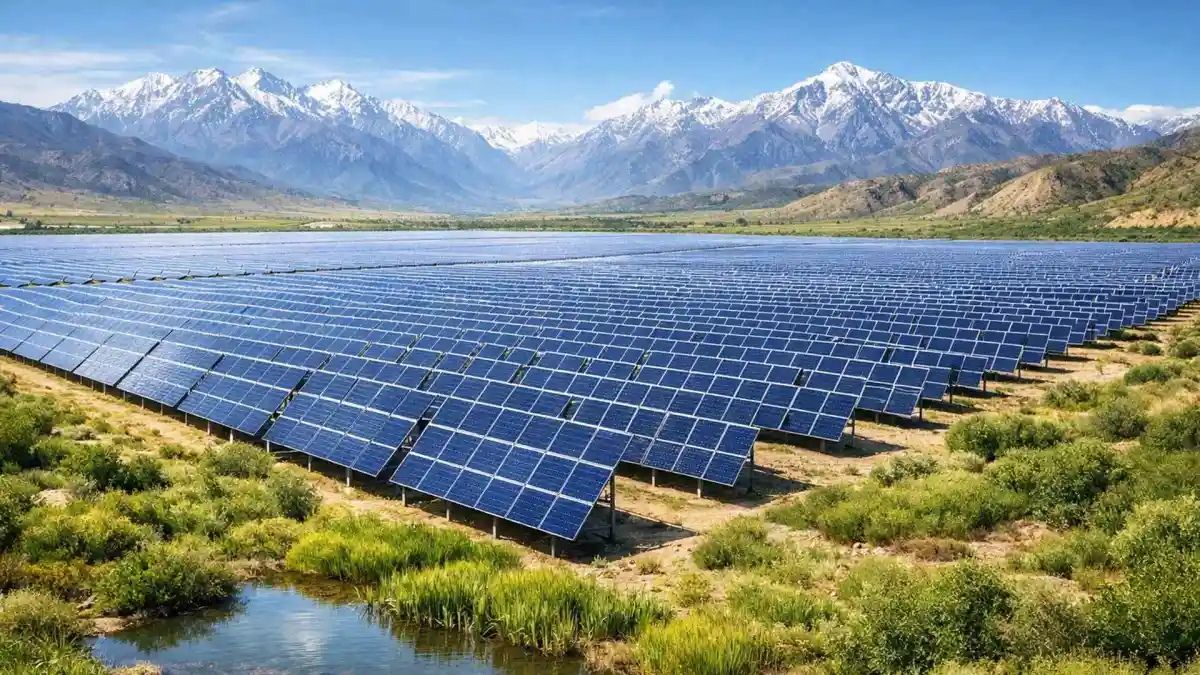
Sixty-four square kilometers of photovoltaic panels sitting at altitude, on one of the harshest plateaus on Earth — and underneath them, grass is growing. That single image captures something genuinely unexpected about the Qinghai Gonghe Photovoltaic Park, the beating heart of a solar complex that now ranks among the largest on the planet.
A mega solar installation reshaping the Tibetan plateau
The Talatan and Gonghe solar complex, located in Qinghai province, has reached a combined capacity of 16 to 17 gigawatts across multiple interconnected plants. To put that figure in perspective, France’s total nuclear capacity sits around 61 GW — this single desert complex already represents more than a quarter of that. Construction began in 2012, and the site has expanded continuously since, turning a wind-hammered alpine desert into one of China’s most ambitious clean energy bets.
The 64 km² Gonghe Photovoltaic Park at its core just received a rigorous ecological analysis, published in Scientific Reports (Nature portfolio). Researchers from several Chinese institutions applied a framework called the Driving Pressure Status Impact Response model, combining 57 separate indicators — vegetation diversity, soil nutrients, bacterial communities, air humidity, and even local economic activity — to build a composite ecological score for the site.
Their findings ? Inside the operating park, the ecological index reached 0.439, classified as “general.” Surrounding untreated land scored around 0.28, falling into the “poor” category. That gap, modest on paper, translates into a measurable transformation on the ground.
Herders who have grazed animals near Talatan for generations describe the area before 2012 as largely bare, battered by frequent sandstorms. Today, vegetation coverage inside the park sits at roughly 15 percent, enough that managers now bring sheep in to prevent grass from growing tall enough to shade the modules. New jobs — panel cleaning, site security — have also appeared for local communities.
How solar panels turn desert soil into a micro-oasis
The mechanism behind this ecological shift is straightforward once you think about it. Panels intercept the fierce plateau sunlight before it hits the ground. The soil beneath stays cooler, loses less moisture through evaporation, and gradually supports more life. Monthly panel washing adds supplementary water that seeps directly into the ground, giving that process an extra push.
Sensors inside the Gonghe array recorded consistently higher soil moisture and finer soil particles compared to control plots outside the fencing. Both factors favor plant establishment and, crucially, carbon storage in the soil. The Nature study documents higher values for above-ground biomass, available phosphorus and potassium, and organic carbon sequestration within the park than in the surrounding desert.
| Indicator | Inside the park | Outside the park |
|---|---|---|
| Ecological index score | 0.439 (“general”) | ~0.28 (“poor”) |
| Vegetation coverage | ~15% | Near zero |
| Soil moisture | Higher | Lower |
| Bacterial & archaeal diversity | Increased | Baseline |
Bacterial and archaeal communities have diversified under the panel rows, forming entirely new microbial assemblages adapted to the patchy shade. This matters for carbon cycling : healthier microbial networks lock more organic matter into the soil long-term. Scaled across hundreds of square kilometers of photovoltaic parks across arid China, even a modest per-hectare gain in soil carbon becomes a non-trivial offset.
Frankly, the “micro-oasis” label is not marketing — it describes a documented biophysical reality. But it comes with real conditions attached.
Not every desert solar farm delivers this result — here’s why
A separate study covering multiple photovoltaic sites across the Qinghai-Xizang Plateau gives a clearer picture of when this works and when it doesn’t. Among all sites examined :
- 56% showed improved vegetation cover compared to surrounding land
- 44% actually lost vegetation cover relative to their surroundings
- Soil moisture explained approximately 62% of the variation between sites
- More than half of the apparent ecological restoration was linked directly to panel-washing water
That last point is critical. Cut back on cleaning water, or push installations into even drier zones, and the balance tips the wrong way. More vegetation under panels also means more transpiration — in extremely arid areas, a lush patch beneath a solar array could theoretically begin straining already scarce water reserves. Researchers are clear : solar park layout and maintenance protocols need deliberate design if both clean power and ecosystem health are goals, not happy accidents.
For China, the stakes extend well beyond electricity generation. Deserts cover roughly a quarter of Chinese territory, and desertification directly affects an estimated 400 million people. Any technology that simultaneously slows sand encroachment, produces low-cost power, and creates rural employment commands serious policy attention. The Qinghai results suggest that utility-scale solar, managed carefully, can serve all three purposes at once.
What other countries can actually learn from Qinghai
The real lesson from Gonghe is not that solar panels magically fix deserts — it’s that intentional water and land management determines whether a giant photovoltaic project becomes an ecological asset or a liability. Countries planning large desert installations in North Africa, Central Asia, or the American Southwest should be studying the Qinghai maintenance protocols right now, not just the panel efficiency specs.
Designing panel spacing to maximize ground shading, scheduling washing cycles to deliver supplementary soil moisture, and integrating controlled grazing to manage undergrowth are all replicable practices. None of them require breakthrough technology — they require operational intent from the start of a project, not as an afterthought. The Gonghe complex proves the concept works at gigawatt scale. The next question is whether project developers elsewhere are willing to build these protocols into contracts before the first panel goes in the ground.
