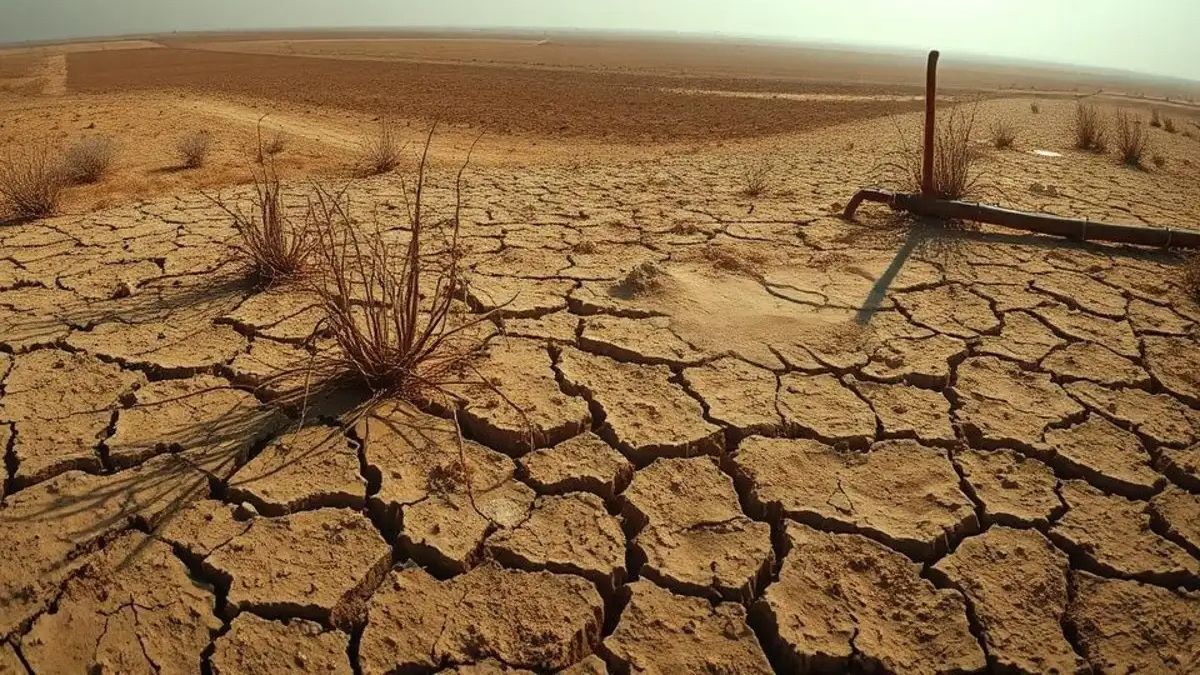
In April 2018, Cape Town’s main reservoir dropped to 13.5% capacity. City officials began counting down to the moment they would shut off household taps entirely — a date locals grimly nicknamed “Day Zero.” That moment never officially arrived, but it came terrifyingly close. What scientists have since discovered is that Cape Town was not an anomaly. It was a preview.
What “Day Zero” actually means — and why it’s spreading
The term Day Zero Drought (DZD) refers to a specific, measurable crisis point : the convergence of prolonged rainfall deficit, rising temperatures, depleted river flows, and water demand that exceeds available supply. It’s not just a dry spell. It’s a structural collapse of the water cycle at a local level. A study published in Nature Communications in January 2026 formalized this definition and mapped where it is already emerging across the planet.
Four conditions must align simultaneously for researchers to declare a DZD event :
- Multi-year precipitation deficit below historical norms
- Elevated temperatures accelerating evaporation from soils and reservoirs
- River flows dropping to critically low levels
- Human water demand outpacing the shrinking available supply
When these four factors converge in a way that has no precedent in pre-industrial climate records, researchers mark the start of what they call the “Time of First Emergence” — the decade when scientists can state with high confidence that a genuinely new category of water crisis has begun. This isn’t modeling for a distant future. For several regions, that emergence window is already the 2020s and 2030s.
Chennai in India, Los Angeles in the United States, and numerous Mediterranean cities have already tasted versions of this reality — severe restrictions, emergency rationing, communities measuring daily consumption in buckets rather than liters. The difference between those episodes and what the research projects is one of permanence. What was once an exceptional crisis is becoming the baseline.
The regions that will hit zero first
The geography of risk is precise, and frankly, it should make certain governments extremely uncomfortable. The Mediterranean basin carries the heaviest exposure, with approximately 196 million urban residents and 85 million rural residents projected to face Day Zero conditions as a recurring reality. Southern Africa, northern China, parts of India, and southern Australia complete the front line of regions where the water system crosses into uncharted territory before mid-century.
| Region | Urban population at risk | Rural population at risk | Emergence window |
|---|---|---|---|
| Mediterranean basin | 196 million | 85 million | 2020–2040 |
| Southern Africa | Moderate | High | 2020–2035 |
| Parts of North America | Significant | Moderate | 2030–2050 |
| Northern China / India | High | Very high | 2030–2060 |
Globally, the numbers are staggering. More than 753 million people could be exposed when their region first crosses into DZD conditions under a high-emission scenario. That’s roughly one in every eleven people alive today. Of those, 467 million are urban residents — concentrated in cities whose infrastructure was built around assumptions about water supply that no longer hold. About 14% of the world’s large reservoirs could face critical depletion during their local Day Zero decade.
One of the most disturbing findings concerns rhythm. In hotspot regions — particularly around the Mediterranean and southern Africa — the duration of a DZD event is longer than the recovery gap before the next one begins. Reservoirs never fully refill. Ecosystems stay under chronic stress. Even an unusually wet season doesn’t buy enough time. The system enters a state where crisis is no longer the exception; it’s the operating condition.
Temperature targets and what’s still worth fighting for
Here’s what the data makes clear, and I think this point gets buried too often in the wider climate debate : the difference between 1.5°C and 3°C of global warming isn’t abstract — it translates directly into hundreds of millions of people who either do or don’t face a drinking water emergency within their lifetime.
Around 61% of the regions where Day Zero conditions emerge do so in a world warmed by just 1 to 2.5°C above pre-industrial levels. Peak exposure occurs near the 1.5°C threshold : at that warming level, roughly 488 million people face their first DZD event, including 322 million urban residents. Push warming higher, and the numbers climb in ways that become increasingly difficult to manage through infrastructure alone.
This means two things simultaneously. Cutting emissions remains meaningful — it’s not too late to reduce the scale of the crisis. But adaptation cannot wait for emissions to come down. The research points to concrete levers : wastewater recycling, rainwater harvesting systems, cross-sector efficiency improvements, and critically, reservoir management practices that don’t mask declining storage until it’s dangerously late. Cape Town’s near-miss in 2018 happened partly because official water accounting obscured how close the city actually was to empty. That kind of institutional blindness, in a world where nearly three-quarters of drought-prone land areas could face unprecedented water scarcity by 2100, is a luxury no city can afford.
The practical priority for any city sitting in a high-risk zone is to start treating water scarcity as a design constraint, not an emergency response. Build the infrastructure for a drier future now, before the reservoir shoreline makes the decision for you.
