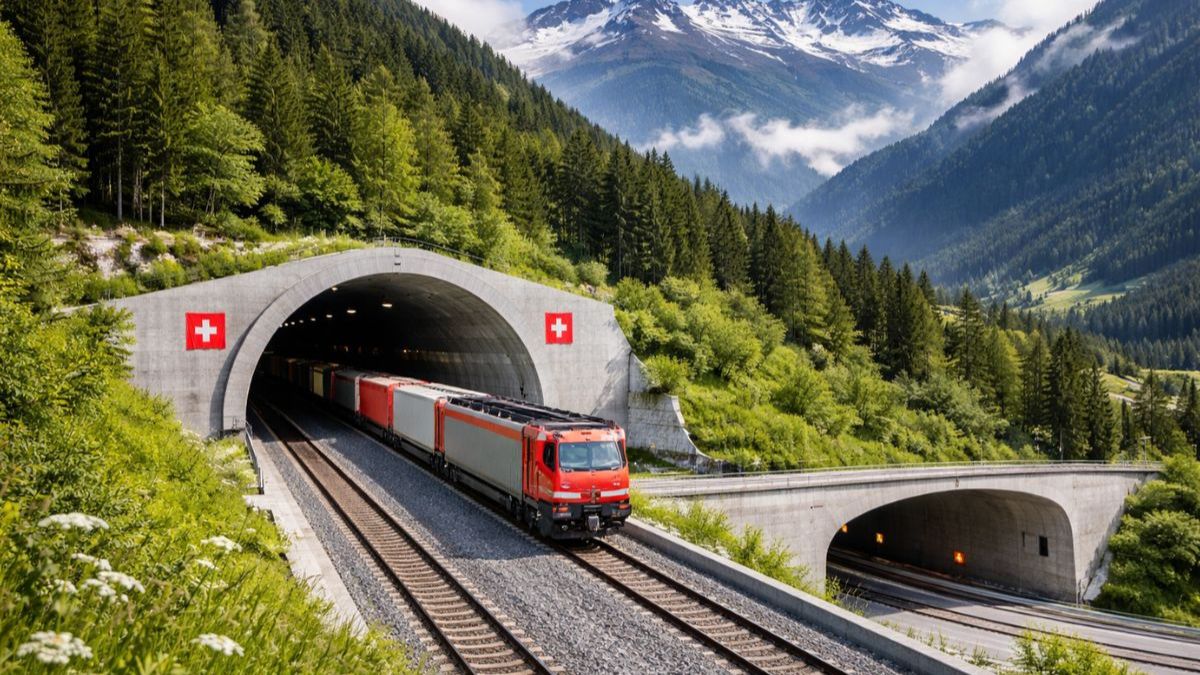
In 2016, a ceremony deep inside the Alps marked the opening of the Gotthard Base Tunnel — 57 kilometers of bored rock connecting Erstfeld to Bodio, making it the longest railway tunnel on the planet. A passenger train covers that distance in roughly 20 minutes. Most travelers barely notice. They check their phones, watch their reflection drift across the black window, and think about dinner. What they are sitting inside, though, is the most visible piece of a vast underground infrastructure that Switzerland has been building and expanding for nearly three decades.
A subterranean network that rivals entire urban systems
Switzerland counts more than 1,400 tunnels, with total tunnel and gallery length exceeding 2,000 kilometers beneath its mountains. That figure includes Alpine rail tunnels, national road tunnels, water management galleries, and power conduits hidden deep in the rock. To put that in perspective, the entire London Underground network covers around 400 kilometers of track. Switzerland’s underground infrastructure is five times larger — and most of it runs under terrain that barely any city planner would dare touch.
The backbone of this buried world is the New Rail Link through the Alps, known by its German acronym NRLA. It combines three base tunnels — Lötschberg, Gotthard, and Ceneri — into a single flat corridor cutting beneath the mountain ranges. “Flat” is the key word here. Traditional Alpine rail routes climb steep gradients that force trains to consume enormous energy and carry lighter loads. A base tunnel bypasses all of that. Trains run at valley level, deep inside the rock, regardless of what the peaks above them are doing.
Building the Gotthard Base Tunnel meant extracting around 28 million tons of rock and managing hundreds of kilometers of shafts and access passages. Swiss construction reports document that 152 kilometers of auxiliary passages were excavated with minimal environmental damage — materials moved by rail and ship where possible, wastewater treated before reaching rivers, and particle filters fitted to on-site machinery. After construction ended, riverbanks were restored, streams returned to more natural channels, and dry-stone walls rebuilt specifically to shelter reptiles and small mammals. The philosophy was deliberate : dig deep, repair the surface.
Shifting trucks off Alpine roads — the real climate objective
Swiss voters approved the Alpine Initiative in 1994, committing the country to move long-distance freight from road to rail. That political decision needed infrastructure to back it up. The tunnels are exactly that infrastructure. Before the NRLA, heavy trucks thundered through narrow Alpine valleys in growing numbers — diesel fumes trapped between steep slopes, summer smog sitting over villages, mounting accident risk on winding passes. The Swiss Federal Office of Transport framed the NRLA explicitly as a mechanism to “shift freight traffic from road to rail in order to protect the Alps.”
The numbers behind this shift are worth examining closely :
| Year | Truck crossings (Swiss Alps) | Rail share of goods transport |
|---|---|---|
| 2000 | ~1,400,000 | approx. 60% |
| 2018 | ~941,000 | ~72% |
| 2022 | ~880,000 | ~74% |
Analysts estimate that at least 651,000 additional trucks would have crossed the Alps in 2016 without Switzerland’s modal-shift policy. The same models suggest roughly 0.7 million tons of CO₂ avoided in 2017 alone compared to a business-as-usual scenario. Trains carry freight using about one-fifth of the energy and produce roughly one-quarter of the greenhouse gas emissions per tonne-kilometer compared with heavy diesel trucks — that ratio matters enormously at this scale.
Yet Switzerland hasn’t completely solved the problem. A specialist from the Swiss Federal Office of Transport acknowledged in 2019 that truck numbers were still approximately 300,000 above the official political target. Bending a curve is not the same as breaking it.
What this underground country actually teaches the rest of the world
The Swiss approach rests on a specific combination of elements that other countries frequently try to copy — and just as frequently get wrong. Tunnels alone produce nothing. The Gotthard Base Tunnel only delivers environmental benefits because it operates within a broader framework :
- A distance-based heavy-vehicle fee that makes trucking through Switzerland financially costly compared to rail alternatives
- Sustained federal rail investment backed by a dedicated long-term fund, insulated from short political cycles
- Strict rules that genuinely push freight operators toward cleaner transport modes rather than simply incentivizing them
Strip out any one of those three elements and the tunnels become expensive infrastructure delivering modest gains. That’s the lesson other countries wrestling with logistics emissions and highway congestion consistently miss.
There’s a climate resilience angle here that deserves more attention than it typically gets. As extreme weather events intensify across Europe, Alpine surface roads face growing disruption — rockfalls, flooding, avalanche closures. Underground routes are immune to most of those risks. Avalanche galleries already protect key lines, and buried freight corridors can remain operational precisely when surface infrastructure fails. Switzerland has essentially built redundancy into its transport network by putting critical routes underground — a strategy that looks increasingly prescient as the climate shifts.
For anyone living in an Alpine valley, the practical reality of all this is straightforward : every freight train that replaces a convoy of trucks means quieter nights, cleaner summer air, and fewer near-misses on mountain roads. That’s not an abstract climate statistic. It’s the difference between opening your window in August and keeping it shut.
