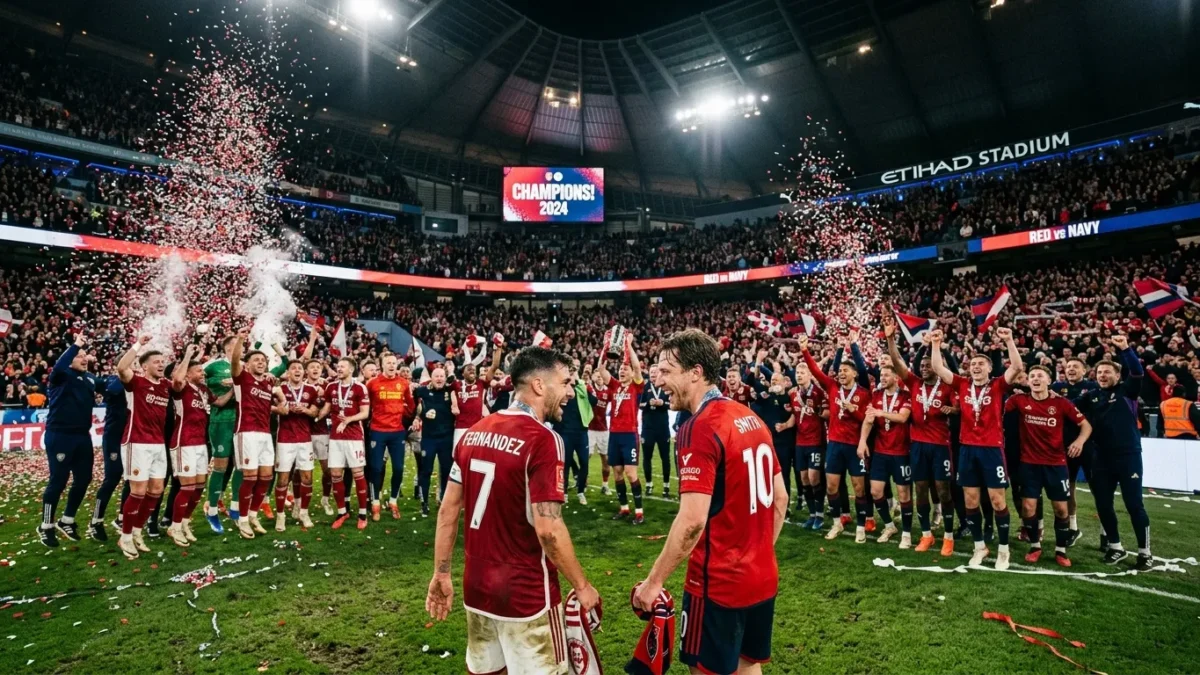
140 years of history, and Arsenal have never done this before — not twice in a row. On the night of April 15, 2026, the Gunners booked their place in the Champions League semi-finals for the second consecutive season, joining Bayern Munich, Atlético Madrid, and Paris Saint-Germain in the last four. Two different games, two completely different stories. One was a tactical chess match at the Emirates. The other ? Pure madness in Munich.
Arsenal grind through against Sporting — and history is made
Let’s be honest : this was not a thriller. Arsenal drew 0-0 with Sporting CP on the night, advancing 1-0 on aggregate thanks to the slender first-leg advantage. Not exactly the kind of performance that sends you into the streets celebrating. But here’s the thing — it gets them through, and that’s exactly what matters at this stage of the competition.
Mikel Arteta addressed the achievement directly after the final whistle. “It’s the first time in our history, in 140 years, that we are on back-to-back semi-finals,” he told TNT Sports. That’s not a line you throw out lightly. Two consecutive Champions League semi-finals at a club like Arsenal represents genuine progress, not just a fortunate run through a bracket.
The absence of Bukayo Saka hung over the second half like a shadow. Former striker Chris Sutton said it plainly on BBC Radio 5 Live : “He is different to anything that Arsenal has in that final third.” That gap was visible. Sporting set up defensively and made life difficult — and Arsenal, without their talisman, couldn’t find the creativity to threaten further. Former Manchester City defender Nedum Onuoha noted that teams are currently coping well against Arsenal defensively, and that transition play — something Arsenal haven’t leaned into this season — could be the key to unlocking that.
Arteta himself acknowledged the internal work behind the result. After a defeat to Bournemouth, the players reportedly sat together, analysed the performance, and held frank conversations. That kind of collective accountability is precisely what separates squads that crumble under pressure from those that keep advancing. Next up : Atlético Madrid. Arteta watched them the day before. He knows what’s coming.
| Semi-final fixture | Teams |
|---|---|
| Semi-final 1 | Atlético Madrid vs Arsenal |
| Semi-final 2 | Paris Saint-Germain vs Bayern Munich |
Bayern tear Real Madrid apart in a seven-goal thriller
If Arsenal’s night was measured and controlled, Bayern Munich’s was something else entirely. Bayern defeated Real Madrid 4-3 at the Allianz Arena, sealing a 6-4 aggregate victory in a quarter-final that delivered everything the Champions League promises at its best. Goals, red cards, momentum swings, and a dramatic finish — it had the lot.
The key contributions came late. Luis Díaz and Michael Olise both scored in the closing stages to put the result beyond doubt after what had been a breathless two-legged encounter. Real Madrid, for their part, will feel the controversy surrounding Eduardo Camavinga’s second yellow card shaped the outcome. Spanish football journalist Juan Castro, speaking on BBC Radio 5 Live, was direct : “You cannot give this second yellow card in the Champions League, in the last minute, when both teams have just equalised.”
Real Madrid’s camp did not take the defeat quietly. Players surrounded the referee at full time, and Arda Güler was reportedly sent off for protesting. Chris Sutton had little sympathy : “An element of sour grapes. Real Madrid go out, so just blame the referee.” Former Liverpool defender Stephen Warnock raised a legitimate tactical concern, though — Bayern were brilliant going forward, but defensively both sides were alarmingly open. Against PSG, that could be punished.
Harry Kane finished the tie with his typically clinical edge. He reached 50 goals in all competitions this season — a figure that prompted Steven Gerrard, speaking on TNT Sports, to call it “phenomenal” and suggest Kane’s Ballon d’Or ambitions remain very much alive. Kane himself was measured post-match : “When you beat a team like Real, especially at this stage, it gives you confidence.” He’s right. And PSG will know it.
What the semi-final draw means for both clubs going forward
Arsenal face the toughest possible test in Atlético Madrid. Diego Simeone’s side is built on defensive solidity and ruthless transitions — exactly the kind of team Onuoha warned about. The Metropolitano Stadium will be a brutal environment, and without Saka at full fitness, Arsenal’s attacking options are limited. That said, reaching back-to-back semi-finals is not accidental. This squad knows how to suffer and how to compete.
- Arsenal’s first-ever back-to-back Champions League semi-final appearances in the club’s 140-year history
- Bayern Munich’s aggregate win of 6-4 over Real Madrid was one of the highest-scoring knockout ties in recent Champions League history
- Harry Kane’s 50-goal season puts him among the elite European strikers of his generation
- PSG eliminated Arsenal in the semi-finals last season — a potential final rematch looms
Bayern’s path looks equally complex. PSG are sharp, organised and dangerous in transition — everything Warnock flagged as a weakness in Bayern’s defensive shape. The Parisians nearly beat Arsenal in last season’s semis, and they arrive with a point to prove at continental level. For Kane, a Champions League winners’ medal with Bayern would complete a career narrative that’s been building for years — and this might genuinely be his best shot at it.
For Arsenal, the domestic picture adds another layer. A crunch Premier League fixture against Manchester City at the Etihad looms on Sunday. City, with a game in hand, could move within three points of the Gunners with a win. Juggling a Champions League semi-final push with a title race is the ultimate test of squad depth — and frankly, it’s the kind of pressure that defines legacies.
