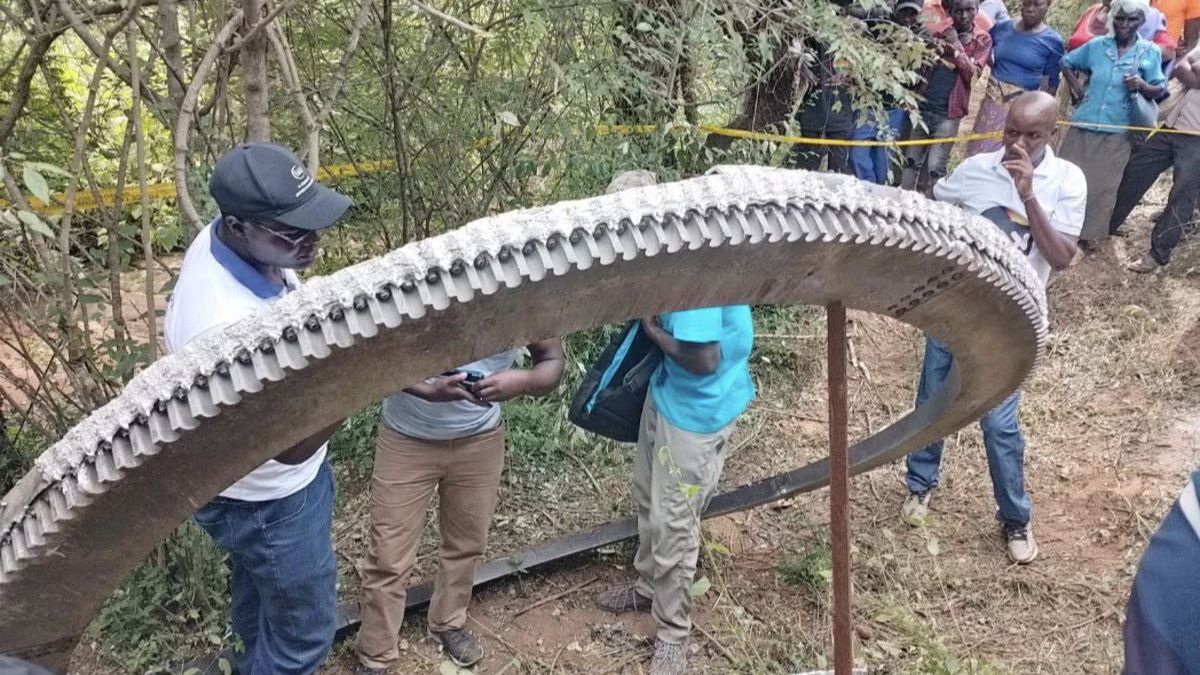
December 30, 2024. A field southeast of Nairobi. Villagers heard a roar, looked up, and watched a half-tonne metallic ring slam into the ground at terrifying speed. No injuries, but the impact left a crater — and a question that space agencies had quietly dreaded for years : how long before orbital junk starts landing on people ?
What exactly fell from the sky over Kenya
The object measured 2.5 meters in diameter and weighed approximately 500 kilograms. Kenyan authorities immediately cordoned off the crash site while the Kenya Space Agency (KSA) dispatched a technical team to collect samples and run analysis. Their verdict was unambiguous : this was a separation ring from a rocket launch vehicle — a structural component engineered to detach from a rocket during its ascent, once the first stage burns out.
These rings are not exotic or rare. Every multi-stage rocket produces them. The problem is their fate after separation. Most burn up during atmospheric re-entry. Some sink into oceans. Others drift in low Earth orbit for years before gravity pulls them back down. This one chose a Kenyan field on New Year’s Eve.
The KSA explicitly denied claims circulating in local media that linked the debris to the Indian Space Research Organisation (ISRO). No confirmed attribution to a specific mission was made public, which itself says something about the opacity of global debris tracking. Frankly, the fact that a 500-kilogram metal object can fall on a populated area and its origin remains disputed is alarming on its own.
The agency classified the event as an “isolated case” but acknowledged it represented a clear breach of international space safety standards. Under the 1972 Liability Convention — the main international framework governing space debris — the launching state is liable for damage caused on Earth’s surface. Identifying that state, however, proved elusive.
Space debris : from abstract threat to documented reality
This incident doesn’t exist in a vacuum. NASA currently tracks more than 27,000 sizeable objects orbiting Earth, with millions of smaller, untrackable fragments also circling the planet at velocities exceeding 28,000 km/h. At those speeds, even a paint chip can compromise a spacecraft’s integrity.
The Kenya event followed another striking case just months earlier. In 2024, an American family filed a lawsuit after hardware from the International Space Station punched through the roof of their Florida home. Two incidents in a single year — this is no longer a theoretical exercise from a physics lecture.
| Target affected | Potential consequence |
|---|---|
| Active satellites | Loss of GPS, communications and weather services |
| Space stations | Risk to crew and onboard research |
| Earth’s surface | Property destruction and potential casualties |
| Future launches | Elevated collision probability during ascent |
Scientists refer to the worst-case scenario as the Kessler Syndrome — a cascade where one collision generates a debris field that triggers further collisions, progressively rendering entire orbital bands unusable. Once started, this chain reaction would be nearly impossible to stop. The Kenyan ring confirms that the debris problem has already breached the boundary between outer space and everyday life on the ground.
What the international community is — and isn’t — doing about it
Following the Kenya crash, authorities opened an investigation under international space law. The event accelerated existing conversations between space agencies and private aerospace operators about tightening end-of-life disposal requirements for satellites and rocket components.
Several technical approaches are already under development :
- Specialized capture satellites designed to grab and deorbit defunct hardware
- Passive drag devices that accelerate re-entry for small satellites
- Impact-resistant materials for shielding active spacecraft
- Coordinated space traffic management frameworks across agencies
- Mandatory end-of-life disposal plans for any new mission seeking a launch license
The European Space Agency’s ClearSpace-1 mission, scheduled for the late 2020s, represents one of the most advanced attempts to physically remove an existing piece of debris from orbit. Still, removing one object at a time while thousands more accumulate is, to put it plainly, nowhere near sufficient at the current pace of launches.
The deeper obstacle is political. No binding international consensus exists on who bears responsibility for legacy debris — objects launched decades ago by states or companies that no longer exist in their original form. Negotiating liability for historical junk involves geopolitical sensitivities that technical solutions alone cannot resolve.
Why this moment demands a different kind of attention from space-faring nations
Here is what the Kenya incident should change in practice : every mission planning document needs a credible, independently verified deorbit strategy before a launch license is granted. Not a box-ticking exercise. A real plan with timeline, fuel budget and fallback options.
Private operators now account for the majority of new launches. SpaceX alone has placed thousands of Starlink satellites in orbit since 2019. As commercial space traffic scales, the volume of potential debris multiplies proportionally. Regulators in the US, Europe and increasingly Asia are tightening rules, but enforcement across jurisdictions remains inconsistent.
The Kenyan field southeast of Nairobi offered something rare : a physical object that made the orbital debris crisis tangible. No simulation, no diagram — a 500-kilogram ring of metal sitting in the dirt. For any space agency or launch company that still treats debris management as a secondary concern, that image should function as a wake-up call they cannot dismiss.
The most actionable step you can take as a citizen ? Pressure your national space authority to publicly report on its debris mitigation compliance rates. Transparency is the minimum. Accountability comes next.
