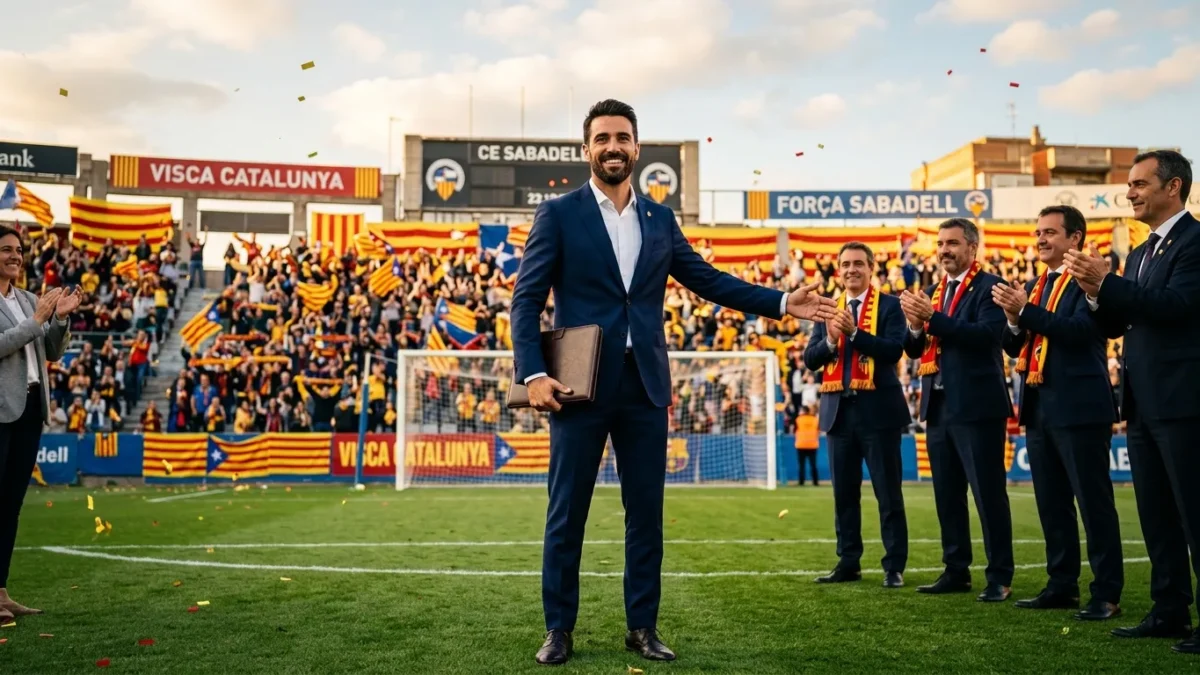
Lionel Messi has become the new owner of Cornellà, a Catalan club based just south of Barcelona. The announcement dropped on April 16, 2026, and it sent shockwaves through Spanish football — not just because of who Messi is, but because of what this move signals for lower-league clubs across Europe.
Messi takes ownership of Cornellà : what we know
The deal is official. Leo Messi now owns Catalan side CE Cornellà, a club whose stadium holds just 1,500 spectators — a far cry from the 99,354-seat Camp Nou where he spent the bulk of his career. The contrast is striking, frankly. But that gap between scale and ambition is precisely what makes this story compelling.
Cornellà is not a household name globally, but it carries real significance in Catalan football. The club has historically served as a breeding ground for talent. Arsenal goalkeeper David Raya and former Barcelona and Inter Miami defender Jordi Alba both came through Cornellà’s youth system — proof that small clubs can produce world-class players with the right infrastructure in place.
The club itself framed the acquisition in clear terms : “Leo Messi’s arrival marks the beginning of a new chapter in the club’s history, aimed at driving both sporting and institutional growth, strengthening its foundations, and continuing to invest in talent.” The statement also referenced a long-term strategic vision combining ambition, sustainability, and local roots. That’s not just PR language — it’s a blueprint.
| Club | New owner | Stake / deal type | Date |
|---|---|---|---|
| CE Cornellà | Lionel Messi | Full ownership | April 2026 |
| UD Almería | Cristiano Ronaldo | 25% stake | February 2026 |
The timing is also worth noting. Just two months earlier, in February 2026, Cristiano Ronaldo — Messi’s long-time rival, currently playing for Al-Nassr in the Saudi Pro League — acquired a 25% stake in Spanish second-division side Almería. Two of football’s greatest players, investing in Spanish football at almost the same moment. That’s not a coincidence; it’s a pattern worth watching.
From Camp Nou to a 1,500-seat ground : Messi’s journey back to Catalonia
Messi left Argentina at 13 to join Barcelona’s famed La Masia academy. He made his first-team debut in October 2004, aged just 17. What followed was arguably the most decorated individual career in football history — 672 goals in 778 appearances for Barcelona, a record that may never be broken at that club.
After leaving Barça in 2021 for Paris Saint-Germain, Messi moved to Inter Miami in 2023. His time in MLS rekindled public interest in American football, but his heart, it seems, never fully left Catalonia. Buying Cornellà is a way back — not as a player, but as someone shaping the future of a community club from the inside.
This is what separates the Cornellà project from a simple celebrity investment. Messi grew up in the Spanish football system. He understands its structures, its culture, its gaps. Owning a club at this level gives him direct influence over youth development, local identity, and long-term sustainability. Those aren’t abstract concepts for him — they’re the exact pillars that built his own career.
What this ownership means for Cornellà’s future
Realistically, what changes when a global icon takes over a 1,500-capacity club ? Quite a lot, actually. Here are the most immediate areas where Messi’s involvement could reshape Cornellà :
- Youth academy investment — with Raya and Alba already in Cornellà’s history books, upgrading scouting and coaching infrastructure becomes a credible priority.
- Commercial visibility — global sponsorship interest will spike almost immediately. Small clubs routinely struggle with commercial revenue; that problem disappears with Messi’s name on the project.
- Stadium development — a 1,500-seat ground will likely need expansion if the club progresses through the Spanish football pyramid.
- Community engagement — the club’s statement emphasized local roots, suggesting Messi’s model prioritizes the neighborhood over pure sporting ambition.
The Cornellà district, located roughly 8 kilometers southwest of Barcelona’s city center, has a working-class identity. Staying connected to that identity while attracting investment is the central challenge of this project. Messi’s team seems aware of it — the explicit mention of sustainability and local roots in the official statement isn’t incidental.
For me, the most interesting question isn’t whether Messi will pour money into Cornellà. He clearly will. The real test is whether he builds a model that works without him in twenty years. That’s the difference between a vanity project and a lasting institution. Given his track record of patience and precision on the pitch, I’d give him a genuine chance of getting it right off it too.
